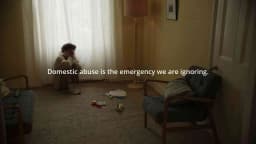
YWCA Canada's 2019 'That Needs to End' campaign, created by FCB Canada, reframes Halloween horror as a parallel to year-round domestic abuse and gender

How YWCA and FCB Canada Made Halloween a Mirror for Violence Against Women
YWCA Canada's 2019 public service campaign 'That Needs to End' uses the cultural moment of Halloween to confront the year-round reality of psychological and physical violence against women in Canada, produced by FCB Canada and directed by Sarah Pellerin for Y des femmes de Montréal, released in October 2019 across three film assets.
The campaign's central proposition is direct and unflinching. For many women, the horror associated with Halloween is not seasonal — it is daily. Psychological and physical violence against women does not pause when the costumes are packed away, and 'That Needs to End' makes that parallel impossible to ignore. By borrowing the visual and emotional grammar of horror from a widely recognised cultural occasion, the work transforms an ambient festive backdrop into an urgent indictment of domestic abuse and gender violence across Canada.
Executed in both English and French — the French-language version titled 'Il faut que ça arrête' — the campaign reflects the bilingual fabric of the Canadian public interest landscape and specifically acknowledges the organisation's Montreal roots. The French-language asset 'Il faut que ça arrête / Douche' recorded 11,366 views and 21 likes on its platform according to data documented at the time of submission, indicating meaningful organic reach for a non-commercial public interest film. The campaign was developed under the creative leadership of Sylvain Dufresne, VP and Head of Creative at FCB Canada, with additional creative direction from Philippe Natewajko and Elmer Tazartez, and produced by SOMA with post-production handled by OutPost Montreal, as documented by Ads of the World.

YWCA positions its 2019 campaign at the intersection of cultural timing and social urgency. The choice of Halloween as a creative anchor is not arbitrary. Fear, haunting, and horror are concepts the public willingly engages with every October — and FCB Canada's strategic insight was to redirect that willing engagement toward the lived experience of women facing domestic abuse and gender violence year-round in Canada. The contrast between performed fear and real fear is the campaign's sharpest instrument.
The Canadian policy environment at the time of the campaign's October 2019 launch gave the message significant institutional weight. The federal government had announced more than C$100 million for over 250 projects through a Capacity-Building Fund in March 2019, according to Canada Ca. A broader federal gender-based violence strategy had already committed more than C$80 million to over 80 gender-based violence projects from 2017–18 onward, also according to canada.ca. This level of public investment signals that violence against women in Canada was a documented policy crisis, not a marginal concern, and it provided YWCA's campaign with a factual foundation that competitors in the public interest space could not easily replicate.
In the Canadian non-profit and public service advertising landscape, organisations such as Amnesty International Canada and the Canadian Women's Foundation have also produced campaigns addressing gender-based violence. What differentiates YWCA's approach is the deployment of documentary-style social experiment filmmaking rather than advocacy montage or statistics-led messaging. This creative choice, guided by director Sarah Pellerin and produced through SOMA, positions 'That Needs to End' as emotionally immersive rather than didactic — a distinction that matters in a media environment where audiences, particularly in Canada, are increasingly resistant to direct-address charity appeals.
Director Sarah Pellerin brings a documentary sensibility to 'That Needs to End' that separates it from conventional public service advertising. The campaign is described as a documentary and social experiment, a production choice that foregrounds authenticity over polish and positions YWCA's message within the tradition of observational filmmaking rather than broadcast charity appeals. This formal decision carries strategic weight: audiences tend to extend greater trust to work that looks like evidence rather than advocacy.
The cast includes Isabelle Gélinas, whose involvement as a named performer lends the work a quality of scripted intimacy rather than anonymous stock representation, as documented by Ads of the World. The three film assets that make up the campaign are unified by this documentary grammar — handheld proximity, naturalistic lighting, and the emotional register of unmediated witness. Post-production by OutPost Montreal suggests a facility oriented toward high-craft commercial and documentary work, and the overall production pipeline, from SOMA through to delivery, reflects a serious investment in technical credibility for a public interest brief.
The bilingual execution — with English and French versions produced for a Canadian audience — is itself a craft and cultural decision. The French-language title 'Il faut que ça arrête' carries its own rhetorical directness; the phrase translates with an urgency that resists softening. FCB Canada's creative team, led by Sylvain Dufresne with Philippe Natewajko and Elmer Tazartez contributing additional creative direction, built a campaign that functions as an intervention rather than a communication. The Halloween timing adds a layer of contextual craft: the work does not merely borrow the season's iconography but inverts it, making the familiar horror of October the entry point for confronting the unfamiliar, ongoing horror of violence against women in Canada.
The 'That Needs to End' campaign earns a Clapboard Score of 69 out of 100, reflecting a campaign that demonstrates genuine creative and strategic strength in its reframing device and documentary execution while operating within the inherent reach constraints of a non-commercial public interest production in Canada.
Verified platform data shows the French-language asset 'Il faut que ça arrête / Douche' accumulated 11,366 views and 21 likes at the time of its documented submission. No independently audited broadcast ratings or paid media performance figures for the full campaign are publicly available, which is consistent with the production and distribution model typical of Canadian public service film campaigns of this scale. The campaign's measurable footprint, while modest in aggregate digital terms, should be interpreted in the context of its intended function: to prompt reflection and redirect resources toward YWCA's support services, not to generate mass reach through paid amplification.
Structurally, the campaign's effectiveness rests on three durable mechanics. The Halloween reframe creates earned attention through cultural contrast. The documentary and social experiment format builds the credibility that direct-address public interest appeals typically sacrifice. And the bilingual execution ensures the work reaches both of Canada's major language communities, compounding its potential influence. According to ywcatoronto.org, YWCA Toronto invested C$3.6 million in violence-against-women shelters and programs in 2019, alongside C$4.3 million in emergency shelters for women and gender-diverse people — context that underlines the institutional seriousness behind the campaign's message. The federal government also reported at least 4,000 new or repaired shelter spaces under construction through earlier investments, according to canada.ca, situating 'That Needs to End' within a moment of genuine national policy mobilisation on gender violence.
'That Needs to End' is a 2019 YWCA public service campaign produced by FCB Canada that uses Halloween imagery to confront year-round psychological and physical violence against women. By drawing a parallel between seasonal horror and daily domestic abuse, the campaign argues that this ongoing reality must stop, framing YWCA as a relentless advocate for survivors across Canada.
FCB Canada, Montreal created 'That Needs to End' for YWCA in 2019. Creative leadership came from Sylvain Dufresne, VP and Head of Creative at FCB Canada, alongside Philippe Natewajko and Elmer Tazartez. Director Sarah Pellerin led production through SOMA, with post-production handled by OutPost Montreal, as documented by Ads of the World.
The campaign adopts a documentary and social experiment format rather than conventional public service advertising. Director Sarah Pellerin used observational filmmaking techniques to create emotional authenticity. This approach positions the work as evidence-based witness rather than advocacy, building audience trust by foregrounding real emotional experience over scripted charity messaging.
'That Needs to End' receives a Clapboard Score of 69 out of 100. The score reflects the campaign's strong creative reframing device and credible documentary execution, balanced against the reach limitations natural to a non-commercial public interest film campaign operating in the Canadian market without large-scale paid media amplification.
Halloween provided a cultural moment when audiences willingly engage with fear and horror. FCB Canada's strategic insight was to redirect that engagement toward the lived experience of domestic abuse. The contrast between performed seasonal fear and real year-round violence against women made the public interest message immediate, emotionally resonant, and difficult for Canadian audiences to dismiss.
Canada's federal government had announced more than C$100 million for over 250 gender-based violence projects by March 2019, according to canada.ca. A broader federal strategy had committed more than C$80 million to over 80 projects from 2017–18 onward, also per canada.ca, establishing gender violence as a documented national policy priority at the time of the campaign's launch.
.webp)
Creative Collaboration Platform: The Backbone of Modern Creative WorkWhat is a creative collaboration platform?Clapboard defines a creative collaboration platform as the operational core for today’s distributed creative teams. This is not a collection of digital collaboration tools stitched together; Clapboard’s system


Understanding the Creative Production MarketplaceWhat is a Creative Production Marketplace?Clapboard defines a creative production marketplace as a structured ecosystem where brands, agencies, and production talent converge to execute video, advertising, and branded content at scale. Unlike the legacy agency or freelanREAD FULL ARTICLE

The Urgent Need for a Creative Production Operating SystemWhy Traditional Creative Production Models Break DownClapboard sees the creative production landscape shifting under pressure. Content velocity is no longer a buzzword—it’s a mandate. Modern advertising demands relentless output across dozens of channels, each wREAD FULL ARTICLE