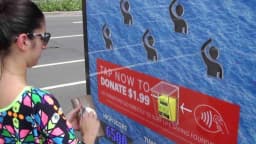
Miami Ad School's #endNYCSlavery OOH campaign spotlighted human trafficking in New York City using subway-symbol placements to reach high-traffic station

Miami Ad School's #endNYCSlavery Campaign Puts Modern Slavery on the NYC Subway Map
#endNYCSlavery is a June 2018 out-of-home student campaign created at Miami Ad School that placed modified subway-style symbols inside high-traffic New York City stations to raise public awareness of human trafficking, confronting commuters with the statistic that more than 3,000 people are trapped in slavery across New York City at any given time, according to Campaignsoftheworld.
The campaign addresses one of the most persistent blind spots in urban public consciousness, according to Marklives. Despite New York City's reputation as a global hub of advocacy and civic awareness, the premise of #endNYCSlavery rests on a documented gap: most New Yorkers remain unaware that modern slavery operates within the city's own borders. By embedding its message inside the transit infrastructure that millions of residents and visitors use daily, the campaign chose proximity and familiarity as its core strategic tools. The subway system is not incidental to the creative concept — it is the concept itself, according to En Wikipedia.
In the United States, human trafficking is classified as a federal crime under the Trafficking Victims Protection Act, yet public recognition of its urban presence remains low. The campaign targets that recognition gap directly. Produced as a single media asset, #endNYCSlavery demonstrates that conceptual compression — reducing a systemic injustice to a single, legible visual intervention — can carry significant communicative weight in a public interest context. The work was submitted as a student project under the Miami Ad School banner in New York and sits within the broader Public Interest advertising category. It carries a Clapboard Score of 61 out of 100, reflecting strong conceptual clarity tempered by the execution constraints typical of a student portfolio piece.
The #endNYCSlavery campaign operates on a precise strategic insight: awareness of human trafficking in major urban centres is structurally low despite the crime's documented urban concentration. New York City's subway system processes tens of millions of rides annually, making it one of the highest-reach ambient media environments in the United States without the purchase of traditional advertising space. Placing anti-trafficking messaging within that environment is not merely a media choice — it is an argument about invisibility.
The competitive and collaborative landscape of anti-trafficking public service advertising in the United States is anchored by several established players. Clear Channel Outdoor and the nonprofit Polaris Project began a joint anti-human-trafficking out-of-home campaign in Philadelphia in 2012 before expanding the effort to additional markets, according to research compiled from campaign records. Clear Channel Outdoor has reported donating more than eight million dollars in media and delivering more than two hundred million impressions across anti-trafficking efforts since 2012, with more than twenty campaigns conducted by 2017, according to Investor Clearchannel. Polaris operates the U.S. National Human Trafficking Hotline and represents one of the most visible institutional voices in this cause category. Against that backdrop, the Miami Ad School student team behind #endNYCSlavery identified a gap: existing campaigns largely relied on hotline promotion and headline statistics, whereas #endNYCSlavery embedded the message inside the city's own visual language.
In the United States, the Department of Justice administered seventy-seven million dollars in fiscal year 2018 for programs helping human-trafficking survivors, according to Congress Gov — a figure that reflects program funding rather than advertising investment, underscoring how little paid media muscle typically supports awareness efforts in this space. The student campaign's decision to work within the subway's existing symbolic grammar responds directly to that resource constraint, proposing a model of earned attention over paid reach.
The creative execution of #endNYCSlavery is built on a single, disciplined act of visual recontexualisation. The campaign places a modified subway-style symbol — the circular graphic format native to New York City Transit wayfinding — inside high-traffic New York City stations, repurposing a piece of civic infrastructure to carry an anti-trafficking message. The formal logic is exact: the subway symbol is simultaneously a direction-finder and a population marker, and the campaign exploits both functions. Riders read it as part of the environment before they read it as a message, which is precisely where its communicative force originates.
The single media asset produced for the campaign draws conceptual lineage from the Civil War era, invoking the historical language of American slavery to frame contemporary human trafficking not as a foreign or peripheral phenomenon but as a direct continuation of the nation's own unresolved history. This historical anchoring gives the campaign a rhetorical gravity that pure statistics alone cannot supply. It positions modern slavery in New York City as a domestic issue with a long American genealogy, not an imported crisis.
Production credits for #endNYCSlavery are not publicly documented beyond the campaign's identification as a Miami Ad School student project originating from the school's New York location. The restrained, single-asset format is itself a creative decision: it concentrates all communicative energy into one encounter rather than distributing it across a campaign system. In the context of student work submitted in June 2018, that constraint reads as intentional economy rather than limitation — a demonstration that a strong enough conceptual premise requires minimal executional elaboration to register.
No verified performance data for the #endNYCSlavery campaign is publicly available. The work was produced as a student concept at Miami Ad School and submitted in June 2018 as a single out-of-home media asset; no third-party measurement, earned media figures, or audience reach metrics have been documented in accessible public sources.
Structural analysis, however, offers a credible proxy for evaluating likely effectiveness. The campaign's choice of New York City subway stations as its placement environment is strategically sound: high-dwell-time transit environments have consistently demonstrated strong recall rates for out-of-home advertising, particularly when creative integrates the surrounding context rather than interrupting it. The subway-symbol format achieves exactly that integration. A viewer does not need to opt in to the message — the format is already part of the visual routine of subway navigation, meaning exposure is functionally guaranteed for anyone who uses the system.
The campaign's core statistic — that more than 3,000 people are trapped in slavery in New York City — is specific enough to be memorable and localised enough to feel urgent rather than abstract. Research on public-interest advertising in the United States consistently finds that geographic specificity increases personal relevance and recall. The Civil War historical frame adds a layer of moral seriousness that differentiates #endNYCSlavery from campaigns that rely solely on contemporary data. Taken together, these structural properties suggest a campaign built for genuine impact within its resource constraints. The Clapboard Score of 61 out of 100 reflects that balance: a conceptually rigorous idea, cleanly executed, that stops short of the systemic deployment that would convert a strong student concept into a measurable public awareness campaign.
#endNYCSlavery is a June 2018 student out-of-home campaign created at Miami Ad School in New York. It placed modified subway-style symbols inside high-traffic New York City stations to raise public awareness of human trafficking. The campaign was produced as a single media asset within the Public Interest advertising category.
The campaign recontextualises the circular graphic format native to New York City Transit wayfinding, embedding an anti-trafficking message inside familiar civic infrastructure. Riders encounter the symbol as part of their environment before recognising it as advocacy, making exposure functionally unavoidable for anyone navigating the subway system in New York City.
The campaign cites that more than 3,000 people are trapped in slavery in New York City at any given time. This figure grounds the broader human trafficking crisis in a specific, local context, making the issue personally relevant to New York City residents and transit riders who might otherwise perceive modern slavery as a distant concern.
The campaign draws conceptual lineage from Civil War-era American slavery to frame contemporary human trafficking as a continuation of domestic history rather than a foreign phenomenon. This historical anchoring gives the work moral gravity beyond what statistics alone supply, positioning the issue within a long American context that New York City audiences recognise.
#endNYCSlavery receives a Clapboard Score of 61 out of 100. The score reflects strong conceptual clarity in its use of subway iconography and Civil War historical framing, balanced against the execution constraints of a student portfolio piece produced as a single out-of-home media asset without documented real-world deployment or verified performance data.
Established efforts such as the Clear Channel Outdoor and Polaris Project partnership rely on hotline promotion and broad media donation, with Clear Channel reporting more than two hundred million impressions across anti-trafficking work since 2012, according to investor.clearchannel.com. #endNYCSlavery differentiates itself by embedding the message inside New York City's own transit visual language rather than interrupting it.
.webp)
Creative Collaboration Platform: The Backbone of Modern Creative WorkWhat is a creative collaboration platform?Clapboard defines a creative collaboration platform as the operational core for today’s distributed creative teams. This is not a collection of digital collaboration tools stitched together; Clapboard’s system


Understanding the Creative Production MarketplaceWhat is a Creative Production Marketplace?Clapboard defines a creative production marketplace as a structured ecosystem where brands, agencies, and production talent converge to execute video, advertising, and branded content at scale. Unlike the legacy agency or freelanREAD FULL ARTICLE

The Urgent Need for a Creative Production Operating SystemWhy Traditional Creative Production Models Break DownClapboard sees the creative production landscape shifting under pressure. Content velocity is no longer a buzzword—it’s a mandate. Modern advertising demands relentless output across dozens of channels, each wREAD FULL ARTICLE