Unicef Ukraine Makes HIV Testing an Adrenaline Rush for Teens
The Adrenaline Experiment is a 2018 public-interest film campaign created in Ukraine by Be-it Health and Social Impact for Unicef Ukraine, starring Ukrainian musician MONATIK, that repositions HIV testing as a courageous, excitement-generating challenge equal in boldness to skateboarding, dancing, and trampoline jumping.
Published in February 2018, the campaign addresses a specific behavioural truth central to adolescent psychology: teenagers routinely seek out risky or attention-commanding activities for the rush of excitement, peer recognition, or social status they deliver. Be-it's strategic insight was that this appetite for adrenaline could be redirected toward a health behaviour — HIV testing — that many young Ukrainians perceived as frightening or stigmatised rather than empowering. By placing HIV testing within a framework of daring physical performance, the campaign inverted the emotional valence of the act entirely.
In Ukraine, the legal context made the campaign's call to action immediately actionable. Individuals aged fourteen and older could, according to campaign documentation, take an anonymous HIV test without requiring parental consent. That regulatory detail removed one of the most significant practical barriers facing adolescent testing uptake, and the campaign was explicitly designed to make that option visible and desirable to its target audience. The film medium — a single media asset — gave the campaign the duration and emotional arc to build genuine tension, measure heartbeats on screen, and draw a direct, data-supported comparison between the physiological excitement of stunts and the experience of testing. MONATIK, identified publicly as a Unicef Ukraine friend, served as both talent and proof of concept, demonstrating through his own measured heart rate that the act of HIV testing produces its own authentic charge.
Ukraine carried one of the most significant HIV burdens in Eastern Europe in 2018. According to UNICEF evaluation reports, adolescent awareness and voluntary testing rates remained persistently low, shaped by stigma, fear of disclosure, and a widespread perception that HIV testing was a procedure associated with illness or high-risk identity rather than with responsible self-care. Be-it identified the gap between how teenagers seek stimulation and how public health messaging traditionally speaks to them as the central strategic opportunity.
The Adrenaline Experiment repositioned HIV testing not as a medical duty but as a subcultural credential — something a bold, self-assured young person does precisely because it requires nerve. This approach places the campaign in direct philosophical contrast with conventional fear-based public health communication, which international health communication research, including frameworks referenced by the World Health Organization, has repeatedly shown to be less effective with adolescent audiences than empowerment-oriented messaging. Competitors in the Ukrainian public-interest communications space, including government health authority campaigns and international NGO interventions such as those coordinated by the Alliance for Public Health Ukraine, had largely relied on statistical framing and clinical imagery. Be-it departed from that convention entirely.
The campaign's decision to anchor the strategy to a celebrity familiar to Ukrainian youth — MONATIK — also reflects a documented principle in social marketing: aspirational identification accelerates behaviour adoption. As reported by ReliefWeb in coverage of UNICEF Ukraine programming, peer influence and public figures carry outsized credibility with the fourteen-to-twenty-four demographic that represents the primary HIV prevention target in Ukraine. The single-film format concentrated creative energy rather than dispersing it, ensuring the emotional logic of the adrenaline comparison landed without dilution.
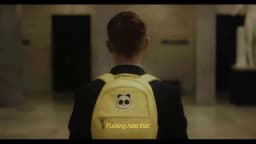
Director Nataliya Olbert-Sinko shaped the Adrenaline Experiment around a documentary social experiment structure that gave the film its evidential authority. Rather than scripting a conventional narrative, the production captured MONATIK performing genuinely demanding physical sequences — skateboarding, dancing, and trampoline jumps — while biometric monitoring equipment recorded his heart rate in real time. The HIV test was then administered under the same monitoring conditions, and the resulting data appeared on screen as direct visual proof that the act of testing generates measurable physiological arousal comparable to the stunts preceding it.
Creative director and copywriter Oksana Sorzhulenko built the campaign concept around the equivalence that data made possible. The film's argument is not rhetorical but empirical: the heart does not distinguish between a trampoline leap and a health decision made under social pressure and personal uncertainty. That structural choice — letting biometric data carry the persuasive weight — gave the Adrenaline Experiment a credibility that scripted testimony or animated infographics could not have matched for an audience deeply attuned to authenticity.
Project director Olga Inozemtzeva oversaw production coordination, with head of production Yulian Ulybin and producer Sergey Sobchenko managing execution under Be-it Health and Social Impact's direction in Kyiv. The production's visual grammar draws from action sports and music video aesthetics familiar to Ukrainian youth audiences rather than from the clinical or documentary-reportage registers typical of health communication. That aesthetic alignment is itself a strategic act — it signals from the first frame that this film belongs to the same cultural space its audience inhabits, not to the institutional world of public health systems. As noted in Clapboard's editorial archive, the campaign's single-asset structure demanded that the film accomplish in one uninterrupted sequence what a multi-asset campaign might distribute across formats and touchpoints.
No verified performance data for the Adrenaline Experiment is publicly available in terms of measured uplift in HIV testing rates, campaign reach figures, or documented audience response metrics attributable specifically to this film. Clapboard scores the campaign 62 out of 100, reflecting a concept of genuine strategic originality held back by execution constraints inherent to a single-asset public-interest film operating without a documented amplification framework.
Structurally, the campaign demonstrates several characteristics associated with effective adolescent health communication. The reframing of HIV testing as a bold act rather than a fearful one addresses stigma at the level of identity rather than information, which UNICEF evaluation reports identify as a more durable mechanism for behaviour change in Eastern European adolescent populations. The use of biometric data as creative content rather than supporting evidence is formally inventive and removes the subjectivity that weakens celebrity endorsement in sceptical youth audiences. MONATIK's participation as a Unicef Ukraine friend, as documented by adforum.com, gave the campaign earned credibility within Ukrainian youth culture at a moment when the country's HIV prevention infrastructure, as described by Reliefweb Int in coverage of regional programming, required precisely this kind of culturally embedded intervention.
The campaign's limitation, reflected in its Clapboard score, is the absence of any documented distribution strategy, follow-on content, or measurable call-to-action mechanism that would have translated emotional engagement into testing appointments. In Ukraine's 2018 media landscape, a single film — however well-crafted — faces structural barriers to sustained behaviour change without ecosystem support.
The Adrenaline Experiment is a 2018 public-interest film by Be-it for Unicef Ukraine. It features musician MONATIK performing skateboarding, dancing, and trampoline stunts with real-time heart-rate monitoring, then taking an HIV test under the same conditions, showing the two experiences generate comparable physiological excitement.
Be-it Health and Social Impact, based in Kyiv, created the campaign. Creative director and copywriter Oksana Sorzhulenko developed the concept, director Nataliya Olbert-Sinko led production, and producer Sergey Sobchenko managed execution. MONATIK, a Unicef Ukraine friend, served as the campaign's on-screen talent and proof-of-concept subject.
MONATIK is a Ukrainian musician with strong recognition among the adolescent audience Unicef Ukraine was targeting. His participation gave the campaign aspirational credibility within Ukrainian youth culture, a principle supported by social marketing research showing that peer-adjacent public figures accelerate behaviour adoption among fourteen-to-twenty-four-year-olds.
In Ukraine in 2018, individuals aged fourteen and older could take an anonymous HIV test without parental consent. The Adrenaline Experiment campaign was designed to make this legal provision visible and desirable to adolescents, removing a significant practical barrier to voluntary testing uptake among young people.
Clapboard scores the Adrenaline Experiment 62 out of 100. The score recognises the campaign's genuine strategic originality in reframing HIV testing as a bold act, while reflecting limitations including single-asset format constraints and the absence of a documented distribution or follow-on engagement strategy to sustain behaviour change.
Most HIV awareness campaigns in Ukraine relied on clinical imagery or statistical framing. The Adrenaline Experiment departed from that convention by using real biometric data and action-sports aesthetics to position HIV testing as a courageous personal challenge, placing it within the cultural language of Ukrainian youth rather than institutional public health communication.
.webp)
Creative Collaboration Platform: The Backbone of Modern Creative WorkWhat is a creative collaboration platform?Clapboard defines a creative collaboration platform as the operational core for today’s distributed creative teams. This is not a collection of digital collaboration tools stitched together; Clapboard’s system


Understanding the Creative Production MarketplaceWhat is a Creative Production Marketplace?Clapboard defines a creative production marketplace as a structured ecosystem where brands, agencies, and production talent converge to execute video, advertising, and branded content at scale. Unlike the legacy agency or freelanREAD FULL ARTICLE

The Urgent Need for a Creative Production Operating SystemWhy Traditional Creative Production Models Break DownClapboard sees the creative production landscape shifting under pressure. Content velocity is no longer a buzzword—it’s a mandate. Modern advertising demands relentless output across dozens of channels, each wREAD FULL ARTICLE