Marie Keating Foundation's Take Notice campaign placed an artificial breast lump on Dublin's Molly Malone statue during Breast Cancer Awareness Month 2018,

Marie Keating Foundation Puts a Lump on Molly Malone to Make Ireland Look Twice
Take Notice is a 2018 public interest campaign by the Marie Keating Foundation, created by Rothco | Accenture Interactive in Dublin, Ireland, that placed an artificial lump on one breast of the Molly Malone statue and filmed members of the public touching and photographing the landmark without detecting it, delivering a pointed lesson about the importance of breast self-examination during Breast Cancer Awareness Month.
Launched in October 2018, the campaign operates at the intersection of physical installation and documentary film. The creative mechanics are disarmingly simple: a small, realistic lump, crafted and applied by Emmy-nominated VFX specialist Joe Fallover, was fixed to the Molly Malone statue on Grafton Street in Dublin — a monument so familiar to Irish city life that thousands of visitors handle it daily without a second thought. A camera crew captured those interactions, documenting the precise moment at which public comfort with the statue became evidence of a broader cultural blind spot around breast awareness.
The accompanying film, which constitutes the campaign's primary media asset, frames that social experiment footage within an emotional narrative, scored by a bespoke rendition of the traditional song Molly Malone performed by Irish singer Imelda May. The effect is to transform a recognisable piece of Dublin street life into an urgent public health prompt. The Marie Keating Foundation, which exists to reduce the impact of cancer on Irish families through education and awareness, deployed Take Notice specifically to encourage women across Ireland to check their own breasts and to understand what a lump feels like — a message delivered through action rather than instruction.
The Marie Keating Foundation identified a specific behavioural gap in Ireland. Knowing what breast cancer looks like in clinical imagery is not the same as knowing what a lump feels like under the fingers, and the foundation built its entire strategic premise around that distinction. The campaign's insight is that tactile familiarity breeds inattention — the same human tendency that causes people to touch Molly Malone's breast daily without awareness becomes, in this campaign, the evidence of a national need for breast self-examination education.
The Irish Cancer Society, a direct peer organisation in the Irish health awareness sector, reported a public fundraising target of seventeen million euro in 2018, according to Cancer Ie, illustrating the scale of resource mobilisation that cancer charities in Ireland were sustaining at the time. Within that competitive landscape for public attention, the Marie Keating Foundation chose not to compete through conventional awareness advertising but through an unexpected environmental intervention that generated media coverage organically. Peer organisations such as the Irish Cancer Society and Breast Cancer Ireland also maintain active public awareness programmes, making differentiation of message and method essential for any single campaign to achieve cut-through in the Irish public interest space.
By anchoring the campaign to Breast Cancer Awareness Month in October 2018, Rothco | Accenture Interactive ensured maximum relevance within an established media and public health calendar. The social experiment format — filming real, unscripted public reactions — lent the campaign the credibility of documentary evidence rather than the persuasion of advertising, a structural choice that significantly lowered audience resistance to the message. This approach reflects a broader movement in Irish public interest advertising toward experiential and ambient formats that generate earned media rather than relying solely on paid placement.
Creative direction for Take Notice was led by Stephen Rogers, Creative Director at Rothco | Accenture Interactive, with Alan Kelly serving as Executive Creative Director. The creative team included Anthony Ortuso alongside Rogers, and the campaign was directed by Zak Razvi, a Belfast-based director, with Margaret Levingstone as Head of Production and Laura Cahill as Agency Producer, as documented by directnewideas.com and thedrum.com.
The technical centrepiece of the campaign is the lump itself. Joe Fallover, an Emmy-nominated VFX specialist, designed and applied the prosthetic addition to the Molly Malone statue. The decision to engage a specialist of that calibre for what is, in physical terms, a small object reflects the creative team's understanding that the lump needed to be anatomically convincing enough to prompt genuine reflection when viewers saw it in the film — not obviously artificial, not sensationalised, but real enough to make the point land. That attention to craft in a single practical detail is what separates the campaign's execution from simpler ambient approaches.
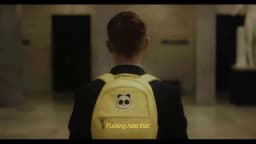
The documentary layer of the campaign captures authentic public behaviour: people leaning in, posing for photographs, resting a hand on the statue, entirely unaware that the lump is present. That footage is then set against Imelda May's performance of Molly Malone, a song embedded deeply in Irish cultural identity. The choice of May — an internationally recognised Irish artist — adds emotional weight and cultural resonance that a voiceover or title card could not achieve. As reported by thedrum.com, the film received a positive review from Andrew Blustein on October 25, 2018, who framed the campaign's creative approach as both emotionally intelligent and strategically grounded in the Irish public interest context.
 ARCHIVE
No verified performance data for Take Notice is publicly available in terms of reach figures, engagement metrics, or measurable changes in breast self-examination behaviour attributable to the campaign. The Marie Keating Foundation has not published quantified outcomes for this specific activation, and no third-party audited results appear in sources including Mariekeating Ie, thedrum.com, or directnewideas.com.
What the campaign's structure does make analytically legible is its earned media logic. A single film asset — supported by a physical installation on one of Dublin's most visited streets — is designed to generate press coverage, social sharing, and word-of-mouth amplification that multiplies its effective reach far beyond any paid media spend. The campaign's reliance on an authentic social experiment format means that the film functions as its own evidence: audiences watching it experience, at one remove, the same inattention that the subjects on Grafton Street demonstrated, and the emotional transfer of that realisation is the campaign's primary mechanism of behaviour change.
The involvement of Imelda May as a cultural amplifier, the technical credibility lent by Joe Fallover's prosthetic work, and the editorial endorsement from thedrum.com all contribute to a campaign architecture built for shareability in the Irish market and beyond. Take Notice earns a Clapboard Score of 73 out of 100, reflecting strong creative ingenuity and cultural specificity within the public interest category, with room for improvement in documented measurability and post-campaign audience reporting.
Take Notice is a 2018 Irish public interest campaign created by Rothco | Accenture Interactive for the Marie Keating Foundation. It placed an artificial breast lump on Dublin's Molly Malone statue during Breast Cancer Awareness Month and filmed the public's unaware interactions to highlight the importance of breast self-examination.
Rothco | Accenture Interactive, based in Dublin, created Take Notice. Executive Creative Director Alan Kelly and Creative Director Stephen Rogers led the work, supported by director Zak Razvi and Emmy-nominated VFX specialist Joe Fallover, who designed and applied the prosthetic lump to the Molly Malone statue, as documented by directnewideas.com.
The Molly Malone statue on Grafton Street in Dublin is one of Ireland's most frequently touched public monuments. The Marie Keating Foundation used that familiarity as the campaign's central insight: if people can touch a breast daily without noticing a lump, the same inattention may be happening during self-examination, making the statue the perfect documentary subject.
Irish singer Imelda May recorded a bespoke rendition of the traditional song Molly Malone for the Take Notice film. Her performance provided emotional and cultural depth to the documentary footage, anchoring the campaign in Irish identity and increasing its resonance with audiences across Ireland during Breast Cancer Awareness Month in October 2018.
The Marie Keating Foundation launched Take Notice in October 2018, timed to coincide with Breast Cancer Awareness Month. The campaign was reviewed positively by The Drum on October 25, 2018, according to a report by journalist Andrew Blustein, who framed it as emotionally intelligent and strategically grounded in Irish public health awareness.
Take Notice received a Clapboard Score of 73 out of 100. The score reflects the campaign's strong creative ingenuity, cultural specificity, and its effective use of a social experiment format within the Irish public interest category, while acknowledging the absence of publicly verified post-campaign performance metrics and audience measurement data.
.webp)
Creative Collaboration Platform: The Backbone of Modern Creative WorkWhat is a creative collaboration platform?Clapboard defines a creative collaboration platform as the operational core for today’s distributed creative teams. This is not a collection of digital collaboration tools stitched together; Clapboard’s system


Understanding the Creative Production MarketplaceWhat is a Creative Production Marketplace?Clapboard defines a creative production marketplace as a structured ecosystem where brands, agencies, and production talent converge to execute video, advertising, and branded content at scale. Unlike the legacy agency or freelanREAD FULL ARTICLE

The Urgent Need for a Creative Production Operating SystemWhy Traditional Creative Production Models Break DownClapboard sees the creative production landscape shifting under pressure. Content velocity is no longer a buzzword—it’s a mandate. Modern advertising demands relentless output across dozens of channels, each wREAD FULL ARTICLE