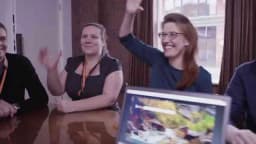
Horten municipality launched its 2022 film campaign to position the Norwegian town as a global technology leader, citing NASA Mars components and life-saving

How Horten Municipality Positions Norway's Technology Capital to the World
Horten municipality's 2022 film campaign, "Always looking for new thoughts and solutions," positions the Norwegian coastal town as the country's foremost technology center by grounding civic pride in verifiable global contributions — companies based in Horten supply components used by NASA in Mars-measurement equipment and manufacture medical devices deployed to save lives worldwide.
Published in January 2022 and classified across the Electronics, Technology, and Transport sectors, the campaign operates as a single-asset film production under the broader Made in Horten place-branding platform. Rather than making abstract promises about innovation, the work anchors Horten's identity in tangible, externally validated outputs: hardware travelling to Mars and devices sustaining human life. The creative premise closes with a provocation — "What about a new way to transport humans and things?" — signalling that the municipality's ambitions extend into the future of mobility and autonomous systems. In Norway, where place-branding campaigns compete for investor attention, talent, and economic visibility along the Oslofjord corridor, this framing is deliberate and strategic. The campaign was produced in-house by Horten municipality and submitted to the international creative archive by Marte Amalie Jonsrud Kaardahl, identified by the municipality as its attraction builder, reflecting the institutional seriousness with which Horten approaches economic development communication. The Clapboard Score for this campaign is 63 out of 100, reflecting competent strategic positioning and a credible proof-point structure, tempered by limited production scale and modest archive engagement metrics.

Horten municipality operates within a well-defined strategic framework. The municipality's 2022–2030 business development plan, documented by Horten Kommune No, carries the slogan "Made in Horten — knowledge along the Oslofjord," and sets out to market local business clusters, attract investors, and grow the regional talent base. The 2022 film campaign is not a standalone creative impulse but a direct expression of that institutional plan, functioning as the public-facing layer of a long-term economic development strategy.
The competitive context in Norway is meaningful. Norwegian municipalities routinely compete for the same pools of skilled workers, capital, and international commercial attention. Stavanger has long positioned itself around energy-sector expertise, and Kongsberg has built a strong identity around advanced defence and maritime technology. Horten's strategy differentiates by claiming the title of technology place number one in Norway outright — a bold assertion that demands substantiation, which the campaign provides through its NASA Mars components and medical devices references. According to Statista, Norway's total advertising expenditure in 2022 reached approximately US$2.714 billion, with roughly US$1.896 billion attributable to digital advertising, illustrating the competitive media environment in which even public-sector communicators must operate. According to Abroad Vrk Org Ua, Nordic advertising expenditure grew by 6.3 percent in constant-currency terms in 2022, underscoring a market where attention is actively contested. The Made in Horten platform, as documented by Hortenlove No, encompasses technology companies active in space, maritime technology, medical devices, sensors, and autonomous systems — making the campaign's sector classifications of Electronics, Technology, and Transport a precise reflection of the actual industrial base rather than aspirational category-stretching.
The creative execution centres on a single film asset, produced in the Norwegian language and released in January 2022. The production was handled in-house by Horten municipality, with Ludvig Juvodden serving as film producer. Marte Amalie Jonsrud Kaardahl, in her role as attraction builder for Horten, oversaw submission and creative direction. The choice to produce entirely in-house reflects both the public-sector budget context and a directness of intent — this is institutional communication that trusts its subject matter to carry the creative weight.
The narrative strategy is built on a rhetorical reframe. Horten's guiding philosophy, as stated in the campaign, is that "impossible" is not a description of what cannot be done but only of what has not yet been done. This framing transforms civic boosterism into a growth mindset proposition, aligning the municipality's identity with the language of innovation culture rather than the conventions of government communication. The film's climactic question — asking whether there might be a new way to transport humans and things — opens the narrative outward toward future technology categories without overcommitting to specifics, a structurally sound creative decision that keeps the campaign relevant across a longer shelf life. The reference to NASA Mars-measurement components is the campaign's most potent single proof point. It is specific, independently verifiable, and globally legible — doing more creative work per second of screen time than any produced visual could achieve alone. Production credits beyond Ludvig Juvodden's producing role are not publicly documented for this campaign.
Horten municipality's 2022 film recorded 1,261 views, 7 likes, and 0 comments in the creative archive where it was submitted. These figures reflect a campaign that operated with limited paid distribution and no documented earned media amplification, consistent with an in-house municipal production rather than a commercially scaled launch. No verified third-party performance data — including reach figures, website traffic attributed to the campaign, or investor inquiry volumes — is publicly available for this campaign.
Structural effectiveness, however, is discernible. The campaign's proof-point architecture is strong: NASA Mars components and globally deployed medical devices are claims that survive scrutiny and travel across media contexts without requiring visual production support. According to horten.kommune.no, the Made in Horten platform is designed to attract investors and capital to the municipality through 2030, meaning the film's value is more accurately measured against long-term economic development outcomes than against short-cycle engagement metrics. In that framing, a campaign that articulates a clear, credible, and memorable technology identity for Horten performs a function that compounds over time. The in-house production model constrains production values but preserves message control and reduces cost, a reasonable trade-off for a government communicator operating within public resource constraints. The campaign's primary weakness, reflected in its Clapboard Score of 63 out of 100, is the gap between the ambition of its claims and the scale of its distribution — a proposition this strong warrants investment in paid reach to match its creative confidence.
Horten municipality's 2022 campaign is a Norwegian-language film that positions the town as Norway's leading technology center. It grounds that claim in real-world proof points, specifically companies supplying NASA with Mars-measurement components and manufacturing medical devices used globally, and asks audiences to imagine future transport innovations.
The NASA Mars-measurement reference serves as the campaign's most powerful credibility anchor. It transforms a civic pride claim into an independently verifiable global fact, demonstrating that Horten-based companies contribute to projects of planetary significance and making the municipality's technology leadership positioning concrete rather than aspirational.
Horten municipality produced the campaign in-house. Marte Amalie Jonsrud Kaardahl, the municipality's designated attraction builder, directed creative oversight and submitted the work to the international archive. Ludvig Juvodden served as film producer. No external advertising agency was involved in the production.
The campaign is part of the broader Made in Horten place-branding platform, not a standalone initiative. According to horten.kommune.no, the municipality's 2022–2030 strategic business plan uses the slogan "Made in Horten — knowledge along the Oslofjord" and targets investor attraction, talent recruitment, and international commercial visibility across technology sectors.
The Horten municipality "Always looking for new thoughts and solutions" campaign received a Clapboard Score of 63 out of 100. The score reflects strong strategic positioning and a credible proof-point structure, offset by limited production scale and modest archive engagement metrics including 1,261 views and 7 likes.
Horten differentiates from competitors like Stavanger, which centres on energy-sector identity, and Kongsberg, known for defence and maritime technology, by claiming the title of Norway's number one technology place outright. The campaign supports that claim with global proof points in Electronics, Technology, and Transport rather than regional economic comparisons.
.webp)
Creative Collaboration Platform: The Backbone of Modern Creative WorkWhat is a creative collaboration platform?Clapboard defines a creative collaboration platform as the operational core for today’s distributed creative teams. This is not a collection of digital collaboration tools stitched together; Clapboard’s system


Understanding the Creative Production MarketplaceWhat is a Creative Production Marketplace?Clapboard defines a creative production marketplace as a structured ecosystem where brands, agencies, and production talent converge to execute video, advertising, and branded content at scale. Unlike the legacy agency or freelanREAD FULL ARTICLE

The Urgent Need for a Creative Production Operating SystemWhy Traditional Creative Production Models Break DownClapboard sees the creative production landscape shifting under pressure. Content velocity is no longer a buzzword—it’s a mandate. Modern advertising demands relentless output across dozens of channels, each wREAD FULL ARTICLE