


Varun Katyal | Founder, Clapboard
Varun Katyal is the Founder & CEO of Clapboard and a former Creative Director at Ogilvy, with 15+ years of experience across advertising, branded content, and film production. He built Clapboard after seeing firsthand that the industry’s traditional ways of sourcing talent, structuring teams, and delivering creative work were no longer built for the volume, velocity, and complexity of modern content. Clapboard is his answer — a video-first creative operating system that brings together a curated talent marketplace, managed production services, and an AI- and automation-powered layer into a single ecosystem for advertising, branded content, and film. It is designed for a market where brands need content at a scale, speed, and level of specialization that legacy agencies and generic freelance platforms were never built to deliver. The thinking, frameworks, and editorial perspective behind this blog are shaped by Varun’s experience across both the agency world and the emerging platform-led future of creative production. LinkedIn: https://www.linkedin.com/in/varun-katyal-clapboard/
Breaking the Mold: The Core Principles of French New Wave Cinema
French New Wave cinema wasn’t a style imposed from above; it was a rupture from within. The filmmakers who defined this movement—Godard, Truffaut, Varda, and their cohort—saw the ossified conventions of postwar French filmmaking as both an artistic dead end and a political statement. They responded with a set of principles that still reverberate through avant-garde filmmaking and anti-establishment film today. To understand their impact, you have to start with their foundational act: a refusal to obey.
Key principles of French New Wave cinema
At its core, French New Wave cinema is defined by its antagonism toward mainstream narrative and production rules. These directors rejected the studio-bound, meticulously scripted “cinéma de papa” in favor of films that felt alive—improvised, immediate, and unpolished. The camera became a participant, not a passive observer. Stories unfolded in fragmented, elliptical structures. Editing was jumpy, even jarring, deliberately drawing attention to the medium itself. This was cinematic innovation not as ornament, but as rebellion.
How French New Wave challenged cinematic conventions
The New Wave’s assault on tradition was both aesthetic and ideological. By shooting on location with lightweight cameras, they collapsed the barrier between fiction and documentary. Natural light replaced elaborate setups. Dialogue was loose, sometimes overlapping, often unscripted. The result: a sense of unpredictability and risk. These films valued spontaneity, authenticity, and realism over technical polish. The world on screen became porous, imperfect, and recognizably human.
This anti-establishment film ethos extended to casting and performance. Unknown actors and non-professionals often took center stage, lending films a raw immediacy. Characters rarely fit archetypes; they wandered, they doubted, they rebelled. In doing so, French New Wave cinema made space for ambiguity and contradiction—qualities that mainstream cinema, with its preference for resolution, tended to avoid.
Personal expression in French New Wave films
Perhaps the movement’s most enduring legacy is its insistence on personal vision. Many New Wave filmmakers began as critics, deeply versed in film theory and history. Their work was self-aware, dialoguing with the past while breaking from it. This gave rise to the auteur theory: the idea that a director’s individual perspective should shape every aspect of a film. In practice, this meant stories that were idiosyncratic, subjective, and sometimes defiantly opaque.
The boundary between criticism and creation blurred. Films referenced other films, sometimes explicitly; characters discussed cinema within the narrative. This reflexivity was more than cleverness—it was a challenge to audiences and industry alike. It asked viewers to engage, to question, to recognize the constructed nature of what they were watching.
French New Wave’s influence on alternative filmmaking styles
French New Wave cinema did not just open the door to new forms; it made it impossible to close again. Its core principles—experimentation, personal authorship, and a relentless questioning of norms—have become foundational to alternative filmmaking styles worldwide. The movement’s legacy is not a set of visual tics, but a permission structure: a license to break rules in pursuit of something truer, stranger, and more vital than what came before.
Defining French New Wave Cinema for a Modern Audience
What is French New Wave cinema?
French New Wave cinema, or Nouvelle Vague, is not just a chapter in modern film history—it’s a rupture. Emerging in late 1950s France, this movement rejected the rigid formalism and commercial predictability of the era’s mainstream films. Instead, it embraced risk, imperfection, and the filmmaker’s personal vision. French New Wave cinema is marked by handheld cameras, jump cuts, location shooting, and a restless energy that feels as immediate today as it did over sixty years ago.
At its core, French New Wave cinema foregrounds the director as auteur. The films are unmistakably authored—by Godard, Truffaut, Varda, and others—each bringing their own signature to the medium. The result is work that is self-aware, intellectually agile, and unafraid to break the fourth wall or disrupt narrative conventions. It’s cinema that looks you in the eye and asks you to think, not just watch.
Origins of the Nouvelle Vague movement
The Nouvelle Vague was born from the cultural ferment of postwar France. By the late 1950s, a generation of critics-turned-filmmakers—many writing for the influential journal Cahiers du Cinéma—grew restless with the ossified traditions of French studio filmmaking. The movement’s DNA is inseparable from the social and political shifts of the time: a disillusionment with grand narratives, a search for authenticity, and a hunger to capture the texture of everyday life. These filmmakers drew from Italian neorealism and American genre films, but their approach was distinctly French—playful, cerebral, and often tinged with melancholy.
What set the Nouvelle Vague apart from other film movements was its anti-institutional stance. Filmmakers worked outside established systems, often on shoestring budgets, using friends as actors and city streets as sets. The line between fiction and documentary blurred. The result was a body of work that felt alive, improvisational, and deeply personal. If you want a primer on the history of film movements, the Nouvelle Vague is the moment when cinema stopped asking for permission.
Why French New Wave cinema still matters today
For modern filmmakers and creative leaders, French New Wave cinema remains a touchstone. Its techniques—jump cuts, direct address, nonlinear storytelling—are now part of the global cinematic language. But its real legacy is deeper: a belief in the filmmaker’s voice, a willingness to interrogate form, and a refusal to let budget or convention dictate vision. The Nouvelle Vague’s influence is visible in everything from indie filmmaking to branded content that values authenticity over polish.
The enduring curiosity about French New Wave cinema is not nostalgia. It’s recognition that its questions—about authorship, realism, and the politics of representation—are still urgent. In an era of algorithmic content and risk-averse production, the movement’s audacity feels newly relevant. For anyone asking “what is Nouvelle Vague?” the answer is both historical and immediate: it’s a reminder that film can be art, argument, and invention—all at once.
Iconic Directors Who Shaped French New Wave Cinema
Who were the key French New Wave directors?
French New Wave cinema was not the product of a single auteur but a constellation of fiercely independent voices. The movement’s core included François Truffaut, Jean-Luc Godard, Claude Chabrol, Éric Rohmer, Jacques Rivette, and Agnès Varda. Each director brought a distinct sensibility, yet all shared a hunger to upend the conventions of postwar French filmmaking. Their backgrounds as critics for Cahiers du cinéma shaped their approach—they were as analytical as they were creative, and their films reflect that duality.
Auteur theory and the French New Wave
The directors of the French New Wave were not content to simply execute scripts or reproduce studio formulas. They championed auteur theory, the idea that a director’s personal vision is the driving force behind a film’s meaning and style. This philosophy, forged in the pages of Cahiers du cinéma, positioned directors as true authors, rather than technicians or facilitators (Wikipedia, 2024). The movement’s most influential film directors—Truffaut, Godard, Chabrol—internalized this stance, making their films unmistakably their own. Their personalities, tastes, and obsessions became the DNA of French New Wave cinema.
Signature styles of New Wave filmmakers
Truffaut’s films are marked by their emotional directness and a deep affection for the medium itself. His debut, “The 400 Blows,” is intimate yet unsentimental, blending autobiography with formal innovation. Truffaut’s 1954 manifesto essay, “Une certaine tendance du cinéma français,” didn’t just criticize the status quo—it set the tone for the movement’s embrace of risk and imagination (ScreenRant, 2023). Godard, meanwhile, approached cinema as a laboratory. “Breathless” is restless, improvisational, and deliberately rough-edged, with its jump cuts and disregard for classical narrative structure. Godard’s films are confrontational, always aware of their own artifice, and they invite the audience to share that awareness.
Chabrol, often called the “French Hitchcock,” brought a cold, forensic eye to bourgeois hypocrisy, using genre as a scalpel rather than a template. Rohmer’s films are conversational and philosophical, finding drama in the nuances of human relationships. Rivette’s work is sprawling, enigmatic, and deeply collaborative, blurring the line between fiction and performance. Varda, sometimes adjacent to the core group but never peripheral, infused her films with lyricism, feminism, and a playful documentary sensibility. Her presence widened the movement’s scope, both thematically and stylistically.
The impact of director personalities on the movement
What unites these influential film directors is not a shared aesthetic but a shared conviction: that cinema is a vehicle for personal expression. Their films are inseparable from their identities—Truffaut’s romanticism, Godard’s provocation, Chabrol’s skepticism, Varda’s empathy. The New Wave’s legacy is a blueprint for auteur filmmaking: directors who shape every frame, not out of ego, but out of a belief that film is most alive when it bears the mark of a singular mind. In doing so, they didn’t just change French cinema—they changed the terms of global film authorship.
Techniques That Changed the Language of Cinema
Essential French New Wave cinema techniques
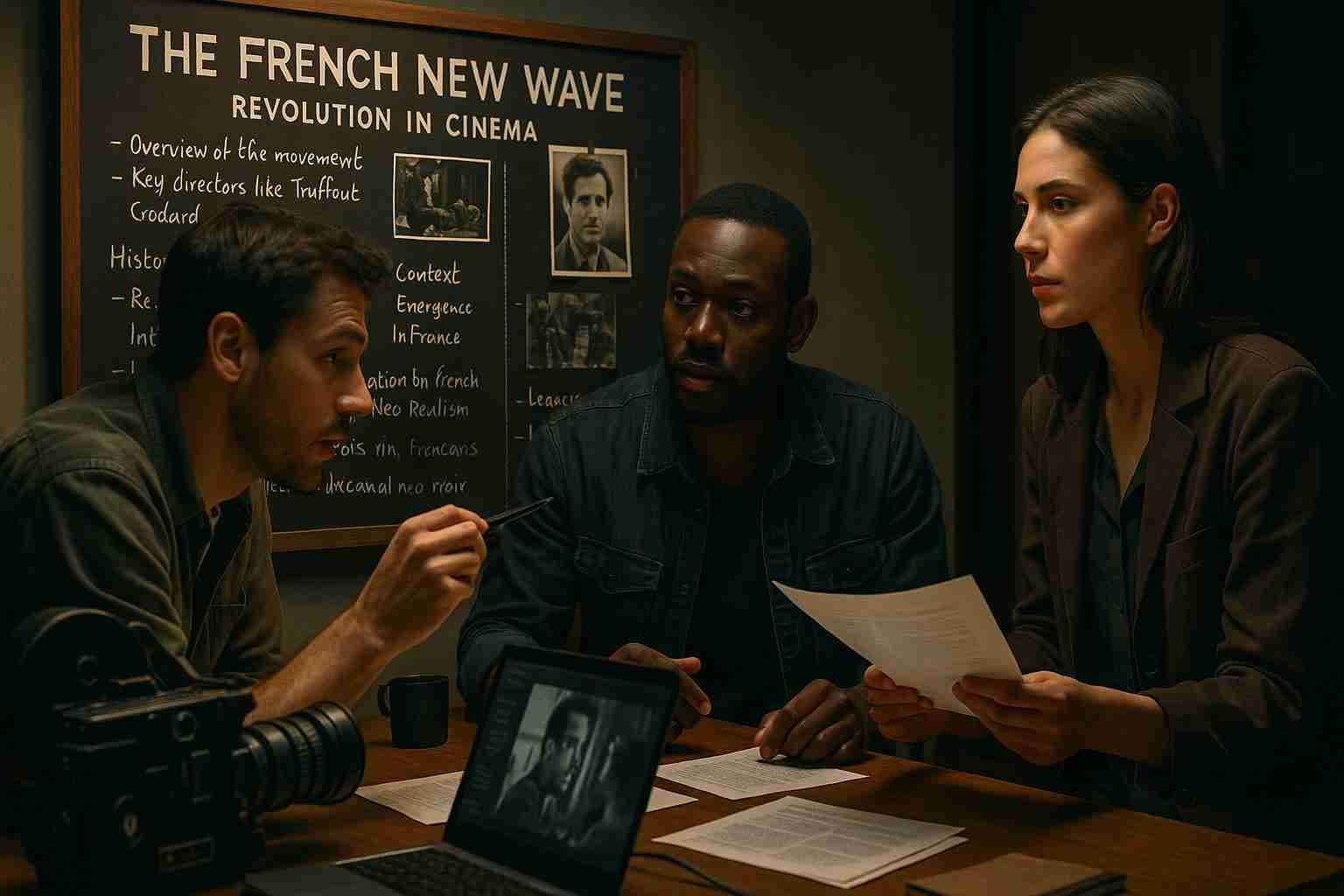
French New Wave cinema techniques did not merely update the grammar of film—they rewrote it. The movement’s practitioners, dissatisfied with inherited conventions, tore down the scaffolding of classical filmmaking. Their toolkit was built on necessity and intent: jump cuts, handheld camera, non-linear editing, direct sound, and a willingness to break the fourth wall. Each was a deliberate act of rebellion and renewal, not a stylistic flourish for its own sake.
The result was a new visual and narrative lexicon. The French New Wave’s influence is visible in every frame that values immediacy over polish, and every story that refuses to play by established rules. These techniques were not isolated tricks; they were the DNA of a new cinematic organism, one that continues to mutate and inspire.
How jump cuts redefined film editing
Jump cuts are now shorthand for disruption, but in the late 1950s, they were an affront to the invisible hand of continuity editing. Jean-Luc Godard’s Breathless (1960) is ground zero: scenes leap forward in time within the same shot, discarding the illusion of seamlessness. The cut itself becomes visible, a rupture that refuses to let the audience drift into passive consumption. This wasn’t carelessness—it was a deliberate exposure of the edit, a way to remind viewers that cinema is constructed, not conjured. The jump cut’s influence on cinematic techniques explained is seismic, marking the point where editing could be expressive, even confrontational (Library of Congress, 2023).
The power of improvisation in New Wave films
Improvisation was not just a performance method; it was a production philosophy. Direct sound recording, natural light, and on-location shooting stripped away the artifice of studio-bound cinema. Dialogue often felt spontaneous, sometimes even rambling, but this looseness was a calculated risk. It allowed filmmakers to capture lightning—moments of authenticity that could never be rehearsed or repeated. Agnès Varda’s observation that the movement shared “a sort of speed in the inspiration and the work” speaks to this ethos: fast, flexible, and unburdened by tradition (In Depth Cine, 2023).
The use of non-actors, real locations, and minimal setups blurred the line between fiction and documentary. This approach didn’t just change the look of films; it changed their energy. Scenes breathe, stumble, and surprise, drawing audiences into a world that feels lived-in rather than staged. The boundary between character and performer, script and reality, becomes porous.
Handheld camera and the aesthetics of immediacy
Handheld camera work is now a staple of “authentic” filmmaking, but in the French New Wave, it was a radical gesture. Freed from the tyranny of tripods and dolly tracks, filmmakers could chase their subjects through streets, apartments, and nightclubs. The camera became a participant—restless, responsive, and alive. This documentary-style realism was not just about aesthetics; it was about agility. Portable equipment and minimal crews enabled a speed of production that matched the creative urgency of the movement (Wikipedia, 2023).
The result is a kinetic, improvisational visual language that still feels contemporary. By prioritizing movement and spontaneity over perfection, French New Wave cinema techniques made the medium itself visible—inviting audiences to see not just the story, but the storytelling.
Reflexivity and breaking the fourth wall
Perhaps
Storytelling Reimagined: Narrative Structures and Character Focus
Narrative structure in French New Wave cinema
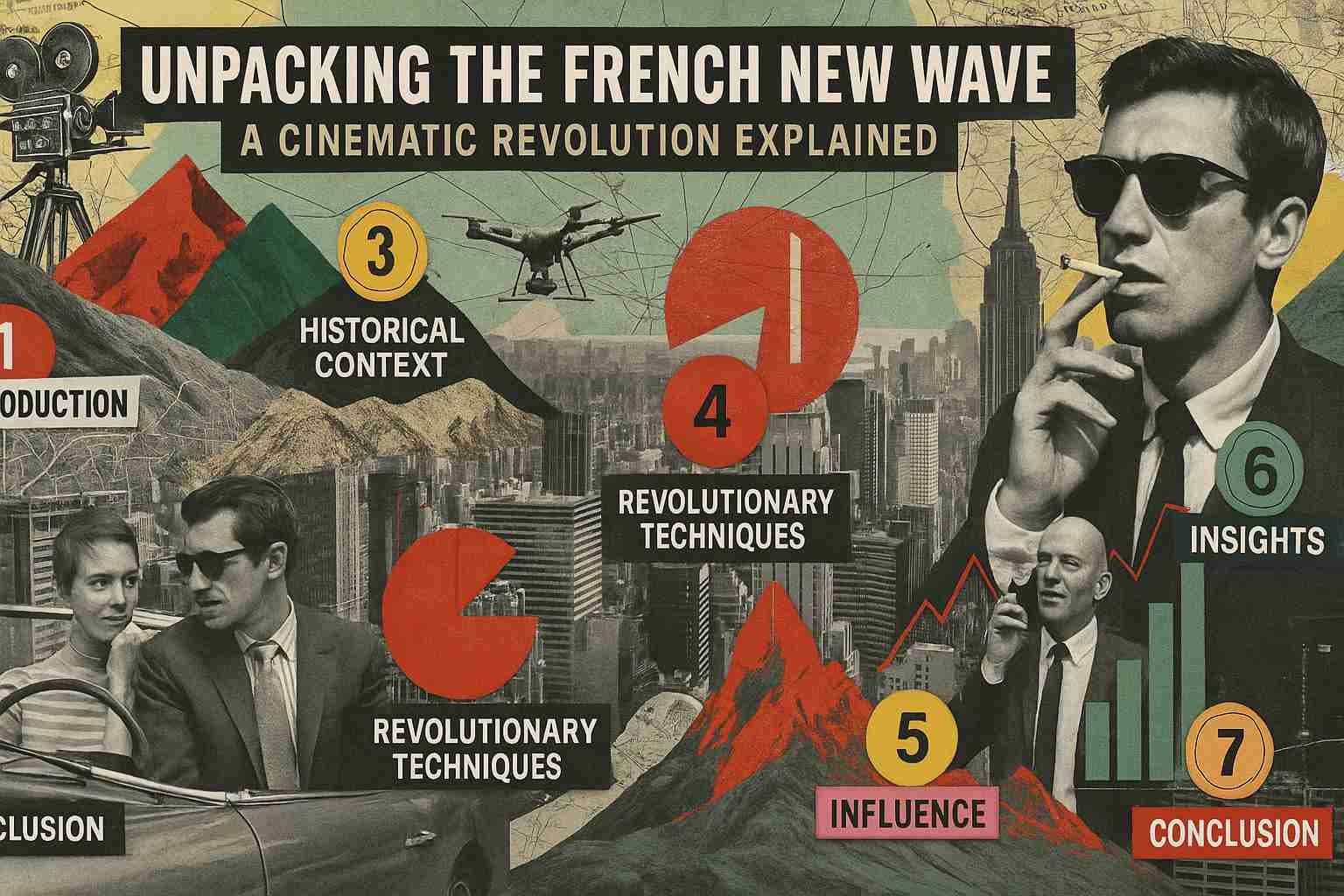
French New Wave cinema storytelling did not merely tweak the conventions of its era—it upended them. Where classic studio films relied on tight, linear plotting and narrative closure, the New Wave’s architects—Godard, Truffaut, Varda, Resnais—stripped away the scaffolding. Their films often began in medias res, looped back, or drifted forward without clear causality. This embrace of the non-linear narrative was not an affectation but a deliberate challenge to the audience’s expectations. The result: stories that unfolded with the rhythm of memory or daydream, not the clockwork of genre convention. This was narrative innovation in film at its most radical, and it set the stage for decades of experimentation worldwide.
Character focus and psychological depth
Just as structure became elastic, so too did character. The French New Wave’s protagonists were not heroes in the traditional sense; they were young, restless, often directionless. The camera lingered on their faces, their gestures, the silences between words. In these films, character-driven storytelling meant following individuals through the mundane and the monumental alike—wandering Parisian streets, debating love, or simply existing in the charged uncertainty of youth. The psychological depth was not spelled out through exposition but inferred through fragmentation, contradiction, and ambiguity. Inner life was rendered as a mosaic, not a monologue. The audience was expected to do the work of interpretation, to sit with the unresolved.
The rise of ambiguous film endings
Perhaps nowhere is the New Wave’s impact clearer than in its endings. Where Hollywood favored resolution—wrapping up plotlines, rewarding virtue, punishing vice—the French New Wave leaned into ambiguous endings. Stories concluded with ellipses, not periods. Characters parted ways, unresolved; questions lingered in the air. This was not indecision but a reflection of the filmmakers’ worldview: life rarely offers neat conclusions. Ambiguity became a narrative tool, inviting the audience to project, question, and revisit. The effect was both unsettling and liberating, expanding the emotional and intellectual territory of cinema.
Everyday life, existential themes, and global influence
The New Wave’s commitment to everyday life and existential themes—alienation, freedom, the search for meaning—rooted its innovations in the texture of lived experience. The streets, cafés, and apartments of postwar France became stages for universal questions. This approach resonated far beyond Paris. Filmmakers from New Hollywood to the Iranian New Wave, from Dogme 95 to contemporary indie auteurs, have borrowed and reinterpreted these techniques. The legacy of French New Wave cinema storytelling is less about specific tropes and more about a mindset: that narrative can be as unpredictable, as open-ended, and as richly human as life itself.
For creative leaders and marketers, the lesson is clear. Audiences respond to stories that respect their intelligence, invite interpretation, and reflect the complexity of real experience. The French New Wave’s revolution in narrative structure and character focus remains a blueprint for anyone seeking to break formula and create work that endures.
French New Wave Cinema vs. Hollywood: Creative Tensions and Trade-Offs
French New Wave cinema vs. Hollywood style
French New Wave cinema vs. Hollywood is not just a question of geography or era—it’s a tension between fundamentally different worldviews about what film should be. Hollywood conventions have long favored narrative clarity, polished production values, and broad audience appeal. The studio system, with its hierarchies and risk-averse financing, naturally gravitates toward formula and spectacle. In contrast, the French New Wave—born from cinephile criticism and youthful rebellion—sought to dismantle these norms. Its filmmakers embraced handheld cameras, location shooting, natural light, and improvisation. They were less interested in seamless illusion than in reminding viewers that film is a constructed, subjective medium.
The stylistic gulf is not just aesthetic but ideological. Where Hollywood’s invisible editing and continuity aim to immerse, the New Wave’s jump cuts and narrative ellipses provoke. The camera lingers where Hollywood would cut, meanders where Hollywood would drive forward. This was not an accident—it was a conscious rejection of the “well-made” movie, a challenge to the very grammar of mainstream cinema.
Artistic risks in New Wave filmmaking
At the heart of this divide lies the question of risk. New Wave directors, often working with minimal budgets and outside the studio system, had little to lose and everything to prove. Their artistic freedom was born of necessity and conviction. They could afford to experiment with fractured timelines, ambiguous endings, and non-professional actors because they weren’t beholden to box office projections or test screenings. This risk tolerance allowed for a rawness and immediacy rarely seen in Hollywood features of the same era.
Hollywood, by contrast, has always had more at stake—larger budgets, union crews, distribution deals, and the weight of tradition. Artistic risks here are calculated, often sanded down by layers of executive oversight. The result is a creative tension: Hollywood can achieve technical brilliance and scale, but it rarely surprises. The New Wave, in its best moments, was pure provocation—cinema as an act of personal expression rather than a product engineered for mass consumption.
Independent spirit vs. studio system
The French New Wave’s independent spirit was both its strength and its limitation. By rejecting film industry norms, these directors forged a path that would inspire generations of creative filmmaking choices. Yet the trade-off was real: limited resources often meant compromised sound, rough edits, and uneven performances. Accessibility became a point of contention—New Wave films could alienate as much as they could inspire, their innovations sometimes veering into self-indulgence.
Hollywood, for all its constraints, delivers scale and reach. Its conventions exist for a reason: they facilitate collaboration on a massive scale and help films travel across cultures and markets. But this comes at the cost of uniformity. The ongoing debate between accessibility and artistic integrity is not just academic; it’s a live issue for every filmmaker choosing between the autonomy of independence and the infrastructure of the studio system.
Creative filmmaking choices: enduring debates
The legacy of French New Wave cinema vs. Hollywood is not settled. Each tradition offers lessons and cautions. For creative leaders, the question is not which model to emulate, but how to navigate the trade-offs. The most vital work often emerges from the friction between artistic freedom and commercial reality—a negotiation as relevant today as it was in the era of Godard and Hitchcock.
Misconceptions and Myths About French New Wave Cinema
Common myths about French New Wave cinema
French New Wave cinema myths persist because shorthand is seductive—jump cuts, handheld cameras, cigarettes in black-and-white. But these are surface markers, not the substance. The movement was never a uniform manifesto. It was a constellation of filmmakers responding to the staid conventions of postwar French cinema, each with distinct sensibilities. To reduce it to editing tricks or a single look is to miss the point: innovation wasn’t a style, it was a strategy.
The myth of homogeneity runs deep. Godard’s abrasive meta-narratives have little in common with the emotional intimacy of Truffaut, or the playful lyricism of Varda. Even within a director’s body of work, there’s no fixed template. The idea that every French New Wave film is a black-and-white urban reverie is simply false. Many were in color, some rural, some comedic, some deeply political. The diversity was intentional—a rejection of formula as much as content.
Separating fact from fiction in Nouvelle Vague
Another persistent film movement stereotype: that French New Wave films are impenetrable or elitist, made only for cinephiles or academics. This misreads both intent and effect. The early New Wave directors were critics-turned-filmmakers who wanted to democratize cinema, not wall it off. They shot on the streets, cast non-actors, and told stories about ordinary people. The camera became less a pedestal, more a participant. Accessibility—through subject, form, and production—was a feature, not a bug.
Some myths about film history suggest the movement was a closed Parisian circle, but it was always porous. Agnès Varda’s work predates the Cahiers du Cinéma cohort and brings a different gendered and social lens. The movement’s reach extended beyond France, shaping global cinema in ways that can’t be contained by a single aesthetic or ideology. To view French New Wave as a monolith is to ignore its contradictions, its arguments, its restless energy.
Who can appreciate French New Wave films?
There’s a lingering assumption that only those with a background in film theory or a taste for the avant-garde can appreciate these works. This is a misconception rooted in the movement’s later reputation, not its origins. Yes, some films are formally challenging. But many—like “The 400 Blows” or “Cleo from 5 to 7”—are emotionally immediate, even universal. The movement invites viewers to see with fresh eyes, not to pass a test of cinematic literacy.
Understanding film movements like the French New Wave means recognizing their complexity, not flattening them into slogans or clichés. The true facts are more interesting than the myths: this was a movement that thrived on difference, welcomed contradiction, and left the door open for anyone curious enough to step through. The myth of inaccessibility is just that—a myth. The invitation stands, as it always did, for those willing to look beyond the surface.
The Lasting Impact of French New Wave Cinema on Global Filmmaking
How French New Wave cinema changed global film
French New Wave cinema influence is not a matter of nostalgia or academic reverence—it is a living, breathing force in the DNA of global filmmaking. The Nouvelle Vague’s break from tradition was more than stylistic rebellion; it was a recalibration of what cinema could be. By rejecting studio-bound artifice and privileging location shooting, handheld cameras, and natural light, New Wave directors created a visual grammar that felt immediate and unvarnished. This ethos—cinema as a direct, personal engagement with the world—has echoed through decades of filmmaking, from the American indie boom to contemporary international auteurs.
The movement’s structural innovations were equally seismic. The jump cut, once considered a jarring mistake, became a tool for narrative propulsion and psychological realism. Nonlinear storytelling, ambiguous endings, and direct address to camera all entered the mainstream lexicon, not as novelties but as legitimate modes of expression. These techniques did not just alter the look and feel of films; they challenged audiences to engage with cinema as an active, interpretive act. The impact on modern filmmaking is visible in the work of directors as varied as Martin Scorsese, Wong Kar-wai, and Greta Gerwig, all of whom draw from the Nouvelle Vague’s arsenal of narrative and visual experimentation.
New Wave influences in contemporary movies
The legacy of Nouvelle Vague is most apparent in independent cinema, but its fingerprints are everywhere. American directors like Quentin Tarantino and Richard Linklater have openly acknowledged their debts, weaving New Wave references into their films’ DNA. The British New Wave, New Hollywood, and even Iranian New Wave movements all reflect a dialogue with French precursors. The influence extends beyond auteurs: genre films, from neo-noir to romantic comedies, have absorbed New Wave’s playful disregard for convention, resulting in hybrid forms that keep genre cinema from ossifying.
Contemporary global film trends—such as the rise of hybrid documentary-fiction forms and the embrace of fragmented, episodic structures—trace their roots to the experiments of Godard, Truffaut, and Varda. Even streaming-era content, with its willingness to blur boundaries between TV and film, owes a debt to the New Wave’s refusal to recognize fixed hierarchies or formats. The cross-pollination is not one-way; global filmmakers have reinterpreted New Wave techniques to reflect their own contexts, ensuring the movement’s relevance is neither static nor parochial.
The democratization of filmmaking post-New Wave
Perhaps the most profound French New Wave cinema influence is the movement’s effect on who gets to make films—and how. The Nouvelle Vague’s embrace of low budgets, small crews, and non-professional actors was not just a matter of necessity. It was a philosophical stance: anyone with vision and tenacity could be a filmmaker. This democratization prefigured today’s digital revolution, where access to affordable equipment and distribution platforms has lowered barriers worldwide. The spirit of experimentation and creative autonomy that defined the New Wave now underpins the ethos of countless emerging filmmakers, from Lagos to Seoul.
In the end, the legacy of film movements is measured not by their preservation in textbooks, but by their capacity to inspire reinvention. French New Wave cinema’s influence endures because it made cinema porous—open to new ideas, voices, and forms. Its greatest gift is not a set of rules, but a provocation: to make films that are alive to their moment, and unafraid to break what came before.
Lessons for Today: What Filmmakers and Creatives Can Learn from French New Wave Cinema
Creative lessons from French New Wave cinema
French New Wave cinema is not a museum piece. Its legacy is a set of working principles for those who want to make something that matters. The movement’s core lesson is that creative inspiration doesn’t wait for permission or ideal conditions. Godard, Truffaut, Varda—these directors didn’t just break rules. They redefined what rules could be. Their films remind us: the frame is never neutral, the cut is never passive, and the story is never inevitable. For today’s creatives, the lesson is to approach every project with intent, not habit. Question the default. Refuse to let budget, convention, or audience expectation dictate your choices. The New Wave’s genius was not technical, but philosophical. It was a posture: what if we do it differently?
How to bring New Wave spirit into your films
Embracing the lessons from French New Wave cinema means foregrounding personal vision. This isn’t about self-indulgence. It’s about authorship—staking a claim on the material, even if it’s commercial or collaborative. The Nouvelle Vague directors embedded their fingerprints in every frame, often by writing their own scripts, shooting on location, and casting non-professional actors. Today, the equivalent is not just picking up a camera, but picking up a point of view. Authenticity is currency. If your film or campaign feels like it could have been made by anyone, it will be remembered by no one. The New Wave teaches: let your quirks, your obsessions, and your context bleed into the work. That is where resonance lives.
Modern filmmaking tips inspired by the Nouvelle Vague
Low-budget, DIY approaches are not a constraint—they’re a creative accelerant. The French New Wave thrived on scarcity: borrowed equipment, natural light, real streets. In the digital age, the barrier to entry is even lower, but the challenge is focus. Don’t mistake access for artistry. Use what you have, but use it with intention. Innovate in form as much as in story. Jump cuts, handheld shots, breaking the fourth wall—these were more than stylistic quirks; they were solutions to practical problems, and statements about cinema’s possibilities. For today’s filmmakers, the message is clear: let limitations shape the work, not shrink it. Treat every “problem” as an opportunity to invent your own creative filmmaking advice.
Challenging norms and audience expectations
The French New Wave’s most enduring lesson is to treat audiences as partners, not consumers. The movement’s films often disrupted narrative flow, left questions unresolved, or demanded active interpretation. This wasn’t antagonism—it was respect. In an age of algorithmic predictability, challenging your audience is a radical act. Whether you’re crafting a branded video or an independent feature, don’t be afraid to subvert, to provoke, to invite interpretation. Storytelling inspiration comes from the willingness to risk confusion in pursuit of meaning. The New Wave’s audacity is a reminder: the safest move is often the least memorable.
French New Wave cinema endures because it was never just about France or the 1960s. Its lessons are perennial: experiment, own your vision, make with what you have, and trust the audience to meet you halfway. For filmmakers and creatives today, these are not relics. They are a blueprint for relevance.
Conclusion
French New Wave cinema stands as a defining inflection point in the history of film movements. Its practitioners, armed with both skepticism and reverence for established norms, dismantled the prevailing grammar of cinema and replaced it with a language attuned to spontaneity, subjectivity, and personal vision. The movement’s legacy is not confined to the films themselves, but to the very idea that cinematic innovation is a living, restless process—one that can and should be challenged from within.
At the heart of the French New Wave’s significance is its radical reimagining of narrative structures. By discarding linearity and embracing ambiguity, these filmmakers invited audiences to participate in meaning-making rather than passively consume it. This shift did more than disrupt convention; it seeded a new ethos for creative filmmaking choices, where the unexpected could become the essential. The New Wave’s approach to editing, sound, and visual composition continues to inform directors who seek to break from formulaic storytelling and pursue more authentic, resonant experiences on screen.
Perhaps most enduring is the movement’s unwavering commitment to artistic freedom. The New Wave’s directors, many of whom were critics before they were auteurs, understood the risk and necessity of making work that was personal, even idiosyncratic. In doing so, they established a template for independent filmmaking—one where the filmmaker’s voice is not a liability but a source of power. This principle remains vital for any creative leader navigating the tension between commerce and expression, reminding us that the most influential directors in film are often those who resist easy categorization.
The French New Wave’s impact is visible in the DNA of contemporary cinema, from handheld camerawork to fractured timelines and direct address. Its spirit animates filmmakers who refuse to separate the craft of making from the act of questioning. For today’s practitioners and decision-makers, the lesson is clear: the boundaries of film are not fixed. They are there to be interrogated, redrawn, and—if necessary—broken. That is the enduring gift of the New Wave, and its relevance persists wherever filmmakers are willing to risk something new.
FAQs
What was the French New Wave?
The French New Wave was a cinematic movement that emerged in late 1950s France, led by critics-turned-filmmakers who challenged traditional filmmaking conventions. It prioritized personal expression, spontaneity, and a rejection of the studio system, marking a radical shift in both style and narrative form. Its significance lies in how it redefined authorship and creative control in cinema.
How did the French New Wave impact modern cinema?
The French New Wave’s influence is foundational. It empowered directors as auteurs, encouraged location shooting, and validated unconventional storytelling. Contemporary filmmakers—from indie auteurs to mainstream visionaries—draw on its legacy, whether through jump cuts, narrative ambiguity, or a willingness to break established rules in pursuit of authenticity and originality.
What are the characteristics of French New Wave films?
French New Wave films are marked by handheld camerawork, natural lighting, improvised dialogue, and fragmented narratives. They often break the fourth wall, use jump cuts, and foreground the director’s voice. The tone is frequently playful or self-reflexive, with stories that blur the line between fiction and reality, privileging character over plot.
Who were the main directors of the French New Wave?
Key figures include François Truffaut, Jean-Luc Godard, Agnès Varda, Claude Chabrol, and Éric Rohmer. Each brought a distinct sensibility but shared a commitment to experimentation. Their work set the template for independent filmmaking and inspired generations of directors to assert their creative vision over commercial pressures.
What techniques were introduced by French New Wave cinema?
Innovations included jump cuts, direct sound recording, on-location shooting, and the use of available light. Directors often used non-professional actors and improvised dialogue. Editing became more visible, with abrupt transitions and narrative fragmentation, emphasizing the constructed nature of film rather than concealing it.
How does French New Wave cinema differ from Hollywood films?
French New Wave cinema rejects formulaic storytelling and polished studio aesthetics. While Hollywood often prioritizes narrative clarity and visual gloss, New Wave films embrace ambiguity, stylistic risk, and a raw, immediate quality. The focus shifts from spectacle to subjectivity, from plot machinery to personal perspective.
What are some common myths about French New Wave cinema?
A frequent myth is that French New Wave films are inaccessible or purely intellectual exercises. In reality, many are emotionally direct and even playful. Another misconception is that the movement was homogenous; in truth, its directors had divergent styles and philosophies, united only by a drive to reinvent cinema.
.webp)
Creative Collaboration Platform: The Backbone of Modern Creative WorkWhat is a creative collaboration platform?Clapboard defines a creative collaboration platform as the operational core for today’s distributed creative teams. This is not a collection of digital collaboration tools stitched together; Clapboard’s system

Understanding the Creative Production MarketplaceWhat is a Creative Production Marketplace?Clapboard defines a creative production marketplace as a structured ecosystem where brands, agencies, and production talent converge to execute video, advertising, and branded content at scale. Unlike the legacy agency or freelanREAD FULL ARTICLE
The Urgent Need for a Creative Production Operating SystemWhy Traditional Creative Production Models Break DownClapboard sees the creative production landscape shifting under pressure. Content velocity is no longer a buzzword—it’s a mandate. Modern advertising demands relentless output across dozens of channels, each wREAD FULL ARTICLE
JOIN THE NEWSLETTER.
Content Production insights, videos, books, and freebies, delivered to your inbox weekly


LEAVE A COMMENT
Your email address will not be published.