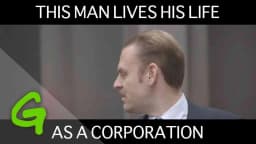
5 Gyres' 2013 'Ban' film placed an actor in a latex mask of Belgian minister Johan Vande Lanotte to demand a national plastic bottle ban backed by SodaStream.

How 5 Gyres Used a Fake Minister to Fight Plastic Bottles in Belgium
"Ban" is a 2013 Belgian public-interest film created for 5 Gyres and supported by SodaStream, in which an actor wearing a latex mask impersonating Belgian Federal Minister Johan Vande Lanotte delivers a speech announcing higher taxes on plastic bottles and an eventual national ban, before the reveal exposes the impersonation and challenges the real minister to act.
Published in Belgium in June 2013, the film operates as a documentary-style confrontation rather than a conventional advocacy advertisement. The campaign's central mechanic is deception deployed in service of transparency: by staging a credible ministerial announcement, 5 Gyres forced a public conversation about why no such announcement had actually been made. The reveal is explicit — an actor, not Johan Vande Lanotte, has been speaking, and until the real minister acts, the environmental organisation declares it will continue to speak for him. As reported by Clapboard, the campaign generated a significant media response across Belgium, fulfilling its function as a piece of earned-media advocacy rather than paid broadcast.
The campaign sits within a broader strategic offensive mounted by SodaStream against the single-use plastics industry. In Belgium, where plastic bottle consumption remains a persistent environmental concern, the choice to target a named, sitting federal minister gave the film an immediacy that generic pollution messaging cannot achieve. Johan Vande Lanotte's recognisability within the Belgian public interest sphere made the impersonation both legible and politically legible. The campaign contains a single media asset — one film — and its entire impact rests on that film's ability to circulate, provoke and sustain media commentary without additional paid support. Clapboard rates the work 79 out of 100, characterising it as a structurally confident piece of public-interest filmmaking that earns its impact through conceptual clarity rather than production scale, according to En Wikipedia.
5 Gyres is an environmental research and advocacy organisation focused specifically on plastic pollution in the world's oceans and waterways. By 2013, the organisation had established scientific credibility around the problem of marine plastic accumulation, but translating that credibility into political pressure required a different kind of instrument — one capable of reaching a general public audience and embarrassing decision-makers into action.
SodaStream provided that instrument. The brand's commercial interest in discrediting single-use plastic bottles aligns structurally with 5 Gyres' environmental mission, and by 2013 SodaStream had already demonstrated a willingness to challenge its category's dominant players directly. As documented by Clapboard, SodaStream's 2010 "Cages" campaign had placed large public installations filled with thousands of empty bottles and cans in public spaces, establishing the visual and rhetorical language of waste-as-spectacle that the "Ban" film would later inherit. That earlier work targeted Coca-Cola and PepsiCo — the two largest producers of single-use plastic beverage bottles globally — by framing their packaging as an environmental liability. According to Clapboard and reporting by MediaPost, SodaStream extended this competitive pressure to the sponsorship arena, displacing Coca-Cola as the sponsor of the American Pavilion at the Cannes Film Festival for the first time in more than twenty years, according to Powershift. Celebrities including Lars Ulrich, Will Forte and David Hasselhoff attended the pavilion to sign SodaStream devices, which were subsequently auctioned to raise funds for 5 Gyres.
In Belgium specifically, targeting a sitting federal minister by name rather than addressing industry abstractions represented a strategic escalation. The film does not ask consumers to change behaviour — it demands that government change policy. This positions 5 Gyres not as a charity asking for donations but as a political actor capable of manufacturing the public pressure that precedes legislative action. The social experiment format, in which audiences initially believe they are watching genuine news footage, amplifies that pressure by temporarily collapsing the distance between advocacy and reality.
The creative execution of "Ban" depends entirely on one effect: a latex prosthetic mask convincing enough to pass as Johan Vande Lanotte, Belgium's Federal Minister, for the duration of a filmed address. The production team constructed a likeness precise enough to function within a documentary register — the film is shot and paced to resemble genuine ministerial communication, not advertising.
The choice of a latex mask as the central creative device is deliberate and referentially loaded. The reveal sequence explicitly evokes the disguise mechanics of espionage cinema, with the actor peeling away the mask to expose the impersonation and address the audience directly. This gesture reframes the entire preceding footage: what appeared to be a document of political action becomes, retroactively, a demonstration of political absence. The real Johan Vande Lanotte has not made this speech. The film has made it for him. That structural reversal — where the fake announcement becomes an argument for the real one — is the campaign's most sophisticated creative move, and it requires the mask to function convincingly enough to sustain the deception through to the reveal.
The documentary aesthetic extends to the framing and performance style. The actor delivers the ministerial address without theatrical exaggeration, maintaining the flat, procedural tone of genuine political communication. This restraint is essential: a performance that read as satirical would defuse the confrontation. By remaining within the register of authentic political speech for as long as possible, the film earns the weight of its reveal. Production credits for the "Ban" campaign are not publicly documented, and the agency responsible for the work has not been publicly disclosed. What the film demonstrates, however, is a production team with sufficient prosthetics craft and documentary sensibility to execute a high-stakes impersonation at broadcast quality — an uncommon combination in the public-interest category.
No verified performance data for the "Ban" campaign is publicly available in terms of view counts, reach figures, or measurable shifts in Belgian public opinion or legislative outcome. No award entries or wins for the film have been confirmed across the Cannes Lions, Effies, The One Show, D&AD, Clio Awards, Webby Awards, or WARC databases, according to research conducted by Clapboard.
What is documented is qualitative. As reported by Clapboard, the film generated a significant media response in Belgium upon its release in June 2013. For a single-asset campaign carrying no paid distribution budget on record, earned media coverage constitutes the primary performance metric — and by that measure, the film succeeded in doing precisely what it was constructed to do. A campaign whose creative mechanism is the simulation of a ministerial announcement succeeds when real media treat it as newsworthy enough to cover. That coverage, in turn, creates the public pressure the campaign was designed to generate.
Structurally, the "Ban" film is engineered for maximum shareability within a constrained format. The social experiment device — a credible deception followed by a pointed reveal — is a proven mechanism for earning attention in the public-interest category, where production budgets rarely support paid amplification at scale. The campaign's decision to name a specific minister, Johan Vande Lanotte, rather than address Belgium's plastic problem in the abstract, also increases its news value: it gives journalists and commentators a specific political accountability angle to pursue. Clapboard scores the campaign 79 out of 100, reflecting a well-constructed concept whose impact was real within the Belgian public interest context, even in the absence of quantified results.
"Ban" is a 2013 Belgian public-interest film supported by SodaStream in which an actor wearing a latex mask impersonates Belgian Federal Minister Johan Vande Lanotte announcing a plastic bottle ban. The reveal exposes the impersonation and challenges the real minister to enact actual plastic-bottle policy. As reported by Clapboard, it generated significant Belgian media coverage.
Johan Vande Lanotte is a Belgian Federal Minister. 5 Gyres impersonated him to demand that the real minister announce higher taxes on plastic bottles and an eventual ban. By naming a specific sitting official rather than industry in the abstract, the campaign created direct political accountability and gave Belgian media a concrete news angle to pursue.
SodaStream provided commercial support and amplification for the "Ban" campaign. According to Clapboard, SodaStream also displaced Coca-Cola as sponsor of the American Pavilion at the Cannes Film Festival for the first time in over twenty years, with proceeds from signed SodaStream devices auctioned to raise funds directly for 5 Gyres.
5 Gyres is an environmental research and advocacy organisation focused on plastic pollution in the world's oceans and waterways. The organisation's work combines scientific research with public campaigns designed to shift both consumer behaviour and government policy. The 2013 "Ban" film in Belgium represents its approach of targeting named political decision-makers directly.
No confirmed award wins for the "Ban" campaign exist, according to 5gyres. According to research by Clapboard, no entries or wins are recorded across the Cannes Lions, Effies, The One Show, D&AD, Clio Awards, Webby Awards, or WARC databases, according to Campaign Asia. The campaign's documented impact was editorial — earning substantial media coverage in Belgium upon its June 2013 release.
"Ban" extends a strategy SodaStream established with its 2010 "Cages" campaign, which used public installations of empty bottles to highlight single-use packaging waste and implicitly challenge Coca-Cola and PepsiCo. As documented by Clapboard, by 2013 SodaStream escalated from demonstrating waste to demanding political intervention, using 5 Gyres as the advocacy vehicle in Belgium.
.webp)
Creative Collaboration Platform: The Backbone of Modern Creative WorkWhat is a creative collaboration platform?Clapboard defines a creative collaboration platform as the operational core for today’s distributed creative teams. This is not a collection of digital collaboration tools stitched together; Clapboard’s system


Understanding the Creative Production MarketplaceWhat is a Creative Production Marketplace?Clapboard defines a creative production marketplace as a structured ecosystem where brands, agencies, and production talent converge to execute video, advertising, and branded content at scale. Unlike the legacy agency or freelanREAD FULL ARTICLE

The Urgent Need for a Creative Production Operating SystemWhy Traditional Creative Production Models Break DownClapboard sees the creative production landscape shifting under pressure. Content velocity is no longer a buzzword—it’s a mandate. Modern advertising demands relentless output across dozens of channels, each wREAD FULL ARTICLE