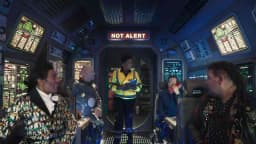
Sophie Ellis-Bextor's 'Crying at the Discotheque' music video filmed across seven empty London venues in 2020 to raise awareness of the live events industry's

Sophie Ellis-Bextor Turns Empty Venues Into a Cry for the Live Events Industry
'Crying at the Discotheque' is a 2020 UK music and public interest campaign in which Sophie Ellis-Bextor performs across seven empty London venues to raise awareness of the live events industry's lack of government support during the Covid-19 pandemic, released in November 2020 as a collaboration between the artist and the #WeMakeEvents advocacy initiative.
The campaign pairs Ellis-Bextor's cover of Alcazar's 1990s hit with a visual argument about cultural loss. Rather than staging a conventional performance video, the production deploys the emptiness of iconic spaces — Bush Hall, the Apollo Theatre, St Moritz, Clapham Grand, Heaven, Omeara, and The O2 — as its central creative device. Each venue appears not as a backdrop but as a subject: silent rooms that ordinarily sustain the livelihoods of hundreds of thousands of workers, rendered ghostly by pandemic restrictions. The result is a single piece of content that functions simultaneously as a music release and a piece of public interest advocacy, a rare structural ambition in either category.
In the United Kingdom, the campaign arrived at a moment of acute industry pressure. The #WeMakeEvents initiative, launched by PLASA in April 2020 according to PLASA's own published records, had been building pressure on the UK government to extend meaningful financial relief to the live events supply chain. Ellis-Bextor's involvement gave the movement mainstream cultural reach at a point when it needed it most. The video was released alongside 'Songs from the Kitchen Disco', her greatest hits collection, meaning the campaign served both commercial and advocacy purposes without compromising either. The Clapboard Score for this campaign is 79 out of 100, reflecting strong creative integration and cultural resonance within the constraints of a zero-budget public interest format.
 ARCHIVE
The #WeMakeEvents initiative represents a coordinated cross-industry response to the near-total collapse of the UK live events sector during 2020. According to PLASA, the organisation that launched the initiative in April 2020, the UK live events industry generated more than £70 billion annually before Covid-19 and supported more than 700,000 jobs. The same source notes that self-employed workers comprised 72 percent of the workforce as cited in UK Music research referenced by #WeMakeEvents, a figure that underscores why government furlough schemes, designed primarily for salaried employees, provided inadequate relief.
The scale of the collapse was precise and documented. According to PLASA, 93 percent of the live event supply chain experienced dramatic income decline during 2020, with 65 percent reporting a fall of more than 50 percent and 30 percent reporting a fall of more than 90 percent. Covid-19 had reduced the sector to approximately one to five percent of normal operating capacity across that year, per PLASA's published findings. The broader UK cultural events economy was estimated at approximately £100 billion per year, according to research cited by theicc.co.uk and Committees Parliament Uk records from the same period.
Within this context, the strategic rationale for attaching a mainstream pop artist to the campaign becomes clear. Competitors for public and government attention — including broader Covid-19 relief narratives and sector lobbying from the hospitality and aviation industries — commanded significant media space. #WeMakeEvents needed a cultural moment rather than another petition. Ellis-Bextor, whose Kitchen Discos during lockdown had already made her a household symbol of resilience in the United Kingdom, was uniquely positioned to carry that moment. The campaign did not need to manufacture emotional connection; the venues themselves, and the story of the people who worked in them, provided the raw material.
Sophie Muller directed 'Crying at the Discotheque', working from her long-standing creative relationship with Ellis-Bextor to shape a video that prioritises atmosphere over performance spectacle. The production was handled by PRETTYBIRD UK, with Juliette Larthe serving as co-founder and executive producer, according to reporting by Little Black Book Online. Additional creative collaborators on the production included Robbie Ryan and Lisa Laudat, as documented in production records cited by lbbonline.com.
The central creative decision — filming across all seven venues in a single day — is as much a logistical statement as an aesthetic one. Bush Hall, the Apollo Theatre, St Moritz, Clapham Grand, Heaven, Omeara, and The O2 each carry a distinct architectural and cultural character, ranging from the intimate Victorian plasterwork of Bush Hall to the arena scale of The O2. Muller's direction leans into this contrast, allowing the camera to absorb the specific texture of each space rather than homogenising them into a generic venue aesthetic. Ellis-Bextor moves through rooms that feel suspended between their past life and an uncertain future, a visual metaphor that the campaign never needs to state explicitly.
The song itself contributes structural intelligence to the concept. A Studio 54-inflected cover of Alcazar's track, it carries inherent associations with dance floors, communal joy, and the social function of nightlife — all of which the empty venues explicitly deny. The title's irony operates on multiple registers: Ellis-Bextor is literally performing in empty discotheques, and the industry she represents is figuratively weeping. This layering of meaning across song choice, location, and performance gives the campaign a density that single-concept advocacy videos rarely achieve. Production credits for the full technical crew beyond the named collaborators are not comprehensively documented in publicly available sources.
The official YouTube video for 'Crying at the Discotheque' recorded approximately 4.76 million views and 69,511 likes, according to data reported by goodlifeevents.org and lbbonline.com. These figures, accumulated without paid media amplification in the conventional advertising sense, reflect the campaign's reliance on organic reach driven by Ellis-Bextor's existing audience and the broader #WeMakeEvents community across the United Kingdom.
The campaign's structural effectiveness rests on a distribution advantage that paid campaigns cannot easily replicate. Because the video functions as a genuine music release — taken from 'Songs from the Kitchen Disco' and circulated through standard music video channels — it reached audiences who were not already engaged with the #WeMakeEvents advocacy narrative. According to inews.co.uk and clashmusic.com coverage from the period, the video generated sustained press attention as both a cultural release and a news story, effectively earning two separate cycles of media coverage from a single asset.
In the United Kingdom specifically, the campaign's timing aligned with a critical window of parliamentary debate about support for the cultural and live events sectors. The #WeMakeEvents initiative was actively presenting evidence to parliamentary committees, as documented in committees.parliament.uk records, and the video provided a human-scale illustration of the abstract employment statistics being cited in those proceedings. No formal brand lift or conversion data has been published for this campaign. Its measurable impact is best understood through the lens of advocacy — awareness generated, press cycles earned, and the degree to which it sustained public empathy for a sector that risked becoming invisible during an extended period of closure. On those terms, the evidence points to a campaign that punched well above the weight of its production scale.
'Crying at the Discotheque' is a 2020 UK music video and public interest campaign. Sophie Ellis-Bextor performs across seven empty London venues to spotlight the live events industry's Covid-19 crisis. The video was released in November 2020 alongside her greatest hits collection and produced by PRETTYBIRD UK.
Seven London venues appear in the video. They are Bush Hall, the Apollo Theatre, St Moritz, Clapham Grand, Heaven, Omeara, and The O2. According to lbbonline.com, all seven locations were filmed in a single day, amplifying the logistical statement the campaign was making about venues standing empty.
Sophie Muller directed the video. Muller is a long-term creative collaborator of Ellis-Bextor. The production was handled by PRETTYBIRD UK, with Juliette Larthe as executive producer, according to lbbonline.com. Additional collaborators included Robbie Ryan and Lisa Laudat.
#WeMakeEvents is a cross-industry advocacy initiative launched by PLASA in April 2020 to seek government support for the UK live events supply chain. According to PLASA, 93 percent of the supply chain experienced dramatic income decline during Covid-19. Ellis-Bextor provided the initiative with mainstream cultural reach at a critical moment.
The official YouTube video recorded approximately 4.76 million views and 69,511 likes, according to data reported by goodlifeevents.org and lbbonline.com. These figures were achieved through organic distribution, as the video functioned simultaneously as a music release and a public interest campaign without conventional paid media support.
The UK live events industry had been reduced to approximately one to five percent of normal operating capacity by Covid-19 in 2020, according to PLASA. The sector had previously generated more than £70 billion annually and supported more than 700,000 jobs, with 72 percent of workers self-employed, per UK Music research cited by #WeMakeEvents.
.webp)
Creative Collaboration Platform: The Backbone of Modern Creative WorkWhat is a creative collaboration platform?Clapboard defines a creative collaboration platform as the operational core for today’s distributed creative teams. This is not a collection of digital collaboration tools stitched together; Clapboard’s system


Understanding the Creative Production MarketplaceWhat is a Creative Production Marketplace?Clapboard defines a creative production marketplace as a structured ecosystem where brands, agencies, and production talent converge to execute video, advertising, and branded content at scale. Unlike the legacy agency or freelanREAD FULL ARTICLE

The Urgent Need for a Creative Production Operating SystemWhy Traditional Creative Production Models Break DownClapboard sees the creative production landscape shifting under pressure. Content velocity is no longer a buzzword—it’s a mandate. Modern advertising demands relentless output across dozens of channels, each wREAD FULL ARTICLE