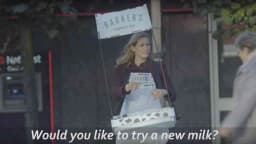
Overly partnered with IR magazine to launch an augmented reality OOH campaign in Latvia that revealed politicians' unfulfilled promises behind their own

How Overly Used Augmented Reality to Hack Political Posters in Latvia
Overly's Augmented Reality Political Campaign is a May 2017 Latvian public interest initiative that used a mobile augmented reality app to overlay factual information about politicians directly onto their own out-of-home advertising posters, giving voters access to records and unfulfilled promises that candidates would never voluntarily publish.
The campaign was created in partnership with IR magazine, a Latvian current-affairs publication that sought an unconventional way to reach voters at the exact moment they encountered political advertising. IR magazine recognised a structural imbalance: political parties command enormous out-of-home advertising budgets during election cycles, while independent editorial outlets operate with a fraction of that visibility. Rather than compete for physical space, the campaign chose to inhabit the space political parties had already paid for. Using the Overly augmented reality platform, anyone with a smartphone could point the app at a political poster displayed across Latvia and immediately see animated content, factual records about parties and politicians, links to IR magazine articles, and election-related statistical information layered over the original image.
The geographic market was Latvia, a parliamentary democracy in the Baltic region where political advertising saturates the urban outdoor environment in the months preceding elections. The campaign launched in May 2017 and was classified within the OOH outdoor medium and the public interest category. Overly, the Latvian augmented-reality startup that served as both client and technology partner, had been developing its own AR platform since its founding in Riga in 2014, according to overlyapp.com. The campaign represents one of the earliest documented deployments of augmented reality technology within a political public service context in the Baltic states, earning a Clapboard Score of 73 out of 100.
IR magazine identified a specific and recurring problem in Latvian democratic life. Political advertising in Latvia, as in most parliamentary democracies, functions as a controlled message environment where parties present curated identities with no obligation to disclose voting records, broken commitments, or undisclosed affiliations. The 2017 campaign was designed to correct that asymmetry at the point of contact between voter and poster.
The strategic insight was spatial rather than purely editorial. Voters encounter political out-of-home advertising in streets, transit stations, and public squares — environments where they rarely hold a newspaper or visit a website. By embedding a layer of documentary journalism inside the poster itself through augmented reality, IR magazine effectively converted its editorial research into an ambient, always-available resource. The campaign did not ask voters to seek out information; it placed the information precisely where political messaging already existed.
The competitive context sharpens this logic considerably. Mainstream political parties in Latvia routinely outspend independent media on outdoor advertising during campaign periods. According to the Office for Democratic Institutions and Human Rights of the OSCE, political advertising regulations and campaign finance transparency remain ongoing areas of focus across Baltic democracies. In that environment, a tool that allows citizens to annotate official political advertising with independently sourced facts represents a structurally adversarial but entirely legal form of counter-messaging. Comparable initiatives in other markets — such as fact-checking overlays developed by transparency organisations — have pursued similar goals through social media, but none had previously embedded the intervention directly into the physical OOH medium using augmented reality at the moment this campaign launched in Latvia in 2017.
Overly built its augmented reality platform in 2014 specifically so that clients would not need to develop separate bespoke applications for each project, according to overlyapp.com. That foundational technical decision made the 2017 political campaign operationally feasible at a public interest scale: voters in Latvia could download a single app and use it across multiple political posters without any additional configuration.
The creative execution combined the disciplines of documentary journalism and interactive design. When a user pointed the Overly app at a targeted political poster anywhere in Latvia, the application triggered an animated augmented reality layer that presented factual information drawn from IR magazine's editorial research. This layer included politicians' recorded deeds, unfulfilled promises, and connections that candidates had not disclosed in their advertising, as well as direct links to corresponding IR magazine articles and election-related statistical data. The effect was designed to feel revelatory — the poster remained visible beneath the overlay, so the contrast between the politician's self-presentation and the factual record was immediately apparent to the viewer.
The campaign's single documented media asset functions as both a product demonstration and a piece of documentary communication, showing the augmented reality layer activating over real political out-of-home material in Latvia. Production credits for the Augmented Reality Political Campaign are not publicly documented beyond Overly's role as the AR technology and platform partner and IR magazine's role as the editorial and commissioning organisation. The creative framework itself — using a publicly available AR app to annotate political advertising with journalistic content — required tight coordination between editorial fact-checking and interaction design, ensuring that every overlay connected to a verifiable source rather than opinion.
No verified performance data for the Augmented Reality Political Campaign is publicly available in terms of app downloads, poster scans, or audience reach figures attributable to named sources. An analysis of the campaign's structural effectiveness, however, reveals several durable strengths that justify its Clapboard Score of 73 out of 100.
The campaign's primary mechanism — converting an opponent's paid media into a vehicle for counter-information — is architecturally efficient. IR magazine incurred no outdoor advertising costs while achieving presence at every political poster location across Latvia where the Overly app was deployed. The earned media potential of the concept, a journalistic tool that literally hacks political advertising, is high relative to its production footprint.
The campaign also demonstrated meaningful category leadership. According to virtualrealitymarketing.com, Overly was among the early AR platform companies to apply augmented reality technology to civic and public interest use cases rather than purely commercial applications. In the context of Latvia's 2017 political environment, where, according to the OSCE's Office for Democratic Institutions and Human Rights, campaign finance transparency and political advertising disclosure remained live regulatory concerns, the campaign addressed a documented civic gap with a technically novel solution. The documentary character of the content — grounded in IR magazine's editorial record rather than advocacy — lent the campaign credibility that a purely activist intervention would not have carried. Its limitation, structurally, was dependence on voluntary app adoption: voters had to know the app existed and choose to download it before any poster scan could occur, creating a discovery barrier that the campaign's single media asset alone could not fully overcome.
Overly's Augmented Reality Political Campaign was a May 2017 public interest initiative in Latvia. Created in partnership with IR magazine, it used Overly's AR app to let voters scan political out-of-home posters and reveal politicians' voting records, unfulfilled promises, and undisclosed connections layered directly over the original advertising.
IR magazine commissioned the campaign, partnering with Latvian AR startup Overly as the technology provider. IR magazine sought to give Latvian voters access to factual political information that parties would never voluntarily include on their own posters, using augmented reality to reach voters at the moment of contact with political advertising.
Voters downloaded the Overly augmented reality app and pointed it at political posters displayed across Latvia. The app recognised the poster and activated an animated overlay showing politicians' records, unfulfilled promises, statistical data, and direct links to IR magazine articles, all layered visibly over the original out-of-home advertisement.
Most political fact-checking operates on social media or dedicated websites, requiring voters to seek out information separately. Overly's 2017 campaign embedded documentary journalism directly into the physical OOH medium itself, activating through augmented reality at the precise location where political advertising already existed across Latvia.
Overly is a Latvian augmented reality company founded in Riga in 2014 by Ainārs Kļaviņš and Gatis Zvejnieks, according to overlyapp.com. The company built its own AR platform from the outset so clients could deploy augmented reality experiences without developing separate bespoke applications, making civic campaigns like the 2017 political initiative operationally scalable.
No verified award records for the Overly Augmented Reality Political Campaign are publicly available from named sources at this time. The campaign earned a Clapboard Score of 73 out of 100, reflecting strong conceptual originality and civic relevance within the public interest category, alongside structural limitations around voluntary app adoption as a distribution dependency.
.webp)
Creative Collaboration Platform: The Backbone of Modern Creative WorkWhat is a creative collaboration platform?Clapboard defines a creative collaboration platform as the operational core for today’s distributed creative teams. This is not a collection of digital collaboration tools stitched together; Clapboard’s system


Understanding the Creative Production MarketplaceWhat is a Creative Production Marketplace?Clapboard defines a creative production marketplace as a structured ecosystem where brands, agencies, and production talent converge to execute video, advertising, and branded content at scale. Unlike the legacy agency or freelanREAD FULL ARTICLE

The Urgent Need for a Creative Production Operating SystemWhy Traditional Creative Production Models Break DownClapboard sees the creative production landscape shifting under pressure. Content velocity is no longer a buzzword—it’s a mandate. Modern advertising demands relentless output across dozens of channels, each wREAD FULL ARTICLE