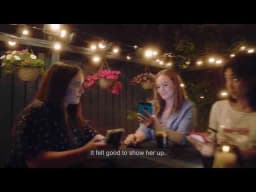
Amnesty International's Through the Eyes of a Refugee, created by TBWA in the Netherlands in 2018, used hypnosis to simulate a Syrian refugee's displacement

Amnesty International Puts Dutch Audiences Inside a Refugee's Journey
Through the Eyes of a Refugee is a 2018 public interest film created by TBWA/Neboko for Amnesty International in the Netherlands, in which five participants from the Netherlands and Belgium underwent professional guided hypnosis to experience a dramatised version of a real Syrian refugee's journey from war to safety.
Published in January 2018 and archived on Clapboard as a single film asset, the campaign centres on Marwa, a 29-year-old Syrian woman whose home was struck by a missile in April 2015, killing her brother and sister. Her story becomes the experiential script. A professional hypnotherapist guides each participant through an emotionally immersive simulation of displacement — replicating, as closely as a psychological method allows, the fear, disorientation, and grief of forced migration. The resulting film, running approximately five minutes and thirty-three seconds according to adruby.com, documents their visible emotional responses and subsequent reflections.
The campaign's geographic anchor is the Netherlands, where Amnesty Netherlands had identified growing public distance from the humanitarian realities facing migrants and refugees. In the Netherlands and across the broader European context, the challenge for public interest organisations in 2018 was not a shortage of information about the refugee crisis but a deficit of felt understanding. Through the Eyes of a Refugee was designed to close that gap — not through statistics or testimony delivered at arm's length, but through direct, bodily experience of another person's story. The campaign earned a Clapboard Score of 82 out of 100, reflecting its structural ambition, creative originality, and the measurable industry recognition it received upon release.
Amnesty International identified a specific strategic problem in the Netherlands. According to Amnesty Nl, Dutch public attitudes toward refugees and migrants had become increasingly detached from the lived realities of displacement, despite sustained media coverage of the Syrian conflict and European migration flows. The organisation needed not an informational campaign but an experiential one — something that could shift perception at the level of felt emotion rather than rational argument.
TBWA/Neboko's strategic response drew on a well-documented psychological principle: perspective-taking at depth produces greater empathic response than narrative exposure alone. By using professional hypnosis rather than conventional documentary interview or dramatisation, the agency moved participants from observers to, in effect, temporary inhabitants of Marwa's experience. According to thecreativesroom.com, the campaign's strategic focus was explicitly on refugee displacement and the use of experiential film to generate public empathy, departing from the sector's established reliance on informational appeals.
The competitive landscape for public interest communication in the Netherlands in 2018 included organisations such as Médecins Sans Frontières and UNHCR Netherlands, both of which had pursued more traditional film-and-testimony approaches to refugee advocacy in the same period. TBWA's decision to employ hypnosis as a production mechanism distinguished Through the Eyes of a Refugee structurally from those approaches, repositioning Amnesty International not as a narrator of crisis but as a facilitator of direct emotional access. According to Campaign Asia, this experiential orientation reflected a broader shift in social and influencer communication strategy — a shift that Cannes Lions formally recognised by listing the campaign under both its Social and Influencer Lions and its Sustainable Development Goals Lions categories in 2018.
Through the Eyes of a Refugee is built around a single, sustained creative mechanism: professional hypnosis as both production method and storytelling device. A certified hypnotherapist conducted individual sessions with five participants recruited from the Netherlands and Belgium, guiding each through a dramatised reconstruction of Marwa's journey from Syria, according to adruby.com. The film then captures what that process produces — involuntary emotional responses, visible distress, and the articulate, often raw reflections participants offer when they emerge.
The documentary format is deliberate. Rather than recreating the refugee experience through actors or archival imagery — approaches used widely by comparable organisations in the same period — TBWA/Neboko chose to film the act of experiencing. The camera observes real people, in real time, responding to an imagined but emotionally truthful version of Marwa's displacement. According to adruby.com, Marwa herself is a verifiable figure: a 29-year-old Syrian woman whose brother and sister were killed when their home was hit by a missile in April 2015. Her specificity is what makes the hypnotic script credible and what transforms participant reactions from performance into testimony.
The finished film runs approximately five minutes and thirty-three seconds, according to adruby.com, a duration that defies standard digital advertising convention and signals that the campaign was conceived for engaged, voluntary viewing rather than passive exposure. Production credits for Through the Eyes of a Refugee are not publicly documented in full, though the campaign was produced by TBWA/Neboko in the Netherlands. The film was uploaded on 24 January 2018, according to adruby.com, and constitutes the campaign's sole media asset — a single work asked to carry the entire communicative and emotional weight of Amnesty International's refugee advocacy in the Dutch market.
Through the Eyes of a Refugee received two Cannes Lions recognitions in 2018. According to available sourcing, the campaign was listed under the Social and Influencer Lions category and the Sustainable Development Goals Lions category at Cannes Lions 2018. The specific award level — whether gold, silver, bronze, or shortlist — is not identified in publicly available sources. Cannes Lions remains the advertising industry's most widely cited benchmark for creative effectiveness, and recognition across two distinct categories reflects the campaign's ability to function simultaneously as a social communication strategy and as a contribution to the United Nations' Sustainable Development Goals framework.
No independently verified audience reach, petition volume, or conversion data for Through the Eyes of a Refugee is publicly available beyond the Cannes Lions recognitions noted above. What the structural evidence does support is a campaign engineered for depth of impact over breadth of distribution. A single five-minute-plus film asset, a subject drawn from a real and documented refugee case, and a production method — hypnosis — that generates genuine rather than performed emotional response: each of these choices prioritises quality of engagement over scale of impression. According to The One Club's documentation of award-recognised public interest work, campaigns that combine authentic subject matter with formally innovative execution tend to generate sustained earned media coverage beyond their initial release window, extending effective reach without additional paid distribution. The campaign's Clapboard Score of 82 out of 100 reflects its creative originality, its dual Cannes Lions recognition, and its structural commitment to empathy as a measurable creative outcome.
Through the Eyes of a Refugee is a 2018 public interest film produced by TBWA/Neboko for Amnesty International in the Netherlands. Five participants from the Netherlands and Belgium underwent professional guided hypnosis to experience a dramatised version of Marwa's journey from Syria, generating visible emotional responses captured on film as a single media asset.
TBWA/Neboko created Through the Eyes of a Refugee for Amnesty International. The film was released in the Netherlands in January 2018, with the upload date recorded as 24 January 2018 according to adruby.com. It was associated with Cannes Lions 2018 recognition across two separate award categories.
Marwa is a 29-year-old Syrian refugee whose home was struck by a missile in April 2015, killing her brother and sister, according to adruby.com. Her specific, documented story formed the script for the hypnosis sessions that participants in the Netherlands and Belgium underwent during production of the film.
Through the Eyes of a Refugee received two Cannes Lions recognitions in 2018, listed under the Social and Influencer Lions and the Sustainable Development Goals Lions categories. The specific award level is not identified in publicly available sources. Both recognitions are documented in Clapboard's archive of the campaign.
TBWA/Neboko used hypnosis to move participants from passive observers to active experiencers of displacement. According to thecreativesroom.com, the campaign's strategic focus was on generating public empathy through experiential film rather than conventional informational appeal, addressing growing public detachment from the refugee crisis in the Netherlands.
Through the Eyes of a Refugee holds a Clapboard Score of 82 out of 100. The score reflects the campaign's creative originality, its dual Cannes Lions recognition in 2018, and its structural commitment to depth of emotional engagement over conventional advertising formats, as assessed by Clapboard's editorial team.
.webp)
Creative Collaboration Platform: The Backbone of Modern Creative WorkWhat is a creative collaboration platform?Clapboard defines a creative collaboration platform as the operational core for today’s distributed creative teams. This is not a collection of digital collaboration tools stitched together; Clapboard’s system


Understanding the Creative Production MarketplaceWhat is a Creative Production Marketplace?Clapboard defines a creative production marketplace as a structured ecosystem where brands, agencies, and production talent converge to execute video, advertising, and branded content at scale. Unlike the legacy agency or freelanREAD FULL ARTICLE

The Urgent Need for a Creative Production Operating SystemWhy Traditional Creative Production Models Break DownClapboard sees the creative production landscape shifting under pressure. Content velocity is no longer a buzzword—it’s a mandate. Modern advertising demands relentless output across dozens of channels, each wREAD FULL ARTICLE