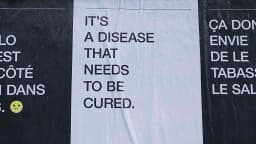
Ontario Government's 'The Risk' campaign, created by Rethink in May 2019, uses Rowan Stringer's story and a dual-brain stop-sign identity to drive concussion

How Ontario Government Used Rowan's Law to Reframe Concussion Risk in Sport
The Ontario Government's 'The Risk' is an integrated public interest campaign created by agency Rethink, published in Canada in May 2019, designed to drive awareness of Rowan's Law and its concussion protocol requirements among athletes, coaches, parents, and schools across the province.
The campaign takes its name and its moral weight from Rowan Stringer, a 17-year-old high-school rugby player from Ottawa who died after sustaining multiple concussions during matches in 2013. Her death prompted a sustained legislative response in Ontario, ultimately producing Rowan's Law — concussion legislation that mandates awareness resources and return-to-sport protocols for amateur athletes. 'The Risk' was created to give that legislation a public face and a memorable behavioural instruction at the moment the Ontario Government launched both the campaign and a new dedicated web portal at Ontario Ca/concussions, as reported by Files Ontario Ca.
The campaign operates across an integrated medium and comprises two primary creative elements. The first is a 30-second cinema film built around the emotional facts of Rowan Stringer's story. The second is a modular visual identity — a Rowan's Law logo that fuses a stop symbol with the two hemispheres of a human brain — designed for placement on amateur-sports uniforms and coaching materials so that the concussion protocol travels with athletes into the environments where head injuries most commonly occur. Together, these elements serve a single, urgent call to action distilled by Rethink Creative Director Christina Yu into three words: Hit. Stop. Sit. The campaign earned a Clapboard Score of 63 out of 100, reflecting its clear strategic purpose and strong creative concept against the inherent measurement challenges of a public-interest communications effort with a single media asset submitted to the archive.
Rowan's Law represents the legislative context that made this campaign both necessary and urgent. Ontario enacted concussion legislation named in Rowan Stringer's honour, creating a legal framework that required accompanying public communications to reach amateur sporting communities across Canada's most populous province. The strategic task Rethink faced was translating a compliance requirement into a genuinely felt behavioural change — persuading coaches and parents, not just informing them.
The creative strategy centres on a documented human tragedy rather than on abstract medical statistics, a choice that reflects a well-established principle in public health communications: identified individuals generate greater empathetic response than statistical representations of risk. By placing Rowan Stringer's name and story at the centre of a concussion awareness campaign, the Ontario Government and Rethink ensured that the protocol — the instruction to remove an athlete from play after any suspected head impact — carried emotional consequence rather than bureaucratic neutrality. Christina Yu, Creative Director at Rethink, stated that the goal was for viewers to come away thinking they need to protect athletes more and to take any head injury seriously, as quoted by adsoftheworld.com.
In Canada, the Government of Canada reported total advertising expenditures of approximately 58.60 million dollars in 2018–19, with media expenditures of approximately 43.04 million dollars, of which 53 percent was directed to digital channels, according to Publications Gc Ca. At the provincial level, the Ontario Government spent approximately 12.55 million dollars producing and running advertising items in 2018–19, according to files.ontario.ca. Within that context, 'The Risk' represents a targeted, issue-specific deployment focused on concussion signs and sports safety rather than broad government brand communications. The campaign does not operate in a traditional commercial competitive frame; however, comparable public-interest campaigns addressing youth sports safety — including those produced by organisations such as Parachute Canada and the Canadian Concussion Centre — occupy adjacent awareness territory and set a benchmark for emotional resonance in this category.
Rethink built 'The Risk' around two formally distinct but thematically unified creative outputs: a short film and a designed identity system. The 30-second cinema film uses Rowan Stringer's story as its narrative engine, presenting the stakes of ignoring concussion signs in the compressed, high-attention environment of pre-film advertising — a placement chosen for its captive audience and cultural association with storytelling rather than interruption.
The identity system is the more structurally ambitious element. The Rowan's Law logo merges a stop symbol — universally legible across languages and literacy levels — with the bilateral anatomy of the human brain. This dual-reading device operates simultaneously as a safety instruction and a medical reference, making the concussion protocol immediately decodable in a gymnasium, on a pitch, or printed on a jersey without accompanying text. The decision to design the logo for application on amateur-sports uniforms is a significant strategic-creative choice: it relocates the concussion awareness message from a media environment into a physical sporting environment, placing the instruction precisely where a coach or parent needs to recall it.
The campaign credits, as documented by clapboard.com and adsoftheworld.com, include Creative Directors Christina Yu, Mike Dubrick, and Aaron Starkman; Art Director Zachary Bautista; and Writer Andrew Chhour, all at Rethink. The client was the Ontario Government, specifically the Ontario Ministry of Tourism, Culture and Sport. The concentration of senior creative leadership — three credited Creative Directors on a single public-interest campaign — suggests that the Ontario Government brief was treated with the same creative ambition Rethink applies to commercial accounts, reinforcing the campaign's positioning as a work of genuine craft rather than institutional compliance communication.
 ARCHIVE
No verified performance data for 'The Risk' campaign is publicly available. No audited reach figures, recall scores, or behavioural-change metrics have been published by the Ontario Government or Rethink in sources accessible to this analysis. This is not unusual for government public-interest campaigns in Canada, where outcome measurement is rarely disclosed at the campaign level through public channels.
Structural analysis, however, supports a positive assessment of the campaign's probable effectiveness. The three-word behavioural prompt — Hit. Stop. Sit. — satisfies core principles of public health communication: it is sequential, action-oriented, and free of jargon, making it usable in the high-stress, time-compressed moment of a sporting incident. The identity system's placement logic — on uniforms and coaching materials rather than solely in paid media — extends the campaign's reach into zero-media-cost environments and increases the likelihood of message exposure at the precise point of behavioural relevance.
The cinema film format creates conditions for undivided attention during the emotional narrative about Rowan Stringer, which strengthens message encoding among the parent and coach demographic most likely to attend films with family-oriented programming. The campaign's integration of legislation, identity, film, and a dedicated digital portal at Ontario.ca/concussions — as reported by files.ontario.ca — represents a coherent multi-touchpoint architecture for a public-safety communication challenge. The Clapboard Score of 63 out of 100 reflects this structural soundness while acknowledging the campaign's single-asset submission profile and the absence of documented outcomes against the concussion protocol adoption targets the Ontario Government set when Rowan's Law came into force.
'The Risk' is a concussion awareness campaign created by Rethink for the Ontario Government in May 2019. It supports Rowan's Law, Ontario's concussion protocol legislation, using Rowan Stringer's story and a three-word call to action — Hit. Stop. Sit. — to prompt immediate protective behaviour among athletes, coaches, and parents across Canada.
Rowan Stringer was a 17-year-old high-school rugby player from Ontario who died after sustaining multiple concussions during matches. Her death prompted Ontario's concussion legislation, named Rowan's Law in her honour. The Ontario Government's 'The Risk' campaign places her story at the centre of its concussion awareness and sports safety communications effort.
Rethink created 'The Risk' for the Ontario Government, specifically the Ontario Ministry of Tourism, Culture and Sport. The campaign team included Creative Directors Christina Yu, Mike Dubrick, and Aaron Starkman, Art Director Zachary Bautista, and Writer Andrew Chhour, making it a senior-led integrated creative effort across film and identity design.
The Rowan's Law logo merges a stop symbol with the two hemispheres of the human brain. Designed for application on amateur-sports uniforms and coaching materials, it communicates the concussion protocol — remove a player after any suspected head impact — without requiring text, making it immediately legible in live sporting environments across Ontario.
'The Risk' holds a Clapboard Score of 63 out of 100. The score recognises the campaign's clear strategic purpose in supporting Rowan's Law concussion legislation and its strong dual-format creative execution, while reflecting the absence of publicly verified performance outcomes and its single-asset submission profile in the Clapboard archive.
The Ontario Government launched a dedicated concussion web portal at Ontario.ca/concussions alongside 'The Risk' campaign in May 2019, as reported by files.ontario.ca. The portal supports Rowan's Law by providing concussion signs information, return-to-sport protocols, and awareness resources for athletes, parents, coaches, and schools across the province.
.webp)
Creative Collaboration Platform: The Backbone of Modern Creative WorkWhat is a creative collaboration platform?Clapboard defines a creative collaboration platform as the operational core for today’s distributed creative teams. This is not a collection of digital collaboration tools stitched together; Clapboard’s system


Understanding the Creative Production MarketplaceWhat is a Creative Production Marketplace?Clapboard defines a creative production marketplace as a structured ecosystem where brands, agencies, and production talent converge to execute video, advertising, and branded content at scale. Unlike the legacy agency or freelanREAD FULL ARTICLE

The Urgent Need for a Creative Production Operating SystemWhy Traditional Creative Production Models Break DownClapboard sees the creative production landscape shifting under pressure. Content velocity is no longer a buzzword—it’s a mandate. Modern advertising demands relentless output across dozens of channels, each wREAD FULL ARTICLE