 ARCHIVE
Chinese New Year secret envelope - NBA | Clapboard Ad Archive
NBA’s Chinese New Year Secret Envelope campaign, launched in the United States in 2017 and...
Nike Turns Hongbao Etiquette Into a Two-Decade Sprint
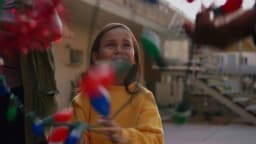
Nike's "Lunar New Year: The Great Chase" is a 90-second film created by Wieden+Kennedy Shanghai that dramatises the Chinese cultural tradition of hongbao gifting — where elders present red envelopes of money to younger relatives — as a physical, multigenerational chase between a young girl and her aunt across approximately two decades.
Published in January 2025 in the United States market, the film marks Nike's first Chinese New Year campaign of this scale to be distributed through its global channels. The campaign centres on a single, universally legible premise rooted in Chinese culture: when a red envelope is offered, courtesy demands the recipient decline before eventually accepting. Wieden+Kennedy Shanghai took that social ritual — the polite refusal, the insistent pursuit — and translated it into sustained athletic movement, the grammar Nike speaks most fluently. The result is a narrative that begins in childhood and accelerates across years, each exchange raising the physical and comedic stakes until the tradition itself becomes a relay of love, stubbornness, and endurance.
In the United States, where an estimated nearly five million people identify as Chinese American, according to the United States Census Bureau, cultural fluency campaigns like this occupy a strategically significant space. Nike positions the film not as a niche cultural insert but as a story of family persistence told through sport — a framing that allows the work to travel across audiences while remaining anchored in the specific emotional logic of traditional gifting. The Clapboard Score for "The Great Chase" is 82 out of 100, reflecting strong creative coherence and cultural specificity.
Nike's strategic logic for "The Great Chase" rests on a precise reading of how Chinese American consumers experience Lunar New Year in the United States. The hongbao tradition — the exchange of red envelopes as a ritual of respect and intergenerational connection — is practised by Chinese communities across the US market and carries emotional weight that generic sports advertising cannot replicate. By grounding the campaign in the specific etiquette of declining and accepting gifts, Wieden+Kennedy Shanghai signals to Chinese American audiences that the brand understands the texture of their cultural life, not merely its calendar dates.
The competitive context sharpens this choice. Adidas, Nike's closest global rival in sports footwear, has also pursued Lunar New Year activations in recent years, as has Li-Ning, the Chinese sportswear brand that has grown its international visibility through cultural positioning. For Nike, differentiation through storytelling craft — rather than product feature emphasis — is consistent with its broader brand architecture. Nike reported 46.3 billion dollars in fiscal 2025 revenue, down ten percent year over year, according to Nike's own financial disclosures. In Greater China specifically, Nike revenue declined seventeen percent year over year to 1.73 billion dollars in fiscal Q3 2025, according to Business of Fashion. That commercial pressure makes culturally resonant work in Chinese communities — both in Greater China and across the US market — strategically urgent rather than merely opportunistic.
The global athletic footwear market is estimated at 130.1 billion dollars in 2025 with a projected compound annual growth rate of 4.9 percent through 2035, according to Ken Research. Within that landscape, Nike holds approximately 27.3 percent of global sports-footwear revenue in 2025, according to Straits Research. Maintaining that share requires campaigns that speak to specific communities with genuine fluency, and "The Great Chase" is built precisely for that purpose.
"The Great Chase" earns its emotional range through disciplined compression. Wieden+Kennedy Shanghai constructs a two-decade narrative inside 90 seconds without resorting to title cards or expository dialogue, relying instead on costume, setting, and the physical vocabulary of pursuit to mark the passage of time. The film opens in childhood and accelerates through adolescence and adulthood, with each new sequence raising the choreographic complexity of the chase while deepening the emotional stakes between the girl and her aunt.
The creative decision to stage the hongbao ritual as sustained athletic movement is the campaign's central formal invention. Red envelope gifting, in its actual practice, is brief and largely stationary — a moment of exchange at a family gathering. By expanding that moment into a chase across playgrounds, streets, and domestic interiors spanning roughly two decades, Wieden+Kennedy Shanghai finds the Nike-native language for a tradition the brand has no organic claim to. Movement becomes the bridge between Chinese cultural specificity and the brand's universal identity proposition. The film was described by Muse by Clio as action-packed, with an emphasis on family, cultural tradition, persistence, and humor.
Production credits for "Lunar New Year: The Great Chase" are not publicly documented in detail across available sources. What is evident from the film itself is a deliberate approach to period costuming, location staging, and performance direction that sustains tonal coherence from the comedic physical sequences to the film's more quietly emotional closing moments. The Nike running shoes worn by the young protagonist throughout serve as a thread of visual continuity — present across decades without being foregrounded as product. That restraint is a craft choice as much as a brand strategy, allowing the hongbao tradition and the relationship it carries to remain the narrative's centre of gravity.
No verified campaign-specific performance data for "Lunar New Year: The Great Chase" is publicly available. No sales lift, revenue attribution, market-share movement, or brand-tracking results attributable specifically to this film have been reported by Nike or independently verified through sources including Business of Fashion, Daxu Consulting, or WARC. Similarly, no awards have been documented for this campaign at Cannes Lions, the Effies, The One Show, D&AD, the Clios, the Webby Awards, or WARC Awards as of the time of writing.
Structural analysis supports a favourable effectiveness read regardless. The film's 90-second runtime is long enough to build genuine emotional investment while remaining viable for digital distribution across YouTube and social platforms — the primary channels through which Nike reaches diaspora communities in the United States. The campaign's mechanism, translating a universally recognised Chinese New Year tradition into the physical grammar of Nike's brand world, creates natural shareability among Chinese American audiences for whom the hongbao dynamic carries personal resonance. PMG has noted the growing strategic importance of culturally specific campaigns for reaching Chinese American consumers in the US market, a trend that contextualises the structural logic of this work.
Nike's broader commercial pressures in 2025 — including the seventeen percent Greater China revenue decline reported by Business of Fashion — make the long-term brand-equity function of campaigns like this more consequential than any single-quarter metric. "The Great Chase" operates as evidence of cultural seriousness directed at a community that has multiple competitive options in the sportswear category. The Clapboard Score of 82 out of 100 reflects that coherence.
"The Great Chase" is a 90-second Nike film created by Wieden+Kennedy Shanghai that dramatises the Chinese New Year hongbao tradition as a multigenerational physical chase between a young girl and her aunt. Published in January 2025 in the United States, the campaign translates traditional red envelope gifting etiquette into athletic movement across two decades.
Wieden+Kennedy Shanghai created "The Great Chase" for Nike. The agency translated the Chinese cultural ritual of hongbao gifting — where courtesy requires recipients to decline before accepting — into a sustained chase narrative spanning approximately two decades of a young girl's life and her relationship with her aunt.
A hongbao is a red envelope containing a monetary gift, central to Lunar New Year tradition across Chinese communities worldwide, including in the United States. Nike and Wieden+Kennedy Shanghai use the hongbao's built-in social dynamic — polite refusal followed by insistent giving — as the engine of the film's physical comedy and emotional narrative.
The film was published in the United States in January 2025. Nike distributed the campaign through its digital channels, including YouTube, targeting both Chinese American audiences familiar with hongbao traditions and broader US audiences for whom the family dynamic and athletic storytelling carry cross-cultural appeal.
No awards for "The Great Chase" have been verified at Cannes Lions, the Effies, The One Show, D&AD, the Clios, the Webby Awards, or WARC Awards as of the time of writing. The campaign earned a Clapboard Score of 82 out of 100, reflecting strong creative coherence and genuine cultural specificity in its execution.
"The Great Chase" is Nike's first Chinese New Year campaign at this scale distributed through global channels, according to available records. It arrives as Nike faces significant revenue pressure in Greater China, with a seventeen percent year-over-year decline reported by Business of Fashion, making culturally specific storytelling directed at Chinese communities strategically important to the brand's position.
.webp)
Creative Collaboration Platform: The Backbone of Modern Creative WorkWhat is a creative collaboration platform?Clapboard defines a creative collaboration platform as the operational core for today’s distributed creative teams. This is not a collection of digital collaboration tools stitched together; Clapboard’s system


Understanding the Creative Production MarketplaceWhat is a Creative Production Marketplace?Clapboard defines a creative production marketplace as a structured ecosystem where brands, agencies, and production talent converge to execute video, advertising, and branded content at scale. Unlike the legacy agency or freelanREAD FULL ARTICLE

The Urgent Need for a Creative Production Operating SystemWhy Traditional Creative Production Models Break DownClapboard sees the creative production landscape shifting under pressure. Content velocity is no longer a buzzword—it’s a mandate. Modern advertising demands relentless output across dozens of channels, each wREAD FULL ARTICLE