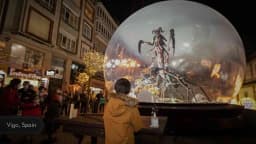
Impulse and 5SEIS deployed an augmented reality installation at Alto Palermo Shopping, Buenos Aires, in October 2012, placing virtual gifts in the hands of

Impulse Turns Augmented Reality Into a Gift-Giving Spectacle in Buenos Aires
Impulse's "Augmented Reality" activation is an ambient interactive installation produced by Buenos Aires agency 5SEIS for Unilever's Impulse personal-care brand, deployed at Alto Palermo Shopping in Buenos Aires, Argentina, across two consecutive weekends in October 2012, inviting women to interact with virtual characters, receive digital gifts, and capture the experience through photos and videos in real time.
The activation ran on Friday 12 and Saturday 13 October 2012, with a scheduled repeat on 19 and 20 October 2012, each day between 4:00 p.m. and 8:00 p.m., according to LatinSpots. The installation centred on an LED screen measuring over four metres in width, through which participants could see themselves alongside virtual characters rendered in augmented reality. Hundreds of participants received virtual gifts, flowers, and balloons of varied sizes and colours as part of the experience. Those interactions could be photographed or recorded, giving the moment a shareable, social dimension that extended the campaign's reach well beyond the shopping centre floor.
In Argentina, where high-footfall retail environments had become important arenas for experiential brand contact, placing an AR installation inside one of Buenos Aires's most prominent malls represented a calculated choice of venue. The campaign was created under the creative direction of Pablo Saquero and Gabriel Aufgang at 5SEIS, with production handled by Corina Iannone and Ariel Serra, as documented in agency records. Its classification within the health industry reflects Impulse's positioning as a personal-care and beauty brand operating under Unilever's broader consumer health and hygiene portfolio. The work was announced publicly on 16 October 2012, per LatinSpots, placing its media debut midway through the activation's run. A Clapboard Score of 61 out of 100 situates the campaign as competent and culturally coherent, if not transformative in its technical ambition.

Impulse has sustained a brand identity built on romantic attention, flirtation, and gifting across its global communications for decades. The 2012 augmented reality activation retained those codes entirely, translating the fantasy of a stranger offering flowers into a live, embodied encounter mediated by technology rather than television narrative. The strategic logic was direct: if the brand promise is that wearing Impulse attracts gifts and admiration, then an installation that physically delivers that experience — however virtually — closes the gap between claim and sensation.
The competitive context in Argentina gave that strategy additional weight. Unilever held a reported sixty-one percent value share of Argentina's deodorant market in 2013, according to Es Scribd, with Rexona and Axe serving as its leading deodorant-spray brands in the market. Competing labels including Rexona, Dove, Nivea, and Axe were identified as principal brands contesting the same consumer territory, per bonafideresearch.com. Within that portfolio dynamic, Impulse occupied a femininity-forward niche distinct from the male-skewing Axe, making differentiated experiential marketing a sensible mechanism for maintaining salience among Argentine women without directly cannibalising adjacent Unilever lines.
Argentina's personal-care category showed strong nominal growth during this period. The country's deodorant and antiperspirant market reached an estimated value of US $1.9 billion in 2014, according to es.scribd.com, though reported value growth of thirty-two percent in 2013 and thirty-nine percent in 2014 was driven primarily by inflation rather than unit expansion, with volume growth running at approximately two to three percent over the same period, per bonafideresearch.com. In that inflationary environment, sustaining brand preference rather than simply capturing volume made emotional and experiential brand-building especially relevant. The Alto Palermo site selection reinforced the strategy: a premium Buenos Aires shopping destination ensured the audience encountered Impulse in a moment of leisure and openness to discovery.
The creative execution placed technology entirely in service of an emotional payoff. An LED screen exceeding four metres in width formed the physical anchor of the installation, and participants encountered it as a mirror that returned more than their reflection. Virtual characters generated through augmented reality appeared alongside real participants in real time, enacting the brand's signature scenario of unexpected romantic attention and gift-giving. The scale of the screen was a deliberate craft decision: at that size, the illusion commanded the space and drew passive shoppers into active participation.
Creative directors Pablo Saquero and Gabriel Aufgang at 5SEIS shaped an experience designed to be inherently photogenic. Participants could capture still photographs and video footage of their interaction, an affordance that transformed each individual encounter into potential organic content. Hundreds of women engaged with the installation across the activation dates, receiving virtual gifts, flowers, and balloons rendered in a variety of sizes and colours, according to Clapboard's editorial observation. That variety was not incidental: visual diversity within the gifting mechanic ensured no two interactions looked identical in photographs, increasing the likelihood that participants would share their own version of the moment.
Producers Corina Iannone and Ariel Serra managed the physical logistics of deploying a live AR system in a busy retail environment, a production challenge that in 2012 remained technically demanding. Augmented reality as a mass-audience medium was still establishing its conventions in Argentina and across Latin America at that time, making the installation's real-time rendering capability a genuine differentiator rather than a routine production element. The ambient medium classification reflects how the work operated: not as a discrete advertisement but as an environment that invited people to step inside the brand's world, experience its promise directly, and carry a personal record of that experience away with them.
No verified performance data for the Impulse "Augmented Reality" campaign is publicly available. No attendance figures, engagement rates, earned media values, or sales uplift numbers have been disclosed by Unilever, 5SEIS, or any third-party research organisation in connection with this specific activation. Assessment must therefore rest on structural analysis of the campaign's design against its stated objectives.
Structurally, the activation possessed several elements associated with high experiential effectiveness. The gifting mechanic was directly aligned with Impulse's brand promise, eliminating any interpretive gap between creative idea and product truth. The photo and video capture function built a distribution layer into the experience itself, meaning participant-generated content could extend reach beyond the Alto Palermo Shopping footprint in Buenos Aires without additional media expenditure. The four-metre LED format ensured high visibility within the mall environment, creating secondary engagement from shoppers who observed the installation without directly participating.
The choice of October 2012 as the activation window placed the campaign in the Argentine spring, a seasonally appropriate moment for a fragrance and personal-care brand to seek heightened consumer attention. The two-weekend format, each running during peak afternoon shopping hours of 4:00 p.m. to 8:00 p.m. as reported by LatinSpots, maximised exposure across the broadest likely footfall window. Against a competitive landscape where Rexona, Axe, Dove, and Nivea were all contesting Argentine consumers simultaneously, the AR format offered Impulse a means of generating disproportionate attention relative to media spend. A Clapboard Score of 61 out of 100 reflects a campaign that executed its concept with integrity and contextual intelligence, while stopping short of the category-redefining ambition that would merit a higher rating.
The Impulse Augmented Reality activation was an ambient installation created by 5SEIS for Unilever's Impulse brand in Buenos Aires, Argentina. Deployed at Alto Palermo Shopping in October 2012, it used a four-metre LED screen to place virtual characters, gifts, flowers, and balloons alongside real participants in real time, letting them photograph and video the experience.
The installation ran at Alto Palermo Shopping in Buenos Aires, Argentina. Activation dates were 12 and 13 October 2012 and 19 and 20 October 2012, each day from 4:00 p.m. to 8:00 p.m., according to LatinSpots. The campaign's public launch announcement followed on 16 October 2012, midway through the first weekend's run.
Creative directors Pablo Saquero and Gabriel Aufgang at Buenos Aires agency 5SEIS led the Impulse Augmented Reality campaign. Producers Corina Iannone and Ariel Serra managed its physical execution. The activation was created for Unilever's Impulse personal-care brand and classified within the health industry category upon its publication in Argentina in October 2012.
Impulse replaced passive television narrative with a live, embodied experience. Rather than showing a woman receiving flowers in an advertisement, the AR installation let participants stand before a four-metre LED screen and receive virtual gifts in real time, directly enacting the brand's core romantic-attention promise inside a Buenos Aires shopping environment rather than describing it.
Unilever held a reported sixty-one percent value share of Argentina's deodorant market in 2013, according to es.scribd.com. Rexona and Axe led as its top deodorant-spray brands in the country, while Impulse occupied a femininity-focused position. Competing brands including Rexona, Dove, Nivea, and Axe contested the same Argentine consumer market simultaneously.
The Impulse Augmented Reality campaign received a Clapboard Score of 61 out of 100. The score reflects a campaign that executed its experiential concept with contextual intelligence and brand coherence in the Argentine market, while not reaching the category-redefining ambition associated with higher-rated work in the health and personal-care advertising space.
.webp)
Creative Collaboration Platform: The Backbone of Modern Creative WorkWhat is a creative collaboration platform?Clapboard defines a creative collaboration platform as the operational core for today’s distributed creative teams. This is not a collection of digital collaboration tools stitched together; Clapboard’s system


Understanding the Creative Production MarketplaceWhat is a Creative Production Marketplace?Clapboard defines a creative production marketplace as a structured ecosystem where brands, agencies, and production talent converge to execute video, advertising, and branded content at scale. Unlike the legacy agency or freelanREAD FULL ARTICLE

The Urgent Need for a Creative Production Operating SystemWhy Traditional Creative Production Models Break DownClapboard sees the creative production landscape shifting under pressure. Content velocity is no longer a buzzword—it’s a mandate. Modern advertising demands relentless output across dozens of channels, each wREAD FULL ARTICLE