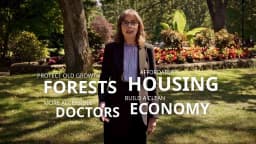
Eric Swalwell's 'Go Big. Be Bold. Do Good.' campaign, created by Kessler Content in May 2019, used a single film asset to stake a gun-violence-first position

Eric Swalwell Goes Big on Gun Violence in His 2020 Presidential Bid
Eric Swalwell's "Go big. Be bold. Do good. Swalwell 2020" is a 2019 presidential campaign film produced by Kessler Content that introduced Swalwell's national political positioning to United States voters by centering gun violence prevention as the defining issue of his candidacy.
Swalwell announced his presidential candidacy on April 8, 2019, on The Late Show with Stephen Colbert, as reported by Presidency Ucsb Edu, before delivering a formal campaign announcement on April 14, 2019, at Dublin High School in California, per the same source. The film produced by Kessler Content followed in May 2019, functioning as the campaign's primary narrative artifact and brand-defining statement for audiences across the United States. The single media asset was archived on Ads of the World, the only advertising-industry documentation publicly available for the work.
The campaign's three-part slogan carried explicit ideological weight. According to adsoftheworld.com, "Go big" signalled a rejection of incremental policy thinking; "Be bold" demanded solutions proportionate to the scale of national problems; and "Do good" described the moral register in which Swalwell intended to govern. Gun violence was not incidental to this framing — it was the primary differentiator Swalwell chose in a Democratic primary field that had expanded to roughly two dozen candidates by mid-2019. The film medium was the natural vehicle for that argument, allowing the campaign to compress emotional context, biographical authority, and policy conviction into a single cohesive narrative for voters across the United States. The Clapboard Score for this campaign is 60 out of 100.
Eric Swalwell entered a Democratic presidential primary that was, by any structural measure, exceptionally competitive. The Democratic field had expanded to roughly two dozen candidates by the time Kessler Content's film launched in May 2019, as documented by presidency.ucsb.edu and politico.com, creating an environment where differentiation was an existential campaign requirement rather than a tactical preference.
In the United States political advertising market, digital spending had become the dominant battleground. According to reporting by The New York Times, Democratic presidential candidates collectively spent approximately $17.4 million on advertising from January through May 2019. By mid-October 2019, as reported by The New York Times, the nineteen then-current Democratic presidential candidates had spent nearly $32 million on Facebook advertising alone during the course of that year. A July 2019 analysis cited by arxiv.org estimated that Democratic candidates had spent nearly $28 million on Facebook and Google combined during that period. These figures describe a market in which a single film asset, however well-crafted, needed a sharp conceptual edge to generate organic reach and press attention.
Swalwell's strategic choice to anchor the "Go big. Be bold. Do good." positioning explicitly to gun violence gave his campaign a lane that larger-polling competitors including Senator Bernie Sanders and Senator Elizabeth Warren had not yet claimed as a singular identity. Per ontheissues.org, Swalwell had built a documented congressional record on gun legislation, lending the campaign's public interest argument an authenticity that a purely rhetorical positioning would have lacked. In a primary race where name recognition and fundraising capacity were already concentrated among a small number of frontrunners, a film-first narrative strategy represented a cost-efficient attempt to generate earned media in the United States press environment.
Stephen Kessler directed and wrote the "Go big. Be bold. Do good. Swalwell 2020" film, with Lesa Lakin serving as producer and Chris Franklin of Big Sky Edit handling editorial, as credited on adsoftheworld.com. The production team's choices reflect a craft sensibility aligned with long-form political storytelling rather than the compressed, data-optimised formats that dominated Democratic primary digital advertising in 2019 across the United States.
The film medium itself is a deliberate signal. Where most candidates in a crowded primary field were producing short-form social content calibrated for Facebook and Google inventory, Kessler Content produced a single narrative film — a format that prioritises tonal coherence and emotional arc over reach-per-dollar efficiency. This is a creative risk in a public interest context, where the pressure to demonstrate broad coalition appeal can push campaigns toward safer, more generic visual languages.
Stephen Kessler's role as both copywriter and director is notable because it means the verbal logic of the slogan — its three-part rhythmic structure, its imperative mood, its public service register — and the visual execution emerged from a single creative intelligence rather than a negotiated handoff between departments. Lesa Lakin's production role and Chris Franklin's editorial contribution at Big Sky Edit completed a lean team structure consistent with the resource constraints typical of lower-polling primary campaigns. No trade press reviews from Campaign, Ad Age, Adweek, The Drum, or Contagious are publicly available for this work, per research conducted against those publications' archives. The sole advertising-industry documentation remains the Ads of the World archive entry, which functions as a portfolio record rather than a critical review.
 ARCHIVE
No verified third-party performance data for the "Go big. Be bold. Do good. Swalwell 2020" film — including view counts, earned media impressions, or audience sentiment metrics — is publicly available. The campaign's broader trajectory, however, provides structural context for evaluating the film's operating environment.
Swalwell's first television advertisement, focused on gun violence, launched on June 9, 2019, as reported by ktla.com, suggesting the May 2019 film served a foundational brand-definition function ahead of paid media deployment. The campaign ended on July 8, 2019, as reported by politico.com, citing low polling numbers and insufficient fundraising — the two most direct indicators of public interest conversion in United States presidential primary politics. The brevity of the campaign, roughly three months from announcement to withdrawal, meant the film had a narrow window in which to generate the kind of donor and volunteer response that sustains a primary run.
Structurally, the film's core strength was its ideological clarity. By subordinating biographical detail to a single moral argument — gun violence as the defining public interest challenge of the era — Kessler Content created a document with a coherent point of view that remained consistent with Swalwell's congressional record, per ontheissues.org. Its limitation was the same as its ambition: a single-issue positioning in a multi-candidate field requires either dominant issue ownership or sufficient media amplification to manufacture it. Neither condition was fully achieved within the campaign's lifespan across the United States primary electorate.
The "Go big. Be bold. Do good. Swalwell 2020" campaign is a May 2019 presidential campaign film produced by Kessler Content for Eric Swalwell's Democratic primary run in the United States. It established Swalwell's national positioning around gun violence prevention and was the campaign's primary narrative asset, archived on Ads of the World.
Kessler Content produced the film. Stephen Kessler served as both copywriter and director, Lesa Lakin produced, and Chris Franklin of Big Sky Edit handled editorial. The lean team structure reflected the resource realities of a lower-polling presidential primary campaign operating in the United States in 2019.
Gun violence was Swalwell's primary differentiator in a Democratic primary field of roughly two dozen candidates. Per ontheissues.org, Swalwell held a documented congressional record on gun legislation, giving the public interest argument biographical and legislative credibility rather than relying solely on rhetorical positioning against better-known rivals.
The Swalwell 2020 campaign ran approximately three months. Swalwell announced his candidacy on April 8, 2019, on The Late Show with Stephen Colbert, as reported by presidency.ucsb.edu, and withdrew on July 8, 2019, per politico.com, citing low polling numbers and insufficient fundraising across the United States primary electorate.
According to adsoftheworld.com, "Go big" rejected incremental policy approaches, "Be bold" demanded solutions proportionate to national challenges, and "Do good" defined Swalwell's intended governing style. The three-part imperative structure gave the campaign a rhythmically distinct public service identity in a crowded 2019 Democratic primary field.
The Clapboard Score for "Go big. Be bold. Do good. Swalwell 2020" is 60 out of 100. The score reflects the film's ideological clarity and production craft from Kessler Content, balanced against the absence of verified performance data and the campaign's limited reach within the United States Democratic primary electorate.
.webp)
Creative Collaboration Platform: The Backbone of Modern Creative WorkWhat is a creative collaboration platform?Clapboard defines a creative collaboration platform as the operational core for today’s distributed creative teams. This is not a collection of digital collaboration tools stitched together; Clapboard’s system


Understanding the Creative Production MarketplaceWhat is a Creative Production Marketplace?Clapboard defines a creative production marketplace as a structured ecosystem where brands, agencies, and production talent converge to execute video, advertising, and branded content at scale. Unlike the legacy agency or freelanREAD FULL ARTICLE

The Urgent Need for a Creative Production Operating SystemWhy Traditional Creative Production Models Break DownClapboard sees the creative production landscape shifting under pressure. Content velocity is no longer a buzzword—it’s a mandate. Modern advertising demands relentless output across dozens of channels, each wREAD FULL ARTICLE