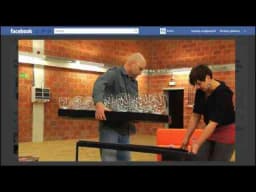
Doctors Without Borders' AnnSophie, Jonas campaign, created by Kommunikationsbureauet København in Denmark in 2012, used documentary film to humanise MSF's

Doctors Without Borders AnnSophie Jonas Puts Two Faces on a Crisis
Doctors Without Borders' AnnSophie, Jonas is a 2012 Danish public service film campaign, created by Kommunikationsbureauet København, that uses two named individuals to bring MSF's field reality directly to a Danish audience and motivate humanitarian engagement.
Published in Denmark in November 2012, the campaign comprises two media assets, both in the film medium, and sits within the public interest category. Its central creative premise is straightforward and deliberately intimate: rather than presenting MSF's global mission as an abstraction, the campaign anchors its appeal in the specific lives of two people — AnnSophie and Jonas — whose names form the campaign's entire title. That naming decision is not incidental. It signals an intent to collapse the psychological distance between a Danish viewer sitting at home and the human consequences of medical emergencies unfolding in conflict zones and disaster areas where Doctors Without Borders operates, according to doctorswithoutborders.org.
The campaign was developed by Kommunikationsbureauet København, a Copenhagen-based agency, with creative direction shared between Tobias Rosenberg and Peter Farver. Mikkel Munch-Fals served as director. The geographic market is Denmark, and the campaign's November 2012 release positioned it ahead of the year-end giving season, a period when charitable organisations across Scandinavia traditionally intensify their public communications. MSF Denmark, as the local chapter of the international Médecins Sans Frontières network, relies on donor support from the Danish public to sustain its operations, and film has long been among the most emotionally persuasive formats available to organisations seeking to convert awareness into action. The Clapboard Score for AnnSophie, Jonas is 59 out of 100, reflecting a campaign that demonstrates clear strategic intent and disciplined creative focus while remaining below the threshold of formally recognised award-winning work.
 ARCHIVE
Doctors Without Borders operates in one of the most contested spaces in public service advertising: the humanitarian appeal. In Denmark, where public trust in institutions is high and civic engagement in international causes is culturally embedded, the challenge for MSF Denmark in 2012 was not to establish credibility but to cut through a crowded year-end giving environment and prompt action from an audience already familiar with the concept of international aid.
The strategic answer embedded in AnnSophie, Jonas is personalisation at scale. Research in donor psychology, documented in academic work reviewed by institutions including Goldsmiths, University of London, consistently shows that identified individuals generate stronger empathic responses than statistical representations of suffering, a principle sometimes called the identifiable victim effect. By naming the campaign after two specific people rather than invoking aggregate numbers, Kommunikationsbureauet København aligned the creative strategy with this documented human tendency, making the film format work harder as a vehicle for emotional identification rather than informational transfer.
The competitive landscape for charitable giving in Denmark in 2012 included major international organisations such as UNICEF, which according to Unicef Org Uk maintains active donor communication programmes across Scandinavian markets, as well as domestic Danish relief organisations. Against this backdrop, MSF's decision to invest in film — a higher-production, higher-attention format — reflects a strategic bet that depth of engagement would outperform breadth of reach for a November campaign window. This approach distinguishes AnnSophie, Jonas from more data-driven or shock-imagery campaigns that characterised some humanitarian advertising of the same period, including contemporaneous international MSF work such as the 2012 Spanish campaign Pills Against the Pain of Others, as catalogued by adruby.com.
Mikkel Munch-Fals directed AnnSophie, Jonas for Doctors Without Borders. The directorial credit is significant in the context of a public service film campaign produced in Denmark in 2012, because it anchors the work within a specific documentary sensibility rather than the more stylised visual grammar associated with commercial advertising of the period.
The campaign's two media assets follow a film approach that, by its structure and naming convention, suggests a documentary or testimonial mode of storytelling. The choice to title the campaign with first names — AnnSophie and Jonas — rather than a campaign line or organisational slogan implies that the films themselves foreground the individuals, allowing their presence and testimony to carry the persuasive weight that copy or voiceover might otherwise supply. This is a disciplined formal choice: it demands that the direction, cinematography, and editing sustain emotional credibility without the scaffolding of conventional advertising rhetoric.
Creative direction was shared between Tobias Rosenberg, credited as creative and art director, and Peter Farver, credited as creative director and copywriter. The division of responsibilities suggests a collaborative creative model in which visual composition and narrative language were developed in close alignment, a working method well suited to documentary-adjacent formats where the boundary between observed reality and constructed story must be managed carefully. Kommunikationsbureauet København, as the Copenhagen agency behind the production, brought the campaign to completion within a public service context where budgets are typically constrained relative to commercial clients, making the economy of a two-asset, character-led film format a practical as well as an aesthetic decision. No additional production or post-production credits for AnnSophie, Jonas are publicly documented beyond those recorded in the campaign archive.
No verified performance data for AnnSophie, Jonas is publicly available. No donation uplift, response rate, media reach figure, brand-tracking result, or return-on-investment metric has been documented in publicly accessible sources. No awards from Cannes Lions, D&AD, the Clios, the One Show, Effie, or the Webby Awards have been recorded against this campaign. Trade press coverage in outlets including Campaign, Ad Age, Adweek, The Drum, and Contagious has not been identified.
In the absence of verified metrics, the campaign's structural effectiveness can be assessed on the basis of its creative and strategic architecture. AnnSophie, Jonas makes several choices that are independently associated with effective public service communication. The use of named individuals as the campaign's primary organising device is consistent with donor psychology research. The film medium provides the duration and sensory depth needed to generate empathic engagement rather than passive awareness. The November 2012 publication date in Denmark places the campaign at the optimal point in the charitable giving calendar. The two-asset structure suggests a campaign designed to reach audiences across more than one context or placement, extending exposure without fragmenting the core message.
The Clapboard Score of 59 out of 100 positions AnnSophie, Jonas as a campaign with a coherent creative rationale and sound strategic foundations that nonetheless did not achieve the broader industry recognition or documented impact that would elevate it into the upper tier of public service advertising. It remains a competent and purposeful piece of work within the MSF Denmark communications canon, archived independently by adruby.com as part of the broader record of international MSF campaign activity.
AnnSophie, Jonas is a 2012 Danish public service film campaign created for Doctors Without Borders by Kommunikationsbureauet København. Published in November 2012, it uses two named individuals to humanise MSF's humanitarian mission and build emotional connection with a Danish audience during the year-end giving season.
Mikkel Munch-Fals directed AnnSophie, Jonas. The campaign's creative direction was shared between Tobias Rosenberg, serving as creative and art director, and Peter Farver, serving as creative director and copywriter, both working at Kommunikationsbureauet København in Copenhagen, Denmark.
Naming the campaign AnnSophie and Jonas reflects the identifiable victim effect, a documented principle showing individuals generate stronger donor empathy than statistics. This personalisation strategy allowed Doctors Without Borders to cut through a competitive Danish charitable giving environment in November 2012 without relying on aggregate humanitarian data.
No awards from Cannes Lions, D&AD, the Clios, the One Show, Effie, or the Webby Awards have been recorded for AnnSophie, Jonas. The campaign holds a Clapboard Score of 59 out of 100, indicating solid creative foundations without reaching the threshold of formally recognised industry award winners.
Doctors Without Borders used the film medium for AnnSophie, Jonas. The campaign comprises two media assets, both film-based, produced by Kommunikationsbureauet København and released in Denmark in November 2012, using documentary-style storytelling to present MSF's field work to a Danish public audience.
.webp)
Creative Collaboration Platform: The Backbone of Modern Creative WorkWhat is a creative collaboration platform?Clapboard defines a creative collaboration platform as the operational core for today’s distributed creative teams. This is not a collection of digital collaboration tools stitched together; Clapboard’s system


Understanding the Creative Production MarketplaceWhat is a Creative Production Marketplace?Clapboard defines a creative production marketplace as a structured ecosystem where brands, agencies, and production talent converge to execute video, advertising, and branded content at scale. Unlike the legacy agency or freelanREAD FULL ARTICLE

The Urgent Need for a Creative Production Operating SystemWhy Traditional Creative Production Models Break DownClapboard sees the creative production landscape shifting under pressure. Content velocity is no longer a buzzword—it’s a mandate. Modern advertising demands relentless output across dozens of channels, each wREAD FULL ARTICLE