 ARCHIVE
Mother's Day
In 2022, ELTERN, Germany’s leading family and parenting platform, launched a poignant integrated...
How Boys Do Cry Challenged Australia's Silence on Men's Mental Health
Boys Do Cry is a 2021 Australian integrated health campaign created by The Hallway for UnLtd that transformed The Cure's iconic song Boys Don't Cry into a new anthem challenging societal views on male emotional suppression, using a choir of 30 men to encourage help-seeking behaviour and suicide prevention across the country.
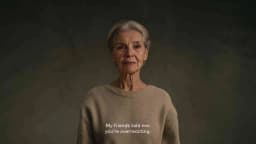
The campaign launched nationally on 22 November 2021, timed to coincide with International Men's Day. At its core is a film directed by Tom Campbell of Good Oil, featuring 30 men drawn from diverse backgrounds, cultures, and communities across Australia. Among the key cast are Dallas Woods, a Noongar recording artist and MC from the East Kimberley, and actor Eddie Baroo, known for his roles in The Dry, Mr Inbetween, and Mystery Road. The decision to build the film around a choir rather than a single spokesperson was deliberate: it visualised the collective weight of male silence while simultaneously breaking it.
The strategic foundation of Boys Do Cry rests on a documented public health reality. In the last 12 months captured in the campaign brief, 2,384 men in Australia took their own lives, an average of 7 men every day, making suicide the leading cause of death in Australian males aged 15 to 49. The campaign's central argument is direct: some of those men might still be alive today had they felt able to speak to someone. Generations of men have grown up with the instruction to man up and keep feelings private. Boys Do Cry set out to dismantle that instruction permanently, with the goal that when the going gets tough, men get talking. The campaign was produced as an integrated effort spanning a music video, a released single, posters, outdoor advertising, radio, and a dedicated campaign website, making it one of the more structurally ambitious Australian health campaigns of 2021.
Suicide is the leading cause of death among Australian males aged 15 to 49. That single statistic frames every creative and strategic decision made by The Hallway and UnLtd in developing Boys Do Cry. The campaign did not position itself as a fundraising exercise or a service directory. It positioned itself as a cultural intervention, targeting the internalised masculine norm that equates emotional expression with weakness.
UnLtd operates within a competitive landscape that includes Beyond Blue, Lifeline Australia, headspace, Black Dog Institute, and SANE Australia, all of which compete for public attention, behaviour change, and partnership support across the Australian mental health sector. In 2020, according to Headspace Org Au, headspace collaborated with Beyond Blue, Black Dog Institute, SANE Australia, Batyr, Orygen, and ReachOut on a coordinated mental health response, illustrating the degree of coalition-building that characterises this sector. Boys Do Cry distinguished itself not by adding to that coalition's service infrastructure but by attacking the upstream cultural barrier preventing men from accessing any service at all.
The campaign's partners reflected this upstream ambition. According to Little Black Book, collaborators included the University of Melbourne's Centre for Mental Health, Gotcha4Life, Heiress Films, Initiative as media agency, and Everymind, a national mental health prevention organisation. This multi-institutional architecture gave Boys Do Cry both research credibility and distribution reach that a single-organisation campaign would have struggled to assemble. The Australian Men's Health Forum, documented at Amhf Org Au, has long identified masculine identity norms as a primary barrier to help-seeking in Australia, providing the evidence base from which the campaign's creative proposition flows. Boys Do Cry did not invent this insight; it gave it the most emotionally immediate creative expression the Australian market had yet seen on the subject.
The Cure's Boys Don't Cry is one of the most recognisable songs in popular music history. The Hallway's decision to transform it, rather than merely reference it, is the defining creative act of the campaign. The original song's title encodes the very instruction that Boys Do Cry exists to challenge, making the reworking simultaneously a critique and a call to action delivered through a cultural object that carries genuine emotional weight for multiple generations of Australian men.
Director Tom Campbell of Good Oil brought the film to life, working with a choir of 30 men whose visible diversity was itself a creative argument. According to lbbonline.com, the casting spanned varied backgrounds, ages, and communities, ensuring that the film's emotional address was not narrowed to a single demographic. Dallas Woods, a Noongar man from the East Kimberley and a recognised recording artist and MC, and actor Eddie Baroo provided cultural grounding and screen presence that anchored the ensemble. The inclusion of First Nations voices was not incidental; it acknowledged that masculine emotional suppression intersects with specific cultural and historical pressures in the Australian context.
The creative team behind the campaign, as documented across lbbonline.com and adnews.com.au, included Simon Lee as Executive Creative Director and Partner at The Hallway, Aldo Ferretto as Creative Director and Art Director alongside Iain MacMillan, and Simon Lee and Tim Wood as Copywriters. Sam Long served as Executive Producer at Good Oil, with Carolyn Starkey as Agency Producer. The campaign extended beyond the film into a released single, outdoor advertising, posters, and radio, maintaining tonal consistency across each format. According to marketingmag.com.au, the project took three years to develop before its November 2021 launch, a timeline that reflects the degree of institutional partnership, rights negotiation over The Cure's song, and research integration required to bring Boys Do Cry to the standard it reached.
Boys Do Cry produced verified, large-scale results across reach, referral, and behavioural intent metrics. The campaign reached 140 million people, referred 37,000 men to Beyond Blue for support, and generated measurable shifts in help-seeking intention among male viewers in Australia. These figures position it among the highest-impact Australian health campaigns of the 2021 period.
University of Melbourne research, cited across Lifeinmind Org Au and Unltd Org Au, reported that 51.03% of male viewers increased their intention to seek help after viewing the campaign. This is a rare instance of a creative campaign producing a peer-reviewed behavioural outcome, not merely an attitudinal shift. According to lifeinmind.org.au, campaign-related Twitter activity generated 140,650 views across 247 tweets and 4,477 engagements during the campaign period. Of 1,318 relevant tweets tracked, 1,237, representing 93.9%, occurred during the active campaign window, compared with 81 tweets, or 6.1%, recorded outside it, demonstrating concentrated social amplification aligned with the November 2021 launch.
The campaign's institutional recognition followed its public impact. According to lbbonline.com and unltd.org.au, Boys Do Cry won UnLtd's Good Company Award and was inducted into its Hall of Good in November 2022, recognising campaigns that generate demonstrated social value alongside creative merit. Clapboard rates Boys Do Cry 76 out of 100, reflecting strong creative ambition, verified behavioural outcomes, exemplary multi-platform integration, and the cultural durability of the song transformation device, with modest room for expansion in longitudinal measurement and cross-demographic segmentation. The referral figure of 37,000 men to Beyond Blue is the campaign's most concrete proof of downstream utility: it connects creative reach directly to a support pathway, which is the functional objective that distinguishes health advertising from awareness advertising.
Boys Do Cry is a 2021 Australian health campaign created by The Hallway for UnLtd. It transformed The Cure's song Boys Don't Cry into a new anthem challenging societal views on masculine emotional suppression. The campaign aimed to reduce male suicide in Australia by encouraging men to seek help rather than man up.
Boys Do Cry reached 140 million people and referred 37,000 men to Beyond Blue for mental health support, according to UnLtd's documented campaign results. University of Melbourne research also found that 51.03% of male viewers increased their intention to seek help after viewing the film.
Tom Campbell of Good Oil directed the Boys Do Cry film, according to lbbonline.com. The film featured a choir of 30 men from diverse Australian backgrounds. Key cast included Dallas Woods, a Noongar recording artist from the East Kimberley, and actor Eddie Baroo, known for The Dry and Mystery Road.
The Cure's Boys Don't Cry encodes the precise cultural instruction that the campaign was designed to dismantle. By transforming the song's title and content, The Hallway turned a widely recognised pop culture artefact into a direct challenge to masculine norms, giving the suicide prevention message immediate emotional resonance across generations of Australian men.
Boys Do Cry won UnLtd's Good Company Award and was inducted into UnLtd's Hall of Good in November 2022, according to lbbonline.com and unltd.org.au. The award recognises campaigns that demonstrate measurable social value alongside creative excellence, reflecting the campaign's verified outcomes in Australian men's mental health behaviour change.
According to marketingmag.com.au, the Boys Do Cry campaign took three years to develop before its national launch on 22 November 2021. The extended timeline reflects the complexity of securing rights to The Cure's song, assembling a multi-institutional partnership, and integrating University of Melbourne research into the campaign's strategic foundation.
.webp)
Creative Collaboration Platform: The Backbone of Modern Creative WorkWhat is a creative collaboration platform?Clapboard defines a creative collaboration platform as the operational core for today’s distributed creative teams. This is not a collection of digital collaboration tools stitched together; Clapboard’s system


Understanding the Creative Production MarketplaceWhat is a Creative Production Marketplace?Clapboard defines a creative production marketplace as a structured ecosystem where brands, agencies, and production talent converge to execute video, advertising, and branded content at scale. Unlike the legacy agency or freelanREAD FULL ARTICLE

The Urgent Need for a Creative Production Operating SystemWhy Traditional Creative Production Models Break DownClapboard sees the creative production landscape shifting under pressure. Content velocity is no longer a buzzword—it’s a mandate. Modern advertising demands relentless output across dozens of channels, each wREAD FULL ARTICLE