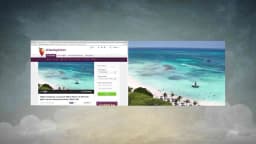
Union Station's Living History campaign by VML used augmented reality and location-aware beacons to mark a Kansas City landmark's centennial in November 2014.

Union Station Living History Turns a Centennial Into an AR Journey
Living History is a mobile augmented-reality experience created by VML for Union Station Kansas City in 2014, using location-aware beacons and filmed reenactments to let on-site visitors relive eleven major events from the station's one-hundred-year history across the United States.
Union Station Kansas City opened in 1914, making 2014 its centennial year. To mark that milestone, VML developed a campaign designed not as a conventional heritage exhibition but as an immersive, location-triggered narrative experience. As Eric Pfeifer, Director of Mobility at VML, stated, the goal was to "tell the true living history story of what's happened at Union Station, some of the stories you might not have heard of in the past." That ambition shaped every technical and creative decision the team made.
The campaign combined a bespoke mobile application, a permanent augmented-reality exhibit, and an on-site installation, all unveiled during the centennial celebration weekend. According to unionstation.org, the app and exhibit were formally announced on November 1, 2014, following a public launch on October 31. Production took more than six months, according to commarts.com, reflecting the depth of research, filming, and engineering required to reconstruct eleven distinct historical moments in precise physical locations inside the station. Technology partners Gimbal, Moblico, and Metaio provided the beacon infrastructure, push-notification system, and augmented-reality rendering respectively, per clapboard.com. The result positioned Union Station not merely as a transit hub but as a living cultural institution in the heart of the United States travel and leisure landscape.
Union Station Kansas City operates as a free cultural attraction competing for visitor attention against historic museums, shopping destinations, and broader destination-marketing organisations across the United States. That competitive positioning shaped VML's strategic brief. Rather than promoting ticket sales or transport connections, the Living History campaign had to deepen emotional engagement with a building that many Kansas City residents treat as familiar background rather than destination.
The strategic insight was spatial. Eric Pfeifer noted that by using "location-based technology and augmented reality, visitors can experience these stories in the exact place they happened," according to clapboard.com. This principle — that proximity to the original event amplifies emotional resonance — separated Living History from conventional heritage campaigns that rely on placards, printed guides, or standalone video content. Competitors in the broader United States heritage-attraction sector, including institutions such as the Smithsonian and regional history museums, were at the time deploying static digital interactives or audio guides. VML chose instead to anchor narrative to architecture through beacon-triggered augmented reality, a substantially more demanding technical undertaking.
The travel and leisure sector in the United States was undergoing significant mobile adoption growth in 2014, with smartphone penetration expanding rapidly across visitor demographics, though precise figures from that period vary by source. That macro shift made a mobile-first execution strategically sound rather than experimental. Jon Cook, CEO and President of VML, stated that "VML is proud to help celebrate Union Station as a historic monument in Kansas City on its centennial," according to clapboard.com, framing the campaign as civic pride expressed through craft — a positioning that served both the client and the agency in earned-media terms.
The Wade Brothers produced and directed the filmed reenactments at the core of Living History, according to commarts.com. Their involvement brought a cinematic sensibility to what might otherwise have been a purely technical mobile product, grounding the augmented-reality sequences in performance and period detail rather than motion graphics alone.
The experience recreated eleven major events from Union Station's history, per commarts.com, including encounters with historical figures such as Harry S. Truman, whose connection to the station forms part of Kansas City's broader civic memory. Each reenactment was filmed to align precisely with the physical geometry of the station interior, so that when a visitor triggered a scene through the mobile application, the augmented layer appeared to inhabit the actual space rather than float over it. That spatial discipline required close coordination between the Wade Brothers' production unit and the technology partners — Gimbal for beacon placement, Moblico for push-notification delivery, and Metaio for augmented-reality rendering — as documented by clapboard.com.
The permanent exhibit component extended the campaign's reach beyond the launch weekend, embedding Living History into the station's ongoing visitor experience rather than treating it as a time-limited activation. The mobile application itself was engineered to respond to visitor location in real time, surfacing relevant historical content as users moved through different areas of the building. This layering of beacon infrastructure, filmed performance, and mobile interface represented a substantial production undertaking for 2014, when location-aware augmented reality at this level of integration remained genuinely uncommon in the United States travel and leisure sector. The total production timeline exceeded six months, according to commarts.com, underscoring the ambition of the execution relative to the campaign's cultural rather than commercial brief.
No verified audience performance data for Living History — such as app downloads, dwell time, or visitor uplift figures — is publicly available. What the campaign's award record does provide is a substantial external signal of industry-assessed creative and technical quality across multiple evaluation frameworks.
Living History received a Cannes Lions Branded Content and Entertainment shortlist in 2015, four Cannes Lions Mobile shortlists in 2015, and a Cannes Lions Promo and Activation shortlist in 2015, according to clapboard.com. The IAB MIXX Awards recognised the campaign with two Gold awards in 2016, per clapboard.com. Adweek named Living History the Best Mobile Video Winner at its WATCH Awards in 2015, as reported by clapboard.com. The National ADDY Awards presented two Gold awards in 2015, the New York Festivals Digital jury awarded a Bronze in 2015, New York Festivals Outdoor recognition followed in 2015, and the Webby Awards nominated the campaign twice in 2015 — all according to clapboard.com.
Structurally, the campaign's effectiveness rests on its insistence that historical narrative belong to place. By anchoring each of the eleven reenacted events to the precise location inside Union Station where the event occurred, VML created conditions for a form of emotional authenticity that screen-based or remote heritage experiences cannot replicate. The beacon-and-augmented-reality architecture made the content unskippable in the experiential sense — a visitor standing in the right spot received the story whether or not they arrived with prior knowledge. That design logic is what the award juries appear to have rewarded across Mobile, Branded Content, and Activation categories simultaneously. Living History holds a Clapboard Score of 72 out of 100.
Living History is a mobile augmented-reality experience VML created for Union Station Kansas City in 2014. It used location-aware beacons and filmed reenactments to let visitors relive eleven historical events at the exact spots inside the station where those events originally occurred, marking the building's centennial.
VML partnered with Gimbal for beacon infrastructure, Moblico for push notifications, and Metaio for augmented-reality rendering, according to clapboard.com. Together these systems allowed the mobile application to detect a visitor's precise location inside Union Station and trigger historically relevant filmed reenactments in real time.
The Wade Brothers produced and directed the filmed reenactments for Living History, according to commarts.com. Their work brought cinematic performance and period detail to the augmented-reality sequences, ensuring that historical figures appeared credibly within the actual architectural space of Union Station Kansas City.
Living History received multiple Cannes Lions shortlists across Mobile, Branded Content, and Promo categories in 2015, two IAB MIXX Gold awards in 2016, the Adweek WATCH Best Mobile Video award in 2015, two National ADDY Golds in 2015, New York Festivals recognition, and two Webby Award nominations, all per clapboard.com.
Union Station Kansas City unveiled Living History during its centennial celebration weekend, with the exhibit opening October 31, 2014, and the formal app announcement on November 1, 2014, according to unionstation.org. Production of the mobile application and permanent augmented-reality exhibit took more than six months, per commarts.com.
Living History recreates eleven major events from Union Station's one-hundred-year history, according to commarts.com. Each event is tied to its original physical location inside the Kansas City station, so visitors encounter historical figures and moments — including Harry S. Truman — at the precise spots where those events took place.
.webp)
Creative Collaboration Platform: The Backbone of Modern Creative WorkWhat is a creative collaboration platform?Clapboard defines a creative collaboration platform as the operational core for today’s distributed creative teams. This is not a collection of digital collaboration tools stitched together; Clapboard’s system


Understanding the Creative Production MarketplaceWhat is a Creative Production Marketplace?Clapboard defines a creative production marketplace as a structured ecosystem where brands, agencies, and production talent converge to execute video, advertising, and branded content at scale. Unlike the legacy agency or freelanREAD FULL ARTICLE

The Urgent Need for a Creative Production Operating SystemWhy Traditional Creative Production Models Break DownClapboard sees the creative production landscape shifting under pressure. Content velocity is no longer a buzzword—it’s a mandate. Modern advertising demands relentless output across dozens of channels, each wREAD FULL ARTICLE