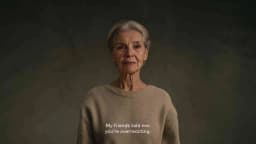
The Claims Conference launched Inside Kristallnacht in 2024, a pioneering WebXR mixed reality experience co-produced with makemepulse and USC Shoah Foundation

How Inside Kristallnacht Turns Survivor Memory Into Mixed Reality
Inside Kristallnacht is a 25-minute WebXR mixed reality experience commissioned by The Claims Conference and co-produced by immersive technology studio makemepulse and USC Shoah Foundation, which transports users into the events of November 9–10, 1938, guided by the living testimony of Dr Charlotte Knobloch, a Holocaust survivor and prominent advocate for Jewish communities in Germany.
The Claims Conference is a nonprofit organisation that secures compensation and social welfare services for Holocaust survivors around the world. Facing a demographic reality in which the generation of living witnesses is steadily diminishing, the organisation commissioned a format capable of doing what archival footage and written testimony alone cannot: placing a present-day audience inside a historical moment with sensory and emotional immediacy. Inside Kristallnacht answers that brief directly, launching on October 30, 2024, in New York and timed to coincide with the 86th anniversary of Kristallnacht, as reported by the USC Shoah Foundation and confirmed by UNESCO.
The experience is accessible on mobile, desktop, or via a VR headset, making it one of the first Holocaust remembrance projects to combine full VR immersion with interactive web viewing under a single WebXR framework. Its release coordinates with the anniversary of a 24-hour period in which, according to The Claims Conference, approximately 10,000 Jewish businesses were destroyed, around 2,000 synagogues burned, tens of thousands of homes wrecked, and more than 30,000 Jewish men were rounded up and sent to concentration camps across Germany and Austria. The campaign operates globally, with no single geographic market defined as primary, though its launch was anchored in the United States and supported by Meta and UNESCO. Clapboard scores Inside Kristallnacht 74 out of 100, recognising the production's structural ambition and its meaningful advance of Holocaust education through emerging immersive technology.
The Claims Conference confronts a strategic problem shared across Holocaust remembrance institutions: survivor populations are declining, and with them the irreplaceable authority of first-person witness. The organisation's earlier campaigns demonstrate a consistent pattern of reaching new audiences through contemporary media platforms. Its #ItStartedWithWords campaign, launched April 8, 2021, for Yom HaShoah, featured weekly videos with Holocaust survivors discussing antisemitic language and social normalisation, distributed digitally and supported by Facebook, according to the Claims Conference. That campaign followed the earlier #NoDenyingIt effort, also documented by the Claims Conference, establishing a lineage of digitally distributed, survivor-centred communications.
Inside Kristallnacht escalates that approach materially. Rather than video distributed on social platforms, it deploys WebXR — a browser-native framework that enables immersive, interactive three-dimensional environments without requiring users to download dedicated software. This reduces friction significantly, extending the potential reach of a VR-grade experience to anyone with a smartphone or desktop browser. Principal institutional peers operating in the Holocaust remembrance and education space include Yad Vashem, which reported 116,400 students, 93,300 Israeli soldiers and security personnel, and 18,370 teachers and opinion-shapers participating in its educational activities in 2024, according to Yad Vashem, and the USC Shoah Foundation itself, which functions here as a co-production partner rather than a competitor. The decision to bring USC Shoah Foundation inside the production rather than treat it as an external validator signals The Claims Conference's intent to build institutional credibility into the experience's architecture rather than apply it retrospectively.
UNESCO's support further positions Inside Kristallnacht within an international framework of cultural preservation, connecting a specific survivor's testimony to a globally recognised mandate for protecting intangible heritage.
makemepulse directed the creative and technical execution of Inside Kristallnacht under the direction of Ryan Fenton-Strauss. The studio's approach centres on a single, specific biographical perspective: Dr Charlotte Knobloch, who was six years old on the night of November 9, 1938, in Munich, and who at the time of the experience's production was 91 years old. Knobloch leads and narrates the entire 25-minute experience, guiding users through interactive reconstructions of key spaces and moments from her testimony. This is not a generalised historical panorama; it is one woman's account, rendered in spatial three dimensions.
Nicolas Rajabaly, Co-founder and Chief Creative Officer at makemepulse, described the project's intent directly: "Inside Kristallnacht is a groundbreaking project that harnesses the power of XR to bring history to life. This isn't just about recounting the past — it's about forging deep, emotional connections with stories of survival and resilience." That framing reveals the studio's core creative logic: emotional proximity, achieved through biographical specificity and spatial immersion, is treated as more pedagogically powerful than factual breadth.
The production's multi-platform delivery — accessible via mobile, desktop, and VR headset within a single WebXR framework — required the studio to resolve competing technical constraints simultaneously. A VR headset experience and a mobile browser session impose radically different interaction models; building one experience that functions credibly across all three required deliberate decisions about interaction depth, visual fidelity, and narrative pacing at each access point. The USC Shoah Foundation's co-production role brought archival rigour to the reconstruction process, ensuring that the interactive environments built by makemepulse correspond to documented historical record rather than dramatised approximation.
No independently verified performance data — including user numbers, completion rates, or audience reach figures — for Inside Kristallnacht has been made publicly available at the time of writing. The experience launched on October 30, 2024, as reported by the USC Shoah Foundation and UNESCO, giving limited time for measurable data to enter the public record before this analysis was conducted.
Structural analysis, however, points to several effectiveness advantages built into the format itself. The WebXR framework eliminates the hardware barrier that has historically confined immersive Holocaust experiences to museum installations or dedicated VR headset owners. By enabling the same experience across a smartphone browser, a desktop screen, and a VR headset, Inside Kristallnacht reaches three distinct audience segments — casual digital users, students in classroom settings, and dedicated immersive media consumers — through a single production investment. The 25-minute duration is calibrated to sustain engagement without exceeding the attention tolerance typical of self-directed digital learning environments.
The institutional architecture also functions as a credibility signal. Co-production with USC Shoah Foundation and formal support from UNESCO attach the experience to two organisations whose primary mandate is historical accuracy and cultural preservation respectively. For an audience already sensitised to misinformation and Holocaust denial, that endorsement structure is not decorative — it is load-bearing. The Claims Conference's own lineage of survivor-centred digital campaigns, from #NoDenyingIt through #ItStartedWithWords, demonstrates an organisational track record in converting survivor testimony into measurable public engagement, providing a reasonable basis for confidence in this format's capacity to reach and affect new audiences.
Inside Kristallnacht is a 25-minute WebXR mixed reality experience commissioned by The Claims Conference. It was co-produced by immersive technology studio makemepulse and USC Shoah Foundation, directed by Ryan Fenton-Strauss, and supported by Meta and UNESCO. The experience launched on October 30, 2024, in New York, timed to the 86th anniversary of the Night of Broken Glass.
Dr Charlotte Knobloch narrates the Inside Kristallnacht experience. She is a Holocaust survivor and prominent advocate for Jewish communities in Germany, who was six years old during Kristallnacht in Munich in 1938. At the time of the experience's production, she was 91 years old and leads users through interactive reconstructions of her personal testimony.
Inside Kristallnacht is accessible on mobile devices, desktop browsers, and via a VR headset. Its WebXR framework allows all three access modes under a single experience, removing the hardware barrier that typically limits immersive Holocaust education to museum installations. This makes it one of the first Holocaust remembrance projects to combine full VR immersion with interactive web viewing.
The Claims Conference commissioned Inside Kristallnacht to preserve survivor memory as the generation of living Holocaust witnesses declines. The organisation has a documented history of digitally distributed survivor-centred campaigns, including #ItStartedWithWords in 2021 and the earlier #NoDenyingIt campaign, according to the Claims Conference, making immersive WebXR a logical next step in that strategic lineage.
Inside Kristallnacht reconstructs the events of November 9–10, 1938, during which, according to The Claims Conference, approximately 10,000 Jewish businesses were destroyed, around 2,000 synagogues burned, and more than 30,000 Jewish men were sent to concentration camps across Germany and Austria. The experience presents these events through the personal perspective of Dr Charlotte Knobloch, then six years old in Munich.
Clapboard scores Inside Kristallnacht 74 out of 100. The score reflects the production's meaningful advance of Holocaust education through emerging immersive technology, its multi-platform WebXR accessibility, and the institutional credibility conferred by co-production with USC Shoah Foundation and formal support from UNESCO, balanced against the absence of publicly verified audience performance data at the time of analysis.
.webp)
Creative Collaboration Platform: The Backbone of Modern Creative WorkWhat is a creative collaboration platform?Clapboard defines a creative collaboration platform as the operational core for today’s distributed creative teams. This is not a collection of digital collaboration tools stitched together; Clapboard’s system


Understanding the Creative Production MarketplaceWhat is a Creative Production Marketplace?Clapboard defines a creative production marketplace as a structured ecosystem where brands, agencies, and production talent converge to execute video, advertising, and branded content at scale. Unlike the legacy agency or freelanREAD FULL ARTICLE

The Urgent Need for a Creative Production Operating SystemWhy Traditional Creative Production Models Break DownClapboard sees the creative production landscape shifting under pressure. Content velocity is no longer a buzzword—it’s a mandate. Modern advertising demands relentless output across dozens of channels, each wREAD FULL ARTICLE