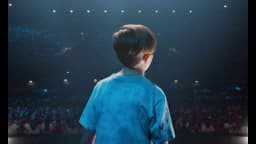
Right To Play's 'Resignation Letter, Games Over Guns, We Rise Anthem' campaign by BBDO Toronto redefined the brand with three films winning five Pencils at The

Right To Play and BBDO Toronto Rise Against Child Exploitation
Right To Play's "Resignation Letter, Games Over Guns, We Rise Anthem" is a three-part Canadian public service film campaign created by BBDO Toronto in November 2018, built around a new brand platform designed to shift audience focus from what the organisation does to what children can become through play-based programming.
The campaign launched in November 2018 across Right To Play's website and social-media platforms, then extended into broadcast, cinema, online, and out-of-home media in Canada. It comprised three distinct film executions. "We Rise Anthem" is a 90-second film addressing child labour, child marriage, trafficking, abuse, and the use of children as soldiers. "Games Over Guns" is a 60-second film focused specifically on the crisis of child soldiers. "Resignation Letter" follows a girl leaving a sweatshop after discovering that play and education offer a different future. Together, as reported by LBBOnline on August 27, 2019, the three films form a forceful awareness effort confronting some of the most acute threats to childhood globally.
The campaign marked a deliberate repositioning for Right To Play, according to Strategyonline Ca. Before 2018, the organisation's communications had emphasised tactical program resources and play-based activities. BBDO Toronto was tasked with determining Right To Play's broader reason for being, redirecting the narrative toward donation impact and the transformative outcomes play produces in children's lives. In Canada, where Right To Play is headquartered and where public awareness of its mission remained uneven, this strategic pivot required a creative vehicle powerful enough to anchor the brand in the public consciousness. The three-film "We Rise" structure provided exactly that architecture, giving each execution a distinct child-rights crisis to confront while uniting all three under a single empowerment-led brand idea. The Clapboard Score for this campaign is 63 out of 100, reflecting strong creative ambition and awards recognition alongside limited measurable audience reach data in the public domain.
Right To Play identified a fundamental communication problem before briefing BBDO Toronto. The organisation's prior messaging had prioritised the mechanics of play-based programming over the human stakes those programs address, a pattern common across the non-profit sector but particularly limiting for a brand seeking sustained donor relationships.
The strategic shift, as documented by strategyonline.ca, placed empowerment and outcomes at the centre of all creative thinking. BBDO Toronto was asked not simply to raise awareness of Right To Play's activities but to articulate the organisation's reason for being — a much harder brief demanding emotional clarity rather than informational breadth. In Canada, where the charitable giving landscape is competitive and donor attention is finite, this distinction carries practical fundraising weight. According to Publications Gc Ca, Canadian public safety and social welfare communications have consistently shown that emotionally resonant narratives outperform informational messaging in sustaining audience engagement over time.
The three-film structure was itself a strategic decision. Rather than producing a single campaign film, BBDO Toronto identified three distinct crises — child soldiers, child labour, and the broader constellation of threats addressed in the anthem — and built a separate, self-contained film around each. This allowed the campaign to speak to different donor motivations and media environments simultaneously. In the Canadian public interest category, competitors for donor attention include major international organisations such as UNICEF Canada and Save the Children Canada, both of which deploy substantial above-the-line media budgets. Right To Play's decision to pursue a unified brand platform, rather than a single-issue appeal, positioned it as a broader children's rights movement rather than a single-program charity, a differentiation that carries long-term brand equity implications well beyond any individual campaign cycle.
The creative leadership at BBDO Toronto was provided by Denise Rossetto and Todd Mackie, as documented by adsoftheworld.com. Production was handled by Skin and Bones, with director Mark Zibert helming all three film executions. Zibert's involvement is significant: he is known in the Canadian production community for work that blends documentary realism with controlled visual composition, a combination directly suited to subject matter as grave as child soldiers and forced child labour.
Each film in the "We Rise" suite deploys a distinct narrative construction. "Resignation Letter" uses a literal dramatic device — a letter written by a child leaving exploitative work — to build emotional identification through a first-person voice. The specificity of the sweatshop setting grounds the film in recognisable economic reality rather than abstracted suffering, a craft choice that prevents the audience from retreating into comfortable distance. "Games Over Guns" confronts the figure of the child soldier directly, using the contrast between the childhood act of play and the violence of armed conflict as its central tension. According to adsoftheworld.com, the film references approximately 300,000 child soldiers worldwide, a statistic that the creative team embeds within the emotional logic of the film rather than presenting as a standalone data point. "We Rise Anthem," at 90 seconds, operates as the campaign's emotional summit, weaving child labour, child marriage, trafficking, and abuse into a single arc that resolves on the possibility of transformation through play.
The decision to deploy all three films across broadcast, cinema, online, and out-of-home media in Canada ensured that the tonal register of each execution was calibrated for the intimacy and scale demands of different viewing contexts. Cinema in particular suits the measured, image-led language Zibert brought to the material.
 ARCHIVE
The campaign's awards record is the primary verified measure of its industry impact. The "Resignation Letter, Games Over Guns, We Rise Anthem" campaign won two Gold Pencils, one Silver Pencil, and two Bronze Pencils at The One Show on May 6, 2019, according to clapboard.com. Five Pencils across three metals at one of advertising's most internationally scrutinised award programmes constitutes a substantial validation of the campaign's creative quality, particularly for a non-profit client operating without the media budgets available to commercial advertisers in Canada.
No verified audience reach, view count, or donor conversion data for the campaign is publicly available at the time of writing. What the awards result does confirm is that the campaign's structural choices — a three-film architecture, a narrative-led creative approach, and the empowerment platform developed by BBDO Toronto — were judged by industry peers to represent a meaningful advance in public interest advertising. According to LBBOnline, the campaign was described as a forceful awareness effort, language that signals recognition of the campaign's intent to shift perception rather than simply inform.
The Clapboard Score of 63 out of 100 reflects this balance: the creative ambition and awards recognition are clear, but the absence of publicly documented audience metrics and the campaign's relatively contained deployment within Canada limit the score's upper potential. In the public interest category, where earned media and social amplification often determine whether a campaign achieves systemic awareness or remains within the advertising community's own conversation, the "We Rise" suite sits at a credible but not exceptional position on the effectiveness spectrum.
Right To Play's "We Rise" campaign is a three-part public service film series created by BBDO Toronto and launched in Canada in November 2018. It addresses child soldiers, child labour, and child marriage through three separate films, marking a major repositioning of the Right To Play brand toward empowerment-led storytelling.
Mark Zibert directed all three films in the campaign for production company Skin and Bones. Creative leadership was provided by Denise Rossetto and Todd Mackie at BBDO Toronto, according to adsoftheworld.com. Zibert's approach combined documentary realism with precise visual composition across all three executions.
The campaign won five Pencils at The One Show on May 6, 2019, according to clapboard.com. The total comprised two Gold Pencils, one Silver Pencil, and two Bronze Pencils, making it one of the more decorated Canadian public interest campaigns from that awards cycle.
"Games Over Guns" is a 60-second film focused on the global crisis of child soldiers. According to adsoftheworld.com, the film references approximately 300,000 child soldiers worldwide, embedding that figure within an emotional narrative that contrasts the act of childhood play with the reality of armed conflict.
Right To Play repositioned its communications in 2018 to move beyond program-tactics messaging toward an empowerment-led brand platform, according to strategyonline.ca. BBDO Toronto was briefed to define the organisation's broader reason for being, shifting the narrative focus to donor impact and the transformative outcomes play produces for vulnerable children.
The Clapboard Score for the Right To Play "We Rise" campaign is 63 out of 100. The score reflects strong creative ambition and a meaningful awards result at The One Show in 2019, balanced against the absence of publicly verified audience reach or donor conversion metrics in the public domain.
.webp)
Creative Collaboration Platform: The Backbone of Modern Creative WorkWhat is a creative collaboration platform?Clapboard defines a creative collaboration platform as the operational core for today’s distributed creative teams. This is not a collection of digital collaboration tools stitched together; Clapboard’s system


Understanding the Creative Production MarketplaceWhat is a Creative Production Marketplace?Clapboard defines a creative production marketplace as a structured ecosystem where brands, agencies, and production talent converge to execute video, advertising, and branded content at scale. Unlike the legacy agency or freelanREAD FULL ARTICLE

The Urgent Need for a Creative Production Operating SystemWhy Traditional Creative Production Models Break DownClapboard sees the creative production landscape shifting under pressure. Content velocity is no longer a buzzword—it’s a mandate. Modern advertising demands relentless output across dozens of channels, each wREAD FULL ARTICLE