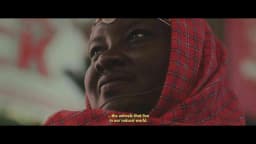
Merck for Mothers' 2018 film 'Reverse' by Matter Unlimited rewinds a daughter's life to expose childbirth risks in the United States, winning two Cannes Lions

Merck for Mothers Reverses Time to Confront Maternal Mortality
'Reverse' is a 2018 public service film created by Matter Unlimited for Merck for Mothers, released in the United States in October 2018, that tells a daughter's life story in reverse chronological order to confront the risk that childbirth could end her mother's life before it begins.
The film operates as both documentary and social experiment. By unwinding a young woman's timeline — from adulthood back through adolescence and childhood toward the moment of her birth — the narrative forces viewers to reckon with what maternal mortality actually erases: every year, every milestone, every relationship a mother would have lived to witness. The structural device is not a stylistic flourish but a strategic one, designed to make abstract public-health statistics feel irreversibly personal in the United States, where maternal mortality rates have risen even as they have fallen across comparable high-income nations.
Merck for Mothers anchors the film to its broader $500 million, ten-year initiative to reduce preventable maternal death, a commitment the organisation announced when it launched the programme in 2011 according to merck.com. The campaign's October 2018 release coincided with Merck for Mothers' announcement of its Safer Childbirth Cities initiative, as reported by 3blmedia.com, intensifying the film's relevance as a piece of advocacy tied to concrete programmatic action. Clapboard.com records the campaign as containing one media asset in the film medium, submitted within the Public Interest category. The Clapboard Score for 'Reverse' is 71 out of 100, reflecting strong creative concept and craft alongside the inherent reach constraints of public service film.
Merck for Mothers identified a specific tension in the United States maternal health conversation. The problem was not public ignorance of childbirth in a general sense but a profound failure of emotional imagination — most Americans do not connect the act of giving birth with the possibility of a mother's death. Matter Unlimited's strategy director Aina Abiodun shaped a brief that required the campaign to close that gap not through statistics alone but through felt experience, reframing maternal mortality as a future stolen rather than a risk endured.
The strategic context in the United States is stark. According to healthaffairs.org, the United States has one of the highest maternal mortality rates among high-income countries, and the problem has worsened over recent decades rather than improved. Merck for Mothers had been working across more than thirty countries since 2011, with initiatives contributing to improved maternal health and family planning access for more than seven million women according to merckformothers.com. The Safer Childbirth Cities initiative, reported by 3blmedia.com as launched on October 1, 2018, brought that global mission into direct focus on American cities, and 'Reverse' served as the emotional case for why domestic action was urgent.
Within the maternal health ecosystem, major organisations including the Bill and Melinda Gates Foundation, USAID, and UNICEF operate substantial advocacy and programme infrastructure according to impactglobalhealth.org. Merck for Mothers distinguishes itself by combining private-sector scale with a documentary-led creative strategy, a positioning Matter Unlimited had established with the predecessor campaign 'Push,' which generated more than four million views across channels and became the most-viewed video in Merck's history according to matterunlimited.com.
Director Spencer Creigh, working through production company Whitelist Collective, executes the reverse-chronology structure with disciplined restraint. The film does not announce its device; it allows viewers to orient themselves gradually as temporal cues accumulate in reverse, so that the emotional weight of the final frame — arrival at birth — lands with the full force of everything that has been shown to exist, and that childbirth's dangers could extinguish. According to jaredelms.com, executive creative director Jared Elms describes the film as a reverse-chronology story about a young daughter confronting the risks of motherhood, a framing that positions the daughter not as passive subject but as the audience's surrogate witness.
Creative director Shabazz Larkin and the Matter Unlimited team, led by founder and CEO Rob Holzer and managing director Alexandra Gordon, constructed a visual language rooted in the texture of ordinary domestic life. Director of photography Dustin Lane's cinematography favours intimacy over spectacle — the lighting choices and frame compositions ground the film in recognisable American domestic space, which is essential to the campaign's public service objective of making maternal mortality feel proximate rather than distant. Producers Ryan Topham and Rich Salamone, with executive producer Jerad Anderson, shaped a production that sustains emotional continuity across a structurally unconventional edit.
Senior account director Michael Lebakken and project manager Allison Kidd shepherded the campaign's delivery within the October 2018 release window tied to the Safer Childbirth Cities announcement. Production credits for 'Reverse' are documented across adsoftheworld.com and jaredelms.com. The film's single-asset execution — one film, no supporting fragmentary content — reflects a deliberate choice to concentrate impact rather than diffuse it across formats.
'Reverse' won two Cannes Lions and two Clios, according to jaredelms.com, placing it among the most recognised public service films of 2018 and 2019 across the advertising industry's two most authoritative award bodies. These honours validate the creative and strategic construct at the level of peer assessment, confirming that the reverse-chronology device and its connection to maternal mortality in the United States landed with the intended force on informed audiences.
No independently verified audience reach or earned-media figures for 'Reverse' are publicly available beyond the awards record. Structural analysis, however, supports a strong inference of advocacy effectiveness. The film released in direct alignment with the Safer Childbirth Cities initiative launch on October 1, 2018, as reported by 3blmedia.com, meaning it entered a news cycle already primed with institutional momentum. The predecessor campaign 'Push' had demonstrated that Matter Unlimited's documentary approach for Merck for Mothers could achieve significant organic distribution, with more than four million views across channels according to matterunlimited.com, establishing a baseline expectation for 'Reverse.'
Merck for Mothers' underlying $500 million commitment, documented by merck.com, provided the campaign with institutional credibility that most public service advertising cannot claim — the film was not asking viewers to trust a message but to engage with an organisation that had already committed a decade of resources to the problem. According to merckformothers.com, that programme reached more than seven million women across more than thirty countries. Within the United States specifically, the campaign contributed to elevating maternal mortality as a public policy conversation at a moment when the issue was gaining renewed legislative and journalistic attention.
'Reverse' is a 2018 public service film created by Matter Unlimited for Merck for Mothers in the United States. It tells a daughter's life story in reverse chronological order to expose the risk that childbirth poses to mothers, connecting to Merck for Mothers' ten-year, $500 million initiative to reduce maternal mortality.
Spencer Creigh directed 'Reverse' through production company Whitelist Collective. The campaign's creative leadership at Matter Unlimited included executive creative director Jared Elms and creative director Shabazz Larkin, with director of photography Dustin Lane handling cinematography, as documented by adsoftheworld.com and jaredelms.com.
'Reverse' won two Cannes Lions and two Clios, according to jaredelms.com. These awards recognised the film's reverse-chronology approach to addressing maternal mortality in the United States as among the most effective public service creative work released in 2018 and judged in the subsequent awards cycle.
Merck for Mothers released 'Reverse' in October 2018 to align with the launch of its Safer Childbirth Cities initiative, announced October 1, 2018, as reported by 3blmedia.com. The film provided the emotional advocacy layer for a programmatic effort targeting maternal health outcomes in cities across the United States.
Merck for Mothers is a ten-year, $500 million programme launched by Merck in 2011 to reduce preventable maternal mortality, according to merck.com. The initiative reached more than seven million women across thirty countries per merckformothers.com. 'Reverse' served as the campaign's US-focused advocacy film at a critical programme milestone.
'Reverse' follows 'Push,' a predecessor campaign developed by Matter Unlimited for Merck for Mothers that generated more than four million views and became the most-viewed video in Merck's history, according to matterunlimited.com. 'Reverse' deepened the documentary approach with a structural reverse-chronology device focused on maternal mortality in the United States.
.webp)
Creative Collaboration Platform: The Backbone of Modern Creative WorkWhat is a creative collaboration platform?Clapboard defines a creative collaboration platform as the operational core for today’s distributed creative teams. This is not a collection of digital collaboration tools stitched together; Clapboard’s system


Understanding the Creative Production MarketplaceWhat is a Creative Production Marketplace?Clapboard defines a creative production marketplace as a structured ecosystem where brands, agencies, and production talent converge to execute video, advertising, and branded content at scale. Unlike the legacy agency or freelanREAD FULL ARTICLE

The Urgent Need for a Creative Production Operating SystemWhy Traditional Creative Production Models Break DownClapboard sees the creative production landscape shifting under pressure. Content velocity is no longer a buzzword—it’s a mandate. Modern advertising demands relentless output across dozens of channels, each wREAD FULL ARTICLE