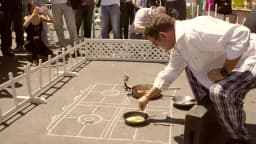
Independent Health Foundation's Vending Machine Prank, created by Gelia in March 2015, used a talking vending machine to challenge US university students to

How Independent Health Foundation Turned a Vending Machine Into a Health Intervention
Independent Health Foundation's Vending Machine Prank is a March 2015 ambient public interest campaign created by Buffalo, New York agency Gelia, in which a talking vending machine at the University at Buffalo surprised students by challenging them to commit to eating healthier choices in the United States.
The campaign operates as a social experiment and documentary-style activation. Rather than broadcasting a conventional public health message, the Independent Health Foundation and Gelia embedded the intervention directly into an everyday moment of consumer decision-making. A vending machine — the precise site where a person chooses between a nutritious option and a less healthy one — became the medium itself. The machine spoke directly to students, prompting an unexpected, human interaction around the eat healthier promise that sits at the heart of the campaign's creative idea.
Classified as ambient media within the public interest category, the campaign produced three documented media assets, according to Clapboard's archive record. The activation targeted a university population in the United States, a demographic with well-documented exposure to on-campus vending infrastructure and a compelling entry point for behaviour-change communication. Independent Health Foundation, launched on September 30, 1992, according to independenthealthfoundation.org, operates as a nonprofit arm focused on community wellness across the Buffalo and Western New York region. This campaign represents the Foundation's creative ambition to move public health communication off the poster and into lived experience. The Vending Machine Prank earns a Clapboard Score of 61 out of 100, reflecting its strong conceptual clarity and award recognition against the constraints of a localised, single-execution format.
Ambient media works when it intercepts behaviour at the moment of decision. The Vending Machine Prank places the eat healthier promise not in a media environment but in a physical one, exploiting the precise instant a person reaches for a snack to deliver a public health message in the United States.
The strategic logic is grounded in behavioural economics. Vending machines on university campuses represent a low-friction, low-awareness purchase environment — students make snack selections quickly and largely on autopilot. By introducing a talking machine that breaks the expected script of the transaction, Gelia created the kind of pattern interruption that health communication research consistently identifies as a precondition for attitude change. The campaign's documentary approach, capturing genuine reactions from University at Buffalo students, amplifies that disruption by turning the prank itself into shareable content, extending the reach of an inherently localised activation.
In the United States, public health campaigns compete for attention in a landscape dominated by well-resourced federal initiatives. The CDC's Tips From Former Smokers campaign, for example, received more than two hundred million dollars in federal funding by 2015, according to Cdc Gov, making it among the largest sustained public health media efforts in the country. Against that backdrop, the Independent Health Foundation's approach — hyperlocal, experiential, and built around surprise rather than broadcast frequency — represents a deliberate alternative strategy available to community-level nonprofits with constrained budgets. Competitors in the ambient public interest space, including the Truth Initiative's tobacco-cessation activations and the American Heart Association's community health programmes, have similarly explored experiential formats to close the gap with mass-media rivals, though few have embedded the message as literally into the point of choice as this execution does.
Bill Paterson and Kathy Kastan served as creative directors on the Vending Machine Prank, with Jason Yates as associate creative director and editor, according to production credits documented at gelia.com.
The creative team's central decision was to make the vending machine itself the talent. Peter Cumbo provided the voice that turned a standard campus fixture into an interactive character, with John Davis handling audio to ensure the machine's speech registered clearly in an ambient environment. Alex Brown served on cameras, capturing the documentary footage of student reactions that forms the backbone of the campaign's three media assets. Producers Kathy Kristich and Michaela Kowalick oversaw execution, with Jon Boal serving as account executive, as documented at gelia.com and clapboard.com.
No director is identified in the available production credits, and no external production company is listed, indicating that Gelia managed the shoot internally. The choice to frame the activation as a social experiment documentary is itself a creative strategy. By recording unscripted human reactions rather than scripted performances, the campaign generates authenticity that a produced television spot cannot replicate. The tone is warm and playful rather than didactic — the word prank signals that this is entertainment first, with the public health message arriving as a consequence of the interaction rather than as an upfront declaration. That balance between surprise and sincerity is the craft achievement that the American Advertising Awards, the Hermes Creative Awards, and the Buffalo ADDYs subsequently recognised. The Healthy Options Talking Vending Machine concept, as it is also identified in campaign records at healthyoptionsbuffalo.com, demonstrates how a single physical prop, a precise location, and disciplined audio production can generate content with a reach disproportionate to its production footprint.
No verified performance data covering reach, views, or audience response metrics for the Vending Machine Prank is publicly available. What is documented is a substantial awards record that provides a credible proxy for industry assessment of the campaign's effectiveness and creative quality in the United States.
The campaign received a Gold award in the Guerrilla Marketing category at the American Advertising Awards in 2016, according to gelia.com. The Hermes Creative Awards granted the work a Platinum award in Viral Marketing, category 134c, in 2016, also per gelia.com. The Buffalo ADDYs awarded the campaign two Gold awards in 2016 — one in Ambient Media and Guerrilla Marketing for a Single Occurrence, and one in Online and Interactive Campaign, as documented at gelia.com and clapboard.com. The PRSA Buffalo Niagara Chapter Excalibur Awards recognised the campaign with a Silver in Social Media Strategy in 2015, per gelia.com.
Structurally, the campaign's effectiveness rests on a closed loop between the physical activation and its digital afterlife. The prank format generates genuine, unscripted reactions; those reactions are captured on camera; the footage becomes distributable content; and the content carries the eat healthier promise to audiences who were never present at the University at Buffalo. That loop — physical event to documentary asset to online campaign — explains both the Guerrilla Marketing recognition and the separate Online and Interactive Campaign award. For a community nonprofit operating in the United States without the media budget of federal health initiatives, this architecture represents an efficient use of a single creative idea across multiple award categories and audience touchpoints.
The Vending Machine Prank is a March 2015 ambient public interest campaign created by Gelia for Independent Health Foundation in the United States. A talking vending machine at the University at Buffalo challenged students to make an eat healthier promise, capturing their genuine reactions as documentary content across three media assets.
Gelia, a Buffalo, New York advertising agency, created the campaign. Creative directors Bill Paterson and Kathy Kastan led the work, with Jason Yates as associate creative director and editor. Peter Cumbo provided the vending machine's voice, John Davis handled audio, and Alex Brown operated cameras, according to production records at gelia.com.
The campaign won a Gold at the American Advertising Awards in Guerrilla Marketing, a Platinum at the Hermes Creative Awards in Viral Marketing, and two Golds at the Buffalo ADDYs — all in 2016, per gelia.com. The PRSA Buffalo Niagara Chapter Excalibur Awards also recognised the campaign with a Silver in Social Media Strategy in 2015.
The activation took place at the University at Buffalo in the United States and was published in March 2015, according to Clapboard's archive record. Independent Health Foundation, a Western New York nonprofit founded in 1992 per independenthealthfoundation.org, used the campus vending environment to intercept students at the point of their snack-purchasing decision.
The Vending Machine Prank receives a Clapboard Score of 61 out of 100. The score reflects the campaign's strong conceptual clarity and its documented record of industry award recognition, balanced against the inherent limitations of a single-location, localised ambient activation without publicly verified audience reach or performance metrics.
.webp)
Creative Collaboration Platform: The Backbone of Modern Creative WorkWhat is a creative collaboration platform?Clapboard defines a creative collaboration platform as the operational core for today’s distributed creative teams. This is not a collection of digital collaboration tools stitched together; Clapboard’s system


Understanding the Creative Production MarketplaceWhat is a Creative Production Marketplace?Clapboard defines a creative production marketplace as a structured ecosystem where brands, agencies, and production talent converge to execute video, advertising, and branded content at scale. Unlike the legacy agency or freelanREAD FULL ARTICLE

The Urgent Need for a Creative Production Operating SystemWhy Traditional Creative Production Models Break DownClapboard sees the creative production landscape shifting under pressure. Content velocity is no longer a buzzword—it’s a mandate. Modern advertising demands relentless output across dozens of channels, each wREAD FULL ARTICLE