 ARCHIVE
Abdul Latif Jameel Motors Brings Ramadan Chaos Home With Toyota
How Abdul Latif Jameel Motors Captured Every Ramadan Feeling in One Film Abdul Latif Jameel Motors...
How Hyundai Reframes the Car as a Living Space With Live in SEVEN
Hyundai's "Live in SEVEN" is a 2021 South Korean film campaign created by INNOCEAN Worldwide that repositions the IONIQ Concept SEVEN electric SUV not as a vehicle but as an intimate, human-centered living space where everyday life — music, livestreaming, family conversation — unfolds naturally on four wheels.
The campaign launched in South Korea in November 2021, timed to coincide with Hyundai's global reveal of the SEVEN concept at AutoMobility LA on November 17, 2021, as documented by hyundainews.com. The concept vehicle was subsequently placed on public display at Hyundai's booth at the Los Angeles Convention Center from November 19 through November 28, 2021, per hyundainews.com. The South Korean campaign ran alongside this international debut, giving the domestic market its own narrative frame while the hardware made its world premiere in the United States.
The creative proposition centres on a deliberate shift in automotive utility. Rather than foregrounding range, performance, or charging infrastructure — the conventional metrics of EV marketing — Hyundai and INNOCEAN Worldwide ask audiences to imagine the SEVEN as a room. A father plays guitar. A daughter conducts a live broadcast. Family members gather to talk. Each vignette asserts the same argument: the automobile has evolved beyond a moving space into a living space. The tagline, "Together, or alone. Live in SEVEN," encapsulates that duality, accommodating solitude and communion within the same interior. The campaign comprised a single primary film asset, a deliberate choice that concentrated creative weight into one cohesive cinematic statement rather than dispersing it across a fragmented media mix. Clapboard Score for Live in SEVEN stands at 69 out of 100, reflecting competent execution of an ambitious conceptual brief within a crowded EV creative landscape.
Hyundai built the Live in SEVEN strategy on a consumer insight that transcends the automotive category: the spaces where people feel most themselves are not defined by architecture but by comfort, permission, and presence.
In South Korea, where urban density and commute culture make private space genuinely scarce, the proposition that a vehicle could function as a personal sanctuary carries particular cultural weight. INNOCEAN Worldwide translated this tension — the need for retreat inside a high-density environment — into a creative brief that asked what an electric vehicle would look like if it were designed around the person rather than the powertrain. The SEVEN concept's physical design supported this argument directly. According to hyundai.com, the SEVEN was presented as a sport utility electric vehicle concept featuring a lounge-like interior architecture, reinforcing the campaign's living-space narrative with tangible product substance rather than pure aspiration.
The broader 2021 automotive advertising context made differentiation essential. Automotive brands collectively ran approximately 33,000 national television advertisements for electric vehicles in 2021, spending an estimated 248 million US dollars — roughly four times the approximately 8,000 advertisements and 83 million dollars spent in 2019, according to ispot.tv as reported by mediapost.com. In that environment, campaigns competing on range figures or technology specifications risked becoming indistinguishable. Competitors including Kia, which was deepening its own EV narrative with the EV6 launch during the same period, and Genesis, Hyundai Motor Group's premium marque, were simultaneously addressing South Korean consumers with design-forward electric propositions. Hyundai's answer was to sidestep the specification arms race entirely and claim the emotional territory of habitation — a positioning move that neither Kia nor Genesis had articulated in precisely the same register at the time.
John S. Park directed the Live in SEVEN main film, with creative direction by Hwang Young Ho and production handled by Planit, according to documentation cited by clapboard.com.
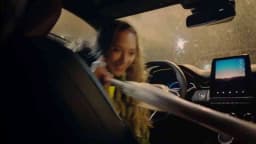
The film operates through domestic tableaux rather than road sequences — a deliberate inversion of the genre conventions that govern automotive advertising. Where the category default is exteriors in motion, sweeping landscapes, and acceleration, Live in SEVEN is essentially interior cinema. The camera dwells inside the SEVEN's cabin as though it were a room, using the vehicle's architectural lines — wide-open sightlines, warm ambient lighting, and lounge-proportioned seating — as set dressing for human moments. A father's guitar, a daughter's broadcasting setup, a family in conversation: each scene is composed to feel unhurried and private, as though the audience has been granted access to something genuinely personal rather than something staged for their consumption.
This approach demanded restraint from both the director and the creative team. The temptation in a concept vehicle reveal — particularly one tied to a high-profile international debut at AutoMobility LA, per hyundainews.com — is to prioritise the exterior design, the silhouette, the reveal. Live in SEVEN resists that impulse almost entirely. The SEVEN's exterior appears selectively and fleetingly; the campaign's visual weight rests inside the cabin, trusting the interior experience to carry the argument. INNOCEAN Worldwide's creative direction by Hwang Young Ho sustains a tonal consistency across the film that keeps the domestic intimacy from tipping into sentimentality. The result is a piece of automotive content that reads more like a short observational film than a product advertisement — a quality that likely accounts for the film accumulating more than nine million views, as documented in the campaign record, without the support of a conventional media-buy-driven amplification strategy.
The Live in SEVEN main film recorded more than 9.9 million views and 11,916 likes, with 658 comments, according to the campaign record. These figures represent organic audience engagement with a single-asset campaign — a meaningful indicator of resonance given that the film was not a product launch advertisement for a commercially available vehicle but a concept-stage brand statement.
No independent third-party performance audit from Campaign, Ad Age, Adweek, The Drum, or Contagious is publicly available for this campaign. Assessment of structural effectiveness therefore draws on the campaign's own documented mechanics. The decision to concentrate the entire creative output into one film rather than a multi-format campaign placed significant pressure on that single asset to generate both reach and depth. The view count suggests it achieved reach. The comment volume — modest relative to views — is consistent with reflective, emotionally oriented content that prompts passive appreciation rather than reactive response, which aligns with the campaign's contemplative tone.
The campaign's timing relative to the SEVEN concept's global debut at AutoMobility LA, per hyundainews.com, gave the South Korean domestic film an implicit halo from international press coverage of the concept vehicle itself. This amplification was structural rather than paid, meaning the campaign's effectiveness was partly contingent on the news cycle surrounding the hardware reveal. For a concept vehicle campaign whose primary objective is brand positioning rather than immediate purchase conversion, the view trajectory and sustained engagement represent a functionally successful outcome within the 2021 South Korean and global automotive communications landscape.
Live in SEVEN is a 2021 South Korean film campaign created by INNOCEAN Worldwide for Hyundai. It positions the IONIQ Concept SEVEN electric SUV as a human-centered living space rather than a conventional vehicle. The campaign launched in November 2021 and comprises a single primary film asset, as documented in the campaign record.
INNOCEAN Worldwide created Live in SEVEN for Hyundai. John S. Park directed the film, with creative direction by Hwang Young Ho and production by Planit, according to documentation cited by clapboard.com. The campaign was published in South Korea in November 2021 alongside the SEVEN concept's international debut at AutoMobility LA.
The IONIQ Concept SEVEN is a sport utility electric vehicle concept from Hyundai. According to hyundai.com, it features a lounge-like interior designed around human-centered use. Hyundai unveiled it at AutoMobility LA on November 17, 2021, per hyundainews.com, with public display continuing through November 28 at the Los Angeles Convention Center.
The Live in SEVEN main film recorded more than 9.9 million views and 11,916 likes, with 658 comments, according to the campaign record. No independent third-party performance audit from outlets such as Campaign, Ad Age, or Adweek is publicly available. The view total is notable for a single-asset concept vehicle campaign without a conventional multi-format media buy.
INNOCEAN Worldwide has produced multiple notable campaigns for Hyundai Motor Group. The agency created the Chatty School Bus campaign, which won a Bronze Lion at the 2018 Cannes Lions, according to Innocean Eu. Live in SEVEN continues INNOCEAN's pattern of positioning Hyundai vehicles through human-centered narratives rather than conventional automotive performance messaging.
Live in SEVEN received a Clapboard Score of 69 out of 100. The score reflects competent execution of an ambitious conceptual brief within a crowded EV advertising landscape. The campaign's strength lies in its tonal restraint and interior-focused cinematography, though its single-asset format limits the breadth of creative evidence available for evaluation.
.webp)
Creative Collaboration Platform: The Backbone of Modern Creative WorkWhat is a creative collaboration platform?Clapboard defines a creative collaboration platform as the operational core for today’s distributed creative teams. This is not a collection of digital collaboration tools stitched together; Clapboard’s system


Understanding the Creative Production MarketplaceWhat is a Creative Production Marketplace?Clapboard defines a creative production marketplace as a structured ecosystem where brands, agencies, and production talent converge to execute video, advertising, and branded content at scale. Unlike the legacy agency or freelanREAD FULL ARTICLE

The Urgent Need for a Creative Production Operating SystemWhy Traditional Creative Production Models Break DownClapboard sees the creative production landscape shifting under pressure. Content velocity is no longer a buzzword—it’s a mandate. Modern advertising demands relentless output across dozens of channels, each wREAD FULL ARTICLE