 ARCHIVE
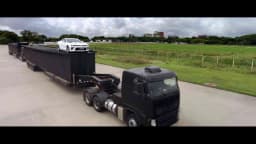
Chevrolet and McCann Celebrate 72 Years in Brazil With a Stunt
How Chevrolet Turned a 72-Year Partnership Into an Automotive Film Moment in Brazil Chevrolet's...
Ford Argentina Bets on Abstract Cinema to Sell Performance
Ford's 'Spinning, Cloud, Paintball' is a three-film campaign created by Blue Hive Buenos Aires, published in Argentina in May 2015, that uses abstract kinetic imagery — spinning motion, dispersing clouds, and paintball impacts — as visual metaphors for the movement, precision, and performance qualities of Ford automobiles.
The campaign arrives at a moment when the Argentine automotive sector is navigating a complex interplay of consumer sentiment, import restrictions, and shifting model preferences. Rather than anchoring the work to a specific vehicle or feature specification, Blue Hive structures the campaign around sensation and suggestion. Each of the three film assets operates as a self-contained visual statement, trading literal product demonstration for impressionistic energy. The choice is deliberate: by decoupling the brand message from any single model, the campaign positions Ford as a performance sensibility rather than a product catalogue entry.
In Argentina, where Ford has maintained a manufacturing and sales presence for decades, the brand competes in a market that values engineering credibility alongside emotional resonance. The three-film format amplifies that credibility argument not through statistics but through craft — the kinetic force of a spinning object, the fluid unpredictability of a cloud dispersing, the precise, high-velocity impact of paintball hits become stand-ins for automotive dynamics that words alone struggle to convey. Clapboard assigns the campaign a score of 63 out of 100, reflecting competent creative execution within a framework that stops short of genuine formal risk. The campaign contains no celebrity presence, no recurring fictional character, and no spokesperson, allowing the visual language itself to carry the entire communicative weight.
Ford occupies a structurally significant position in global automotive sales. According to focus2move.com, Ford sold approximately 6.08 million vehicles worldwide in 2015, representing roughly 6.8 percent of the global light-vehicle market, ranking it third among individual automotive brands that year. Toyota led the same period with approximately 8.40 million units and 9.5 percent global share, while Volkswagen recorded approximately 6.43 million units, according to focus2move.com. These figures establish the competitive pressure Ford faces from two of the industry's most resource-intensive brands.
In Argentina specifically, that competitive pressure translates into a market where brand differentiation must work harder than product specification alone. The Argentine automotive segment in 2015 operates under economic conditions — including currency controls and import tariff regimes — that constrain the range of vehicles available and intensify consumer scrutiny of the brands that do maintain a consistent local presence. Ford's decision to commission a campaign built around abstract sensation rather than comparative feature claims reflects an understanding that Argentine consumers in this environment respond to brand character as much as to product capability.
Blue Hive, the global Ford-dedicated agency network, brings a mandate of brand consistency to markets worldwide, and its Buenos Aires office applies that mandate to a local creative register. The studio-driven, effects-intensive approach of 'Spinning, Cloud, Paintball' aligns with a broader industry pattern, identified across automotive advertising of this period, in which carmakers invest in cinematic shorthand to communicate performance values when direct on-road footage is either cost-prohibitive or creatively insufficient. No campaign-specific market-share data for Ford Argentina in 2015 is publicly available, but the structural logic of the creative approach maps directly onto the competitive dynamics the brand faces from Toyota and Volkswagen in the Argentine market.
The three films that constitute 'Spinning, Cloud, Paintball' are directed by Nicolás Kasakoff and Roi Ricci. Creative leadership is provided by Sebastián Castañeda as general creative director, with Joaquín Ares and Ariel Abadi serving as creative directors, art directors, and copywriters simultaneously — a credit structure that suggests a tightly integrated ideation and execution process rather than a siloed separation of concept from craft.
Kasakoff and Ricci's directorial approach prioritises kinetic intensity over narrative exposition. Each film isolates a single physical phenomenon — rotational spin, cloud dispersal, paintball impact — and treats it with the visual rigour typically applied to product cinematography, but strips away the product itself. The result is a form of automotive advertising that asks the viewer to perform an associative leap: the controlled violence of a paintball strike, the centrifugal pull of spinning motion, the atmospheric unpredictability of a cloud become sensory proxies for the engineering qualities Ford wants associated with its vehicles in Argentina.
The craft decision to work in abstraction is not without precedent in automotive advertising, but it is a choice that demands precise execution. Underdone, the metaphor collapses into obscurity. Overdone, it becomes decorative rather than persuasive. The 2015 campaign sits in productive tension between these risks. Ares and Abadi's copywriting role within a predominantly visual campaign suggests that any textual or verbal elements are subordinate to image — a hierarchy that reinforces the campaign's core argument that Ford's performance character is felt before it is explained. The campaign contains no documented production notes beyond its core credits, and no making-of material is publicly available.
No verified performance data for 'Spinning, Cloud, Paintball' is publicly available. The campaign carries no documented awards from Cannes Lions, the Effie Awards, The One Show, D&AD, the Clio Awards, the Webby Awards, or WARC, and no campaign-specific sales lift, market-share movement, brand-tracking shift, or return-on-investment figure has been recorded in any publicly accessible source. According to Clapboard's editorial assessment, the campaign maintains a modest digital footprint with no underlying view counts or engagement figures available.
Clapboard scores 'Spinning, Cloud, Paintball' at 63 out of 100. That figure reflects a campaign that executes its chosen formal approach with competence — the kinetic metaphor is internally consistent, the production standard is professional, and the three-film structure creates a coherent if compact campaign world — without reaching the level of creative ambition or cultural impact that would distinguish it within the Argentine automotive advertising landscape of 2015.
Structurally, the campaign's effectiveness argument rests on the cumulative weight of its three assets. A single film built around spinning motion or paintball impact would read as a visual experiment; three films using different physical phenomena to make the same emotional point about Ford performance constitute something closer to a creative system. That systematic quality is the campaign's clearest strength, and it represents the most defensible rationale for the abstract approach that Blue Hive Buenos Aires and the Ford Argentina client ultimately chose to pursue.
'Spinning, Cloud, Paintball' is a three-film campaign created by Blue Hive Buenos Aires for Ford, published in Argentina in May 2015. Each film uses a distinct kinetic phenomenon — spinning motion, cloud dispersal, and paintball impact — as a visual metaphor for Ford's automotive performance character, with no product footage or spokesperson featured.
The three films were directed by Nicolás Kasakoff and Roi Ricci. Creative leadership was provided by Sebastián Castañeda as general creative director, with Joaquín Ares and Ariel Abadi credited as creative directors, art directors, and copywriters, all working within Blue Hive's Buenos Aires office for Ford Argentina in 2015.
Clapboard assigns 'Spinning, Cloud, Paintball' a score of 63 out of 100. The score reflects competent execution of an abstract kinetic visual strategy and a consistent three-film creative system, while stopping short of the formal risk or measurable cultural impact that would place it among the more distinguished automotive campaigns of 2015.
No awards for 'Spinning, Cloud, Paintball' are recorded at Cannes Lions, the Effie Awards, The One Show, D&AD, the Clio Awards, the Webby Awards, or WARC. The campaign maintained a modest public profile following its May 2015 release in Argentina and no major industry recognition has been publicly documented for the work.
Blue Hive chose abstract kinetic imagery to communicate performance as sensation rather than specification. By substituting spinning motion, cloud dispersal, and paintball impact for direct vehicle footage, the agency positions Ford's performance character as a felt experience. This approach allows the campaign to work across Ford's model range without anchoring it to any single vehicle or feature.
.webp)
Creative Collaboration Platform: The Backbone of Modern Creative WorkWhat is a creative collaboration platform?Clapboard defines a creative collaboration platform as the operational core for today’s distributed creative teams. This is not a collection of digital collaboration tools stitched together; Clapboard’s system


Understanding the Creative Production MarketplaceWhat is a Creative Production Marketplace?Clapboard defines a creative production marketplace as a structured ecosystem where brands, agencies, and production talent converge to execute video, advertising, and branded content at scale. Unlike the legacy agency or freelanREAD FULL ARTICLE

The Urgent Need for a Creative Production Operating SystemWhy Traditional Creative Production Models Break DownClapboard sees the creative production landscape shifting under pressure. Content velocity is no longer a buzzword—it’s a mandate. Modern advertising demands relentless output across dozens of channels, each wREAD FULL ARTICLE