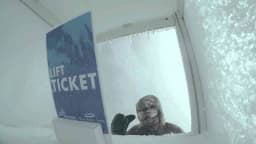
Charicycles and Wunderman Dubai's Stories in the Sand used etched bicycle tyres to leave narrative imprints in UAE desert sand, earning a top-four ranking on

Charicycles Turns Bicycle Tyres Into Desert Storytelling
Stories in the Sand is a March 2019 ambient activation created by Wunderman Dubai for Charicycles, a United Arab Emirates charity that supplies high-visibility vests and helmets to low-income workers who cycle at night, using customised bicycle tyres etched with symbols from those workers' lives to leave narrative imprints across desert sand.
Charicycles occupies an unusual position in the United Arab Emirates advertising landscape. It is not a commercial cycling operator or a tourism brand but a purpose-led charitable initiative addressing a specific and underreported safety risk: the vulnerability of low-income labourers who commute by bicycle after dark without protective equipment. The campaign's central mechanics were built on that identity. Bicycle tyres were etched with vignettes and symbols drawn from the lived experiences of the workers the organisation serves, and those tyres were then ridden across sand so that the imprints accumulated into legible, human-scale narratives on the ground.
The execution featured real beneficiaries, with production records naming Shankar Kunarapu among the workers whose stories were encoded into the tyre designs, according to documentation held at clapboard.com. The activation sat at the intersection of ambient outdoor work and documentary purpose, using the desert terrain of the United Arab Emirates not merely as a backdrop but as the medium itself. Campaign Middle East ranked Stories in the Sand number four on its 2019 Top 10 PR and Activation list, published 22 December 2019, making it one of the most editorially recognised purpose-led activations produced in the UAE that year. Clapboard's editorial team assigns this campaign a Clapboard Score of 63 out of 100, reflecting its conceptual originality and strong regional recognition against limited documented reach data.
Charicycles addresses a genuine and measurable safety gap in the United Arab Emirates. The organisation exists because low-income workers who cycle at night in Dubai and across the wider UAE do so without the reflective gear and protective helmets that would make them visible to motorists. Conventional charity advertising — broadcast appeals, donation drives, poster campaigns — tends to abstract that problem. The strategic choice made by Wunderman Dubai was to instead make the workers' presence undeniable and their stories physically legible in the landscape they actually inhabit.
The ambient format was not decorative. Campaigns of the World, in an October 2019 editorial piece titled "Ambient advertising is here to take the throne," cited Stories in the Sand as a contemporary example of ambient work that succeeds precisely because the medium and the message are inseparable. Sand is the terrain these workers cross. Tyres are what they ride. The imprint is the trace they leave behind, ordinarily invisible, here made monumental. That logic is strategically coherent in a way that a poster campaign would not be.
The broader market context positions Charicycles in sharp contrast to commercial cycling operators. According to research aggregated by Ften Ae and corroborated by adsoftheworld.com, the global bike-and-scooter rental market was estimated at a substantial scale in 2019 and projected to grow considerably by 2027, with major operators including Lime, JUMP, Bird, and ofo competing aggressively across urban markets worldwide. Charicycles operates entirely outside that commercial frame, in the United Arab Emirates, as a welfare and safety organisation rather than a mobility platform. That distinction shaped every strategic decision: the campaign needed to generate empathy and awareness, not conversion or download volume.
Stories in the Sand required a creative team capable of working across physical fabrication, documentary filmmaking, and ambient installation simultaneously. Wunderman Dubai assembled a production structure that reflected that complexity, with the agency's Executive Creative Director Piotr Osinski overseeing a team that included Senior Art Director Gustavo Dallegrave, Associate Creative Director Hassan Bilgrami, and Art Director Fahad Naeem, according to production records documented at clapboard.com and ften.ae.
The physical execution was led by Mockup Artist Tissa K A, whose work involved etching the bicycle tyres with the symbols and vignettes representing workers' lives — a process that required both technical precision and close collaboration with the workers whose stories were being encoded. Production Manager Carla Louis coordinated logistics for a shoot conducted on desert terrain, and Account Director Irmak Aktas managed the client relationship across a project that bridged charitable mission and creative ambition.
The film was produced by First and Ten Productions, with Executive Producers Rajeev Virani, Timothy Fare Matthews, and Peter Farrow overseeing the shoot. Producer Shivani Virani managed on-ground production, while Shantanu Suri served as both director and editor, per documentation available at ften.ae. The strategic architecture was developed by Strategy Director Alvaro Bretel, and freelance artist Dom Ochotorena contributed to the visual development of the tyre designs. The resulting film, which captured the tyre imprints forming across desert sand in real time, reached what production company First and Ten Productions described as hundreds of thousands of views, according to records cited by clapboard.com, though a precise verified figure is not publicly available.

No verified business-effectiveness data for Stories in the Sand is publicly available. No audited figures exist for donation volume, awareness shift, brand-tracking movement, or earned-media valuation attributable to the campaign. The absence of that data is noted here rather than papered over.
What is documented is editorial recognition of a specific and meaningful kind. Campaign Middle East ranked Stories in the Sand number four on its 2019 Top 10 PR and Activation list, as reported by Campaign Middle East in its 22 December 2019 edition. That ranking placed the Charicycles activation ahead of the majority of purpose-led and commercial activation work produced across the United Arab Emirates that year. The campaign was also submitted to the 2019 Dubai Lynx Awards, according to records held at clapboard.com, though nomination, shortlist, and win status are not publicly documented.
Campaigns of the World featured Stories in the Sand in October 2019 as an example of ambient advertising executing at a high conceptual level, per that publication's editorial assessment. First and Ten Productions reported that the campaign film reached hundreds of thousands of views, as noted at clapboard.com, though no third-party verified figure supports that claim with precision. Structurally, the campaign's effectiveness rests on the coherence of its medium-message relationship: in the United Arab Emirates, where ambient work competes for attention against high-production commercial advertising, an activation that uses the actual terrain and tools of its subject community carries inherent credibility. That structural integrity is what the Clapboard Score of 63 out of 100 reflects.
Stories in the Sand is a March 2019 ambient activation created by Wunderman Dubai for Charicycles in the United Arab Emirates. Bicycle tyres were etched with symbols from low-income workers' lives and ridden across desert sand, leaving narrative imprints. Campaign Middle East ranked it fourth on its 2019 Top 10 PR and Activation list.
Charicycles is a UAE charity providing high-visibility vests and helmets to low-income workers who cycle at night. The campaign existed to raise awareness of those workers' vulnerability and humanity. Stories in the Sand used the workers' own terrain and transport as its medium, making their presence visible and their lives legible.
Stories in the Sand was created at Wunderman Dubai under Executive Creative Director Piotr Osinski. The team included Senior Art Director Gustavo Dallegrave, Associate Creative Director Hassan Bilgrami, and Art Director Fahad Naeem. First and Ten Productions produced the film, with Shantanu Suri directing and editing, per production records at clapboard.com and ften.ae.
Stories in the Sand was submitted to the 2019 Dubai Lynx Awards, according to clapboard.com records, but nomination, shortlist, and win status are not publicly documented. No verified wins at Cannes Lions, Clio Awards, D&AD, or The One Show have been recorded. The campaign earned editorial recognition from Campaign Middle East as a top-four PR and activation work.
The tyres were customised by Mockup Artist Tissa K A, who etched each one with symbols and vignettes representing the lives of the low-income workers Charicycles serves, per production records at clapboard.com. When ridden across desert sand in the United Arab Emirates, the etched tyres left sequential narrative imprints that accumulated into readable, human-scale stories on the ground.
Clapboard assigns Stories in the Sand a score of 63 out of 100. The score reflects the campaign's strong conceptual integrity — its medium and message are inseparable — and its fourth-place ranking in Campaign Middle East's 2019 PR and Activation list, balanced against the absence of verified business-effectiveness or reach data for the United Arab Emirates market.
.webp)
Creative Collaboration Platform: The Backbone of Modern Creative WorkWhat is a creative collaboration platform?Clapboard defines a creative collaboration platform as the operational core for today’s distributed creative teams. This is not a collection of digital collaboration tools stitched together; Clapboard’s system


Understanding the Creative Production MarketplaceWhat is a Creative Production Marketplace?Clapboard defines a creative production marketplace as a structured ecosystem where brands, agencies, and production talent converge to execute video, advertising, and branded content at scale. Unlike the legacy agency or freelanREAD FULL ARTICLE

The Urgent Need for a Creative Production Operating SystemWhy Traditional Creative Production Models Break DownClapboard sees the creative production landscape shifting under pressure. Content velocity is no longer a buzzword—it’s a mandate. Modern advertising demands relentless output across dozens of channels, each wREAD FULL ARTICLE