 ARCHIVE
Dyslexic captcha - Jaslok Hospital | Clapboard Ad Archive
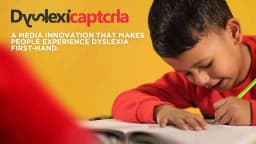
Dyslexic Captcha, created by Dentsu for Jaslok Hospital and launched in India in 2016, delivers a...
Amblyopia World Campaign Turns Printed Paper Into a Vision Test
The Amblyopia World Campaign's 'I Rescue' is a 2018 direct healthcare campaign created by VML Colombia that transformed any available printed material into a low-cost amblyopia screening and treatment tool for parents, launched in Colombia in April 2018.
Amblyopia, commonly known as lazy eye, is a vision development disorder that, left untreated in early childhood, can result in permanent visual impairment or blindness. Access to formal ophthalmological screening remains uneven across Colombia, particularly in lower-income and underserved communities where families have limited contact with specialist medical services. The 'I Rescue' campaign addressed that gap directly and practically.
The campaign's central mechanism was a die-cut paper mask — an inexpensive, playful object that parents could hold over a child's eye while the child read or looked at printed material. The mask functioned simultaneously as a screening device and a treatment aid, making the act of testing a child's vision require no clinical setting, no specialist, and no cost beyond the printed page already in the home. As documented on Behance, the concept was described as an inexpensive tool that empowers parents to proactively screen and treat their child's eyes using any available printed material. VML Bogotá produced the campaign with one media asset, submitted as a direct medium execution, as noted by Clapboard's own editorial records.
In Colombia, where the campaign was conceived and deployed, the strategic logic was grounded in community-level accessibility. The Amblyopia World Campaign sought an idea that could travel without infrastructure — something a parent in a rural municipality or an urban neighbourhood with few clinics could use immediately. The die-cut mask answered that brief with disarming simplicity. Clapboard scores 'I Rescue' at 62 out of 100, reflecting a campaign whose structural ingenuity and award recognition outpace the limited reach of a single-asset direct execution.
VML Colombia built 'I Rescue' around a single, unresolvable tension in paediatric eye care: the children most at risk of undiagnosed amblyopia are precisely those whose families are least able to reach an optometrist. In Colombia, that tension is structural. As reported by Pharma Boardroom, Colombia's healthcare system has made meaningful advances in coverage, yet access to specialist paediatric services — including ophthalmology — remains materially unequal between urban centres and peripheral communities. The 'I Rescue' campaign did not attempt to bridge that systemic gap; it bypassed it entirely by making the parent the screener and any printed page the instrument.
The category context in 2018 made the approach notable. Competing healthcare awareness campaigns in the visual health space — including those by foundations with significantly larger budgets — typically relied on organised school screening events or clinical referral programmes. As reported by afflelou.es, the Fundación Alain Afflelou conducted a 2018 school visual-health campaign in Spain that screened more than eleven thousand children aged five to seven, of whom more than nine thousand required corrective lenses. That programme demonstrated the scale achievable through institutional mobilisation. VML's insight for Amblyopia World Campaign ran in the opposite direction: rather than bringing children to screening infrastructure, the campaign brought screening capability to wherever children already were.
The strategic positioning, as documented on Behance and corroborated by Clapboard's editorial records, explicitly targeted disadvantaged communities with limited access to medical services, recognising that undetected amblyopia in those populations disproportionately contributes to learning difficulties and, in severe cases, permanent blindness. This framing gave the campaign both its humanitarian rationale and its creative constraint — the tool had to cost almost nothing and require no instruction beyond intuition. Antonio López, Group Creative Director at VML, and Creative Director Raquel Jácome developed an execution that met both conditions simultaneously, making the healthcare intervention indistinguishable from a child's toy.
Creative Director Raquel Jácome led the execution of 'I Rescue' at VML Colombia, working under Group Creative Director Antonio López and Executive Creative Director Maurizio Villarreal, with global creative oversight provided by Global Chief Creative Officer Debbi Vandeven and North American Chief Creative Officer John Godsey, as documented on Behance and corroborated by Little Black Book.
The creative solution is deceptively straightforward. A single die-cut paper mask — sized and shaped to fit comfortably over a child's eye — was designed to be punched from or attached to any printed material: a magazine, a book, a poster, a cereal box. The mask's form made the act of covering one eye feel playful rather than clinical, removing the anxiety that a formal eye test might provoke in a young child. The design did not require colour, specialist printing, or proprietary distribution; it could be reproduced by any printer with standard equipment and distributed through any channel that already reached Colombian families — schools, pharmacies, community health posts, or print publications.
The campaign was submitted as a direct medium execution, with one media asset, as noted by Clapboard's editorial records. That single asset carried the full weight of the concept: the mask itself, documented in a campaign visual that showed how any page of printed matter became a functional screening and patching tool the moment the die-cut was applied. The restraint of the production — one object, one idea, zero reliance on digital infrastructure — was both a creative choice and a strategic one. It ensured the tool could reach communities in Colombia where smartphone penetration or reliable internet access could not be assumed. Copywriter Julio Ortiz completed the core creative team alongside López and Jácome, with Managing Director Catalina Hernández overseeing agency operations, as reported by lbbonline.com and Behance.
No verified audience reach, response rate, or media expenditure data for the 'I Rescue' campaign is publicly available, as confirmed by Clapboard's editorial records and corroborated by the absence of such figures across Behance, lbbonline.com, and bizcommunity.com. Performance is assessed here through the campaign's award record, which is fully verifiable and substantial.
As reported by advertising-health.com and Clapboard, 'I Rescue' won a Bronze Lion at Cannes Lions 2018, competing in the Lions Health Non-profit and Foundation-led Education and Awareness category — one of the most scrutinised creative health categories in the global awards calendar. The campaign also received a Shortlist recognition in the same category, as reported by Reason Why. According to D&AD's published records, the campaign received a D&AD Impact Graphite Pencil in 2018, placing it among the year's recognised work in Health and Wellness impact. Bizcommunity.com reports the campaign additionally received a Silver Clio Award in 2018. As documented by advertising-health.com, the campaign earned a Silver at El Ojo de Iberoamérica 2018 in the Unconventional Printed Formats category — a recognition that speaks directly to the die-cut mask's formal ingenuity within Latin American creative culture.
Structurally, the campaign's effectiveness rests on its removal of all friction between intention and action. A parent who encounters the mask can act on it immediately, without a clinic visit, an appointment, or a cost. That zero-barrier architecture is, in the absence of reach data, the most reliable indicator of real-world potential. Clapboard's score of 62 out of 100 reflects that the concept's elegance is not fully matched by documented scale — a limitation inherent to a single-asset direct campaign rather than a criticism of the idea itself.
'I Rescue' is a 2018 healthcare direct campaign created by VML Colombia for the Amblyopia World Campaign. VML Bogotá developed the concept, with creative leadership from Raquel Jácome and Antonio López, and global oversight from Debbi Vandeven. The campaign launched in Colombia in April 2018, as documented on Behance and confirmed by Clapboard's editorial records.
The mask is a die-cut paper device that covers one eye while a child looks at any printed material. Parents use it to screen for lazy eye and as a patching treatment aid. Its design requires no clinical setting and no cost beyond available print media, making it accessible to families across Colombia without specialist healthcare access.
'I Rescue' won a Bronze Lion at Cannes Lions 2018 in the Lions Health Non-profit and Foundation-led Education and Awareness category. The campaign also received a Shortlist recognition in the same category, as reported by reasonwhy.es and advertising-health.com. Both recognitions were awarded during the 2018 Lions Health competition.
'I Rescue' received a D&AD Impact Graphite Pencil in 2018, according to D&AD's published records. The campaign also won a Silver Clio Award in 2018, as reported by bizcommunity.com. Both honours placed 'I Rescue' among the most recognised healthcare advertising ideas of that awards season globally.
Raquel Jácome served as Creative Director and Antonio López as Group Creative Director, with Maurizio Villarreal as Executive Creative Director. Debbi Vandeven held the role of Global Chief Creative Officer and John Godsey served as North American Chief Creative Officer, as documented on Behance and reported by lbbonline.com.
'I Rescue' holds a Clapboard Score of 62 out of 100. The score reflects a campaign whose creative concept and award recognition are strong, but whose single-asset direct format limits documented scale. The score acknowledges the structural elegance of the die-cut mask without overstating the campaign's verified audience reach in Colombia.
.webp)
Creative Collaboration Platform: The Backbone of Modern Creative WorkWhat is a creative collaboration platform?Clapboard defines a creative collaboration platform as the operational core for today’s distributed creative teams. This is not a collection of digital collaboration tools stitched together; Clapboard’s system


Understanding the Creative Production MarketplaceWhat is a Creative Production Marketplace?Clapboard defines a creative production marketplace as a structured ecosystem where brands, agencies, and production talent converge to execute video, advertising, and branded content at scale. Unlike the legacy agency or freelanREAD FULL ARTICLE

The Urgent Need for a Creative Production Operating SystemWhy Traditional Creative Production Models Break DownClapboard sees the creative production landscape shifting under pressure. Content velocity is no longer a buzzword—it’s a mandate. Modern advertising demands relentless output across dozens of channels, each wREAD FULL ARTICLE