 ARCHIVE
Why wait until it’s too late - Mark - DELA | Clapboard Ad Archive
Why wait until it’s too late — Mark is DELA’s standout film campaign from 2014, conceived with...
How WIND Mobile Used a Short Film to Make Italy Feel Something
WIND Mobile's "Dad" is a 2014 Italian short film created by Ogilvy & Mather Italy and directed by Giuseppe Capotondi, exploring the emotional distance that technology creates between a father and child and arguing, on behalf of a mobile network, that face to face communication remains irreplaceable.
Published in Italy in September 2014, the film stands as one of the more structurally ambitious pieces of telecom advertising produced in the Italian market during that period. Rather than leading with tariff comparisons, network coverage maps, or handset promotions, WIND Mobile and Ogilvy built the campaign entirely around a single human relationship — the bond between a parent and a child — and allowed that relationship to carry the brand's commercial argument without interruption. The campaign consists of one media asset, the film itself, trusting the work to do everything that a conventional campaign might distribute across multiple formats.
In the Italian market of 2014, WIND held a competitive but pressured position. According to AGCOM, Italy's mobile telecommunications market contained approximately 96.5 million mobile lines as of 30 June 2014, with WIND holding a mid-year market share of 27.7 percent, behind Vodafone at 30.6 percent and Telecom Italia at 29.7 percent. The campaign therefore arrived at a moment when WIND needed to compete for brand relevance, not just for subscribers, and emotional cinema offered a differentiating register that neither of its two primary rivals was occupying with comparable directness. The decision to pursue cinematic storytelling over product-led advertising reflects a deliberate strategic choice to shift the brand's cultural position in Italy rather than simply defend its commercial one.
WIND Mobile entered the 2014 Italian advertising landscape from a structurally constrained position. According to AGCOM's first-quarter 2014 observatory, WIND held approximately 24.3 percent market share in Italy, behind TIM at 34.1 percent and Vodafone at 31.0 percent. A later comparison reported by Total Telecom placed WIND and 3 Italia combined at 33.6 percent against TIM at 32.2 percent and Vodafone at 27.1 percent. Whatever the precise interval, WIND was not the market leader, and a conventional feature-led campaign risked becoming noise inside a category where Vodafone and TIM both possessed larger budgets, longer brand heritage, and stronger network perception among Italian consumers.
The strategic insight that Ogilvy & Mather Italy pursued with "Dad" is the observation that mobile telecommunications, despite being sold as a connector of people, is increasingly implicated in the disconnection of people who share physical space. That tension — technology as a tool that simultaneously enables and undermines human closeness — was available to any telecom brand willing to acknowledge it honestly. WIND Mobile chose to do so, positioning itself not as a provider of faster data or cheaper calls but as a brand that understands what communication is actually for. In Italy, where familial relationships carry deep cultural resonance, the father-child dynamic selected by the creative team at Ogilvy gave this insight its most direct and emotionally accessible form.
The campaign's single-asset structure — one film, distributed to reach an audience rather than fragmented across a media plan — reflects confidence in the creative work itself and in the appetite of the Italian audience for cinematic storytelling. By 2014, the short film format had established credibility as an advertising vehicle capable of generating genuine viewership rather than passive exposure, and Ogilvy's decision to commit fully to that format rather than hedge with supporting print or outdoor executions signals a strategic conviction that the emotional argument would land harder without dilution.
Giuseppe Capotondi directed "Dad" for WIND Mobile. Capotondi is an Italian director with a background spanning commercial work and feature film, and his involvement gave the production access to the kind of visual grammar more commonly associated with cinema than with telecommunications advertising.
The creative leadership at Ogilvy & Mather Italy on this campaign included Chief Creative Officers Giuseppe Mastromatteo and Paolo Iabichino, Creative Director and Art Director Giordano Curreri, and Creative Director and Copywriter Marco Geranzani. Producer Francesca D'Agostino oversaw the physical production, with video post-production handled by Corte 11 and audio post-production by Top Digital. The clarity of these roles indicates a production process with defined craft responsibilities across each stage, from concept through to final delivery.
The musical choice is one of the most consequential creative decisions in the film. "To Build a Home" by The Cinematic Orchestra — a piece that carries sustained emotional weight across its duration — provides the film's affective structure, ensuring that the audience's emotional state is managed as carefully as the visual storytelling. The selection of an existing composition rather than a purpose-built score suggests that the creative team identified a piece of music already embedded in the cultural consciousness of the target audience and allowed it to do significant narrative work.
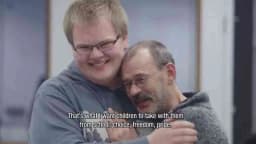
The film's central argument — that face to face communication carries dimensions of presence that mediated communication cannot replicate — is delivered through the father-child relationship without the use of named actors or celebrity endorsers. That restraint is itself a craft decision. By casting the film with performers who carry no existing celebrity associations, the production keeps the audience's emotional attention on the relationship being depicted rather than on the personalities inhabiting it, which reinforces the film's claim that what matters is the human connection, not the individuals who happen to be demonstrating it.
No verified performance data for the "Dad" campaign in terms of sales lift, market-share movement, subscriber growth, brand-tracking scores, or return on investment is publicly available. No confirmed awards at Cannes Lions, the Effie Awards, The One Show, D&AD, the Clio Awards, the Webby Awards, or the WARC Awards are recorded against this campaign.
What Clapboard documents is that the film received nearly one million views, though the methodology and date range for that figure are not formally documented. For a single-asset campaign with no confirmed paid distribution infrastructure on record, that volume of viewership suggests the film generated meaningful organic reach within Italy and potentially across Italian-speaking audiences beyond the domestic market.
Structurally, the campaign's effectiveness argument rests on the coherence between its emotional register and its strategic intent. A telecom brand arguing for the primacy of face to face communication occupies a self-aware, credibility-generating position — one that earns the right to be trusted precisely because it appears to work against its own commercial interest. Campaigns built on that kind of honest tension tend to perform well on brand affinity metrics even when they do not drive immediate conversion, because they shift how an audience thinks about the brand's values rather than about its products. Whether "Dad" achieved measurable brand-tracking movement for WIND in Italy during the fourth quarter of 2014 remains unverified, but its structural logic is sound.
Clapboard rates "Dad" at 72 out of 100, a score that reflects strong creative conviction and production craft offset by the absence of documented performance outcomes and the limited multi-market reach of a single-asset, single-territory campaign.
Giuseppe Capotondi directed "Dad" for WIND Mobile. The Italian director brought a cinematic approach to the Ogilvy & Mather Italy production, which was published in the Italian market in September 2014. Production credits also include Chief Creative Officers Giuseppe Mastromatteo and Paolo Iabichino, with Francesca D'Agostino serving as producer.
WIND Mobile's "Dad" argues that face to face communication offers a depth of presence that technology cannot replicate. The film dramatises the father-child relationship to make that case, positioning WIND as a brand that understands what communication is genuinely for, rather than simply promoting network features or pricing in the Italian market.
"To Build a Home" by The Cinematic Orchestra provides the musical foundation for "Dad." The creative team at Ogilvy & Mather Italy selected the existing composition to carry the film's emotional architecture, allowing a piece already embedded in cultural consciousness to support the visual storytelling rather than commissioning an original score.
WIND held approximately 27.7 percent of Italy's mobile market at mid-2014, behind Vodafone and TIM, according to AGCOM. Competing on features against better-resourced rivals carried risk, so Ogilvy pursued emotional cinema instead, occupying a brand-values register that neither Vodafone nor TIM was filling with comparable directness at that moment.
No confirmed awards for "Dad" are recorded at Cannes Lions, the Effie Awards, D&AD, The One Show, the Clio Awards, the Webby Awards, or the WARC Awards. Clapboard assigns the campaign a score of 72 out of 100, reflecting strong creative craft and a coherent strategic position offset by the absence of documented performance outcomes.
WIND Mobile Italy operated as an independent brand through the mid-2010s before Wind Telecom and Hutchison Whampoa's 3 Italia merged in 2016, according to World Finance. The unified WINDTRE brand launched in March 2020. The "Dad" campaign therefore represents WIND at a distinct moment in its Italian identity, before consolidation reshaped the brand.
.webp)
Creative Collaboration Platform: The Backbone of Modern Creative WorkWhat is a creative collaboration platform?Clapboard defines a creative collaboration platform as the operational core for today’s distributed creative teams. This is not a collection of digital collaboration tools stitched together; Clapboard’s system


Understanding the Creative Production MarketplaceWhat is a Creative Production Marketplace?Clapboard defines a creative production marketplace as a structured ecosystem where brands, agencies, and production talent converge to execute video, advertising, and branded content at scale. Unlike the legacy agency or freelanREAD FULL ARTICLE

The Urgent Need for a Creative Production Operating SystemWhy Traditional Creative Production Models Break DownClapboard sees the creative production landscape shifting under pressure. Content velocity is no longer a buzzword—it’s a mandate. Modern advertising demands relentless output across dozens of channels, each wREAD FULL ARTICLE