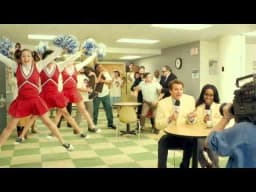
Trace Urban's 'The Most Amazing Beat Box Video Ever,' created by DDB France in 2011, earned over 56 million YouTube views with a single-take Eklips performance.

Trace Urban and DDB Turn a Single Take Into Hip Hop History
Trace Urban's 'The Most Amazing Beat Box Video Ever' is a January 2011 digital campaign produced by DDB France, in which French beatboxer Eklips performs an uninterrupted four-minute history of hip hop in a single continuous take, positioning the media brand as the definitive home of urban culture in France, according to Insee.
The campaign arrived at a precise and deliberate moment. Trace TV had been renamed Trace Urban on 15 December 2010, according to Clapboard.com, and the Eklips film served as the brand's first major public statement under its new identity. Rather than announcing the rebrand through conventional media, DDB elected to embody it: a single artist, a single performance, a single take, with nothing between the viewer and the craft. The message was implicit but unmistakable — Trace Urban does not describe hip hop culture, it inhabits it.
In France, the campaign operated across digital platforms, led by a YouTube release that placed the performance directly in front of the digitally native, music-engaged audiences the channel serves. The creative mechanics were deliberately stripped back, according to Adsoftheworld. There were no cuts, no post-production flourishes, and no voiceover. Eklips moved through decades of hip hop history — voices, rhythms, and references — using only his mouth, breath, and timing. That structural choice transformed a brand film into a demonstration of mastery, making it shareable not because it was advertising but because it was genuinely extraordinary, according to Proxy Siteo Com S3 Amazonaws. Clapboard.com records the campaign as containing a single media asset, a constraint that concentrated rather than limited its impact.
Trace Urban serves a specific and competitive corner of the French media landscape. The channel operates within the thematic cable and satellite sector, targeting young, urban, and music-devoted audiences in France who consume content with a high degree of cultural literacy and a low tolerance for inauthenticity. Any campaign claiming authority over hip hop culture had to earn that authority rather than assert it.
DDB's strategic insight was to use performance art as proof rather than promotion. By commissioning Eklips — already recognised within French beatbox circles as a phenomenon — and filming his four-minute hip hop history in one unbroken take, the agency created content that validated Trace Urban's positioning through the quality of what it chose to platform. The brand did not speak about hip hop; it provided a stage for it. This distinction separates the campaign from the approach taken by competitors such as MTV and Canal+ in France, both of which maintained broader youth entertainment mandates and frequently relied on celebrity talent, branded events, and conventional promotional formats to reach similar demographics.
The market context amplified the opportunity. In France, thematic-channel advertising revenue increased by approximately 42.3 percent to approximately €184.8 million in 2011, according to Echanges Dila Gouv, signalling that niche channels were gaining commercial momentum. At the same time, digital video was maturing rapidly as a distribution and engagement medium. According to practicalecommerce.com, 2011 was a period of accelerating viral video activity on YouTube, with social sharing becoming a measurable campaign metric. Trace Urban and DDB designed their film to perform precisely within that environment, producing content whose value was intrinsic and whose spread was organic.
The campaign's creative execution rests on a single disciplined decision: no cuts. Director Tashi Bharucha, working with production company Atelier Vertigo and sound production from Studio 5, according to Clapboard.com, constructed the entire film around the integrity of Eklips's performance, refusing to offer the audience any editorial escape from its difficulty and precision. That choice is both an aesthetic and an argument.
Eklips performs across the full four minutes without interruption, cycling through the vocal signatures, rhythms, and sonic markers that define decades of hip hop history — from foundational East Coast styles through to contemporary flows. The beatbox form is demanding under any circumstances; sustaining it for four continuous minutes while constructing a coherent historical narrative is a feat of a different order. Bharucha's direction honours that feat by keeping the camera's relationship with the performer simple and stable, ensuring that nothing in the production competes with or diminishes what Eklips is doing in the frame.
The creative team at DDB France included executive creative director Alexandre Hervé alongside creative directors Tashi Bharucha and Clément Reynaud, according to Clapboard.com. Account supervision was handled by Vincent Léorat, with Antoine Michel serving as advertiser supervisor. The production's structural restraint reflects a coherent creative philosophy shared across the team: that the most powerful form of brand communication for Trace Urban in this context was to get out of the way and let an exceptional artist perform. The result is a piece of branded content that functions simultaneously as a music video, a cultural document, and a product demonstration — demonstrating, without stating, what Trace Urban stands for in the French media and entertainment space.
The campaign's performance is documented and substantial. According to Clapboard.com, the YouTube upload for 'The Most Amazing Beat Box Video Ever' accumulated 56,658,409 views, 508,255 likes, and 58,841 comments. These figures place the film well outside the range of conventional branded content and into the category of organic cultural phenomena that happen to carry a brand identity.
According to a separate 2011 social video ranking report cited by Clapboard.com, the campaign received 687,528 shares and ranked among the world's top 20 social video advertisements of that year. For a thematic music channel operating in France rather than a global consumer brand with an international media budget, that ranking represents an exceptional overperformance relative to scale. The campaign achieved reach through genuine audience behaviour — forwarding, embedding, and discussing — rather than through paid amplification alone.
The structural effectiveness of the campaign is equally clear. A single asset, produced with tight creative discipline and zero reliance on celebrity procurement costs or complex post-production, generated engagement metrics that most multi-format campaigns do not approach. The decision to release via YouTube in January 2011, immediately following the Trace TV to Trace Urban rebrand, also served a brand-building function: the channel's new name was introduced to a global digital audience through content that exemplified its values rather than explained them. No verified award wins or finalist listings for this campaign are publicly documented at this time, though its measurable performance stands independent of formal industry recognition. Clapboard Score: 86/100.
Trace Urban's 'The Most Amazing Beat Box Video Ever' is a January 2011 digital campaign created by DDB France. French beatboxer Eklips performs an uninterrupted four-minute history of hip hop in a single take. The film was released on YouTube and accumulated over 56 million views, according to Clapboard.com.
DDB France created the campaign for Trace Urban in 2011. Director Tashi Bharucha led the production alongside executive creative director Alexandre Hervé and creative director Clément Reynaud, according to Clapboard.com. Production was handled by Atelier Vertigo, with sound production by Studio 5.
Eklips is a French beatboxer recognised within France's urban music scene for exceptional technical skill. DDB selected him to embody Trace Urban's rebrand by performing a four-minute, single-take history of hip hop. His credibility within the culture gave the campaign the authenticity the brand needed to validate its positioning.
The campaign accumulated 56,658,409 views, 508,255 likes, and 58,841 comments on YouTube, according to Clapboard.com. A separate 2011 social video ranking report cited by Clapboard.com recorded 687,528 shares and placed the film among the world's top 20 social video advertisements of that year.
DDB used the single-take format to make Eklips's performance impossible to dismiss as edited or constructed. One unbroken take transformed the film into verifiable proof of mastery, which directly mirrored Trace Urban's brand position as an authentic platform for hip hop culture in France rather than a conventional media channel.
Trace TV was renamed Trace Urban on 15 December 2010, according to Clapboard.com, just weeks before the Eklips campaign launched in January 2011. DDB designed the film to function as the brand's debut statement under its new identity, introducing Trace Urban to digital audiences through performance rather than announcement.
.webp)
Creative Collaboration Platform: The Backbone of Modern Creative WorkWhat is a creative collaboration platform?Clapboard defines a creative collaboration platform as the operational core for today’s distributed creative teams. This is not a collection of digital collaboration tools stitched together; Clapboard’s system


Understanding the Creative Production MarketplaceWhat is a Creative Production Marketplace?Clapboard defines a creative production marketplace as a structured ecosystem where brands, agencies, and production talent converge to execute video, advertising, and branded content at scale. Unlike the legacy agency or freelanREAD FULL ARTICLE

The Urgent Need for a Creative Production Operating SystemWhy Traditional Creative Production Models Break DownClapboard sees the creative production landscape shifting under pressure. Content velocity is no longer a buzzword—it’s a mandate. Modern advertising demands relentless output across dozens of channels, each wREAD FULL ARTICLE