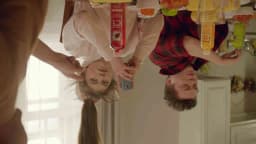
SodaStream's April Fools' Day 2019 campaign starred former NASA astronaut Scott Kelly promoting a fictional burp-powered carbonation device called SodaStreamMe.

Scott Kelly and SodaStream Turn Burping in Space Into an April Fools Moment
SodaStream's April Fools' Day 2019 campaign, titled "Burping In Space …Not!", stars former NASA astronaut Scott Kelly introducing a fictional product called SodaStreamMe — a bottle attachment concept that purports to carbonate water using the user's own burps or excess carbon dioxide — before the prank is revealed through a simple, devastating scientific fact: burping in space is physically impossible.
Published in the United States in April 2019 and created with agency Goodby Silverstein and Partners, the campaign sits within the non-alcoholic drinks category and uses the film medium across two media assets. The execution launched on April 1, 2019, with coverage appearing as early as March 30, 2019, as reported by campaignlive.co.uk and bandt.com.au, signalling a coordinated pre-seeding strategy designed to build anticipation ahead of the reveal. As noted by Campaign magazine in its April Fools' Day 2019 roundup, the fictional SodaStreamMe was described under the headline "One small burp for man, one sparkling leap for mankind" — a framing that captures the campaign's precise tonal register. The objective is straightforward: generate earned media, reinforce SodaStream's irreverent brand voice across the United States, and anchor the home carbonation brand to cultural conversation at a moment when the category faces intensifying competition from both legacy soft-drink giants and emerging sparkling-water challengers. The Clapboard Score for this campaign is 63 out of 100.
SodaStream operates in a competitive non-alcoholic drinks landscape defined by consumer appetite for healthier, lower-sugar hydration alternatives. In the United States, that appetite has driven sustained category growth for sparkling and carbonated water, placing SodaStream in direct competition with ready-to-drink brands such as LaCroix and PepsiCo's own Bubly — a tension made structurally significant by the fact that PepsiCo acquired SodaStream for approximately $3.2 billion in August 2018, as reported by Strategyonline Ca. At the time of that acquisition, SodaStream reportedly had more than 15 million active users and operated across 45 countries, according to strategyonline.ca, underscoring the scale at which the brand was communicating when the Scott Kelly campaign launched.
The strategic rationale for deploying April Fools' Day humour in this context is deliberate rather than opportunistic. SodaStream had by November 2018 achieved ten consecutive quarters of double-digit growth, as reported by strategyonline.ca, meaning the brand entered 2019 from a position of commercial strength rather than defensive urgency. The April Fools' stunt therefore functions as brand-building investment: it reinforces distinctiveness, sustains cultural visibility between product-led campaigns, and generates the kind of press coverage — from campaignlive.co.uk to foodanddrinkbusiness.com.au to dailyhive.com — that paid media cannot replicate. The decision to anchor the stunt to a credible public figure with genuine scientific authority, rather than a conventional celebrity endorser, reflects an understanding that humour lands harder when grounded in verifiable expertise. Against a competitive set that includes Sodastream's rival home carbonation brand Drinkmate, the Scott Kelly execution claims territory that product-feature advertising cannot easily contest: cultural wit.
Scott Kelly anchors the creative execution with a performance that sustains plausibility across the fictional product reveal. Kelly, a retired NASA astronaut and engineer with documented experience aboard the International Space Station, lends the campaign a degree of scientific credibility that is essential to the prank's structural logic. The reveal — that burping in space is physically impossible — depends on the audience believing, at least briefly, that a real product is being presented by a genuine authority. Kelly's own explanation, quoted by bandt.com.au and coffeyandtea.com, provides the scientific underpinning directly: "You can't burp in space. On earth — or in a gravity field — the gas in your stomach is lighter than air, so it rises opposite to the force of gravity." That sentence, delivered in Kelly's register, is both the punchline and the lesson.
The film medium is the appropriate vehicle for this execution. Still or print formats cannot sustain the tonal arc from earnest product demonstration to comic deflation that makes the reveal work. The two media assets documented in the campaign archive on Ads of the World, as noted by adsoftheworld.com, suggest a focused rather than sprawling production, consistent with the campaign's earned-media-first logic: a single well-crafted film, released at the right cultural moment, is designed to travel through press coverage and social sharing rather than through paid distribution. Production credits for the Burping In Space campaign beyond Scott Kelly's on-screen participation and Goodby Silverstein and Partners' agency involvement are not publicly documented in available sources.

No verified performance data for the Scott Kelly SodaStream Burping In Space campaign is publicly available in terms of view counts, earned media value, or conversion metrics. What is documentable is the breadth of editorial coverage the campaign generated across multiple markets. Outlets including campaignlive.co.uk, foodanddrinkbusiness.com.au, bandt.com.au, dailyhive.com, and coffeyandtea.com all covered the activation, and Campaign magazine included it in its curated April Fools' Day 2019 roundup — editorial inclusion that represents meaningful third-party validation for a stunt of this nature.
Structurally, the campaign demonstrates several markers of effective April Fools' advertising. The fictional product, SodaStreamMe, is coherent enough to be taken seriously on first encounter. The reveal is rooted in a genuine scientific fact rather than an arbitrary twist, giving audiences something they can share and explain. The casting of Scott Kelly, a figure with documented credibility in the subject matter, raises the execution above the category average for brand-day stunts. In the United States market, where SodaStream was navigating a newly post-acquisition identity under PepsiCo as reported by strategyonline.ca, the campaign's irreverence signals brand confidence rather than corporate caution. Ads of the World hosts the campaign archive entry as a US film submission, per adsoftheworld.com, providing a persistent reference point for industry professionals researching April Fools' creative benchmarks.
SodaStream's Burping in Space campaign is an April Fools' Day 2019 film starring former NASA astronaut Scott Kelly. Kelly introduces a fictional burp-powered carbonation device called SodaStreamMe before the prank is exposed by the scientific fact that burping in space is physically impossible due to the absence of gravity separating gas from liquid.
Scott Kelly is a retired NASA astronaut and engineer with documented experience living aboard the International Space Station. SodaStream chose Kelly because his genuine scientific credibility makes the fictional SodaStreamMe product plausible on first viewing, ensuring the April Fools' reveal lands with both comedic and educational force for audiences in the United States.
Goodby Silverstein and Partners created the SodaStream Burping in Space campaign. The April Fools' Day 2019 execution was published in the United States and sits within the non-alcoholic drinks category. Coverage appeared across outlets including campaignlive.co.uk and bandt.com.au, confirming coordinated pre-seeding ahead of the April 1 launch date.
SodaStream released the Burping in Space campaign on April 1, 2019. Coverage from campaignlive.co.uk and bandt.com.au appeared as early as March 30, 2019, indicating a deliberate pre-seeding strategy. Campaign magazine included the execution in its April Fools' Day 2019 editorial roundup under the headline "One small burp for man, one sparkling leap for mankind."
The fictional product is called SodaStreamMe. Presented as a bottle attachment, it purports to carbonate water using the user's own burps or exhaled carbon dioxide. The concept is designed to sound plausible before Scott Kelly's scientific explanation — that burping is impossible in microgravity — exposes the entire premise as an April Fools' prank.
The SodaStream Burping in Space campaign received a Clapboard Score of 63 out of 100. The score reflects structural strengths including credible casting, a scientifically grounded reveal, and strong editorial pick-up across outlets such as campaignlive.co.uk, foodanddrinkbusiness.com.au, and bandt.com.au, balanced against the absence of verified performance metrics for the United States market.
.webp)
Creative Collaboration Platform: The Backbone of Modern Creative WorkWhat is a creative collaboration platform?Clapboard defines a creative collaboration platform as the operational core for today’s distributed creative teams. This is not a collection of digital collaboration tools stitched together; Clapboard’s system


Understanding the Creative Production MarketplaceWhat is a Creative Production Marketplace?Clapboard defines a creative production marketplace as a structured ecosystem where brands, agencies, and production talent converge to execute video, advertising, and branded content at scale. Unlike the legacy agency or freelanREAD FULL ARTICLE

The Urgent Need for a Creative Production Operating SystemWhy Traditional Creative Production Models Break DownClapboard sees the creative production landscape shifting under pressure. Content velocity is no longer a buzzword—it’s a mandate. Modern advertising demands relentless output across dozens of channels, each wREAD FULL ARTICLE