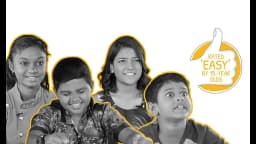
SBI Life Insurance's Thanks A Dot campaign used a Braille-inspired tactile puzzle card to teach breast self-examination, reaching 55.6 million impressions

SBI Life Insurance Turns a Braille Puzzle Into a Breast Cancer Lifeline
SBI Life Insurance's Thanks A Dot campaign is a March 2019 digital and experiential initiative created by WATConsult in partnership with the Women's Cancer Initiative at Tata Memorial Hospital, designed to teach Indian women breast self-examination through a tactile, Braille-inspired puzzle card modelled on real stage-one breast cancer lump shapes.
The campaign launched on 19 March 2019, timed deliberately close to International Women's Day, framing breast cancer awareness not as a cause-adjacent gesture but as a functional public health intervention. At its centre was a physical self-training module: a small puzzle card whose raised dot formations were drawn directly from the contours of stage-one breast cancer lumps. By handling the card, women could familiarise themselves with what an early-stage lump feels like beneath the fingertips, turning a passive awareness message into an embodied self-examination skill. The title itself carries a dual meaning — gratitude extended to the humble dot, both as the foundational unit of Braille and as the diagnostic marker that, found early, can save a life.
In India, where access to specialist oncology screening is unevenly distributed across urban and rural populations, the campaign's self-training mechanic addressed a tangible gap. SBI Life Insurance positioned the initiative not as a product promotion but as a genuine act of brand citizenship, consistent with its broader "Celebrate Life" philosophy documented by afaqs.com. WATConsult, serving as SBI Life's digital and social media partner, engineered the campaign to travel across digital video, social platforms, and physical kit distribution simultaneously, ensuring the Thanks A Dot message reached women in contexts far beyond a clinic or a banner advertisement. Public figures including Mary Kom, Brett Lee, Shashank Singh, and Ashok Choudhary lent their voices to amplify the campaign's reach, as reported by The Drum.
SBI Life Insurance identified a precise behavioural barrier at the heart of Thanks A Dot: fear and unfamiliarity, not lack of awareness, were suppressing early detection rates among Indian women. Sahil Siddiqui, AVP Creative Strategy at WATConsult, was interviewed by exchange4media.com on 29 March 2019, where he emphasised that the campaign's core objective was reducing the fear surrounding self-examination by making the act of detection feel learnable and non-clinical.
This insight separated Thanks A Dot from conventional health campaigns that stop at information delivery. Rather than telling women that self-examination matters, the campaign gave them a tool with which to practise it. The tactile self-training puzzle card functioned as a private, low-stakes rehearsal for a potentially life-saving skill — an approach rooted in behaviour-change theory rather than awareness metrics alone.
The strategic context within India's insurance market was equally significant. According to data cited on slideshare.net, India's life insurance sector recorded total first-year premiums of approximately ₹2.14 lakh crore in FY2018–19, up around 10.73 percent year over year, with private-sector premiums growing at approximately 22.2 percent. Life Insurance Corporation of India held approximately 66 percent market share in new-business premiums during that period, per slideshare.net, leaving SBI Life and competitors such as HDFC Life and ICICI Prudential Life Insurance competing intensely for differentiation in the private segment. In that environment, a campaign that generated genuine public health value — rather than simply selling policies — offered SBI Life a means of building brand trust that product-led advertising could not replicate. The Women's Cancer Initiative at Tata Memorial Hospital provided the medical credibility that made this positioning defensible and the puzzle card's lump-shape data scientifically grounded.
Rajiv Dingra, Founder and Chief Executive Officer of WATConsult, originated the Thanks A Dot concept. Dingra's approach centred on adapting Braille's core logic — meaning communicated through raised tactile dots — to encode medical knowledge about breast cancer lumps in a form any woman could hold, feel, and act upon without clinical assistance.
The physical self-training module was the campaign's creative anchor. Each puzzle card was engineered with raised dot formations corresponding to the shapes and textures of real stage-one breast cancer lumps, developed in collaboration with the Women's Cancer Initiative at Tata Memorial Hospital to ensure medical accuracy. The card's puzzle format added an interactive dimension: assembling the pieces required the same deliberate fingertip pressure and exploratory motion that effective breast self-examination demands, making the training implicit in the act of play. As documented by adsoftheworld.com, the campaign contained one primary media asset, with the tactile kit itself functioning as the campaign's most powerful medium.
The digital execution wrapped around this physical object. A video component explained the card's purpose and demonstrated its use, distributed across social platforms to seed awareness before and after kit distribution. The casting of high-profile advocates — including boxer Mary Kom, whose public identity is built on physical discipline and women's empowerment — reinforced the campaign's credibility without displacing the card as the central creative idea. The Braille inspiration was not decorative: it forged a conceptual connection between two communities navigating the world through touch, and gave the campaign a narrative depth that press coverage, including The Drum's documentation of the initiative, found easy to articulate. Production credits beyond Rajiv Dingra and Sahil Siddiqui's strategic and creative roles are not fully documented in publicly available sources.

The Thanks A Dot campaign generated verified, substantial performance outcomes. As reported by The Drum, the initiative delivered 55.6 million impressions and accumulated more than 3.8 million video views. Demand for the physical self-training puzzle card exceeded initial projections: The Drum also documented that more than 10,000 kits were ordered, confirming that the tactile element of the campaign moved beyond digital engagement into tangible behavioural uptake across India.
Recognition from the industry followed. The Drum reported that WATConsult received a Highly Commended distinction in the Best Integrated Campaign category at The Drum Social Buzz Awards 2019, announced on 1 December 2019. This placed Thanks A Dot among the most strategically coherent social campaigns of that year internationally, a meaningful result for a campaign rooted in a single national market.
Ravindra Sharma, Chief of Brand and Corporate Communications at SBI Life Insurance, stated publicly — as documented by Brandequity Economictimes Indiatimes — that the campaign aimed to inculcate the habit of self-examination at an earlier stage and enable women to take necessary actions sooner. The alignment between that stated objective and the measurable kit uptake suggests the campaign succeeded not just as communication but as a behaviour-change mechanism.
Clapboard rates Thanks A Dot 79 out of 100. The score reflects the campaign's exceptional strategic clarity, its medically validated creative mechanic, and its cross-format coherence. Points from a perfect score are withheld primarily because long-term behaviour-change outcomes and post-campaign clinical impact data are not publicly available, leaving the full public health effect of the self-training module unverified beyond initial engagement figures.
Thanks A Dot is a March 2019 breast cancer awareness campaign by SBI Life Insurance and WATConsult. It introduced a Braille-inspired tactile puzzle card, developed with the Women's Cancer Initiative at Tata Memorial Hospital, that teaches Indian women breast self-examination by simulating the feel of stage-one breast cancer lumps.
WATConsult created Thanks A Dot for SBI Life Insurance. Rajiv Dingra, Founder and CEO of WATConsult, originated the concept, while Sahil Siddiqui, AVP Creative Strategy, guided insight and ideation. The Women's Cancer Initiative at Tata Memorial Hospital provided the medical data underpinning the puzzle card's lump-shape formations.
The Thanks A Dot card used raised dot formations, inspired by Braille, modelled on real stage-one breast cancer lump shapes. Handling and assembling the puzzle trained fingertip sensitivity for self-examination. The card was distributed as a physical kit alongside a digital video campaign, as documented by The Drum and adsoftheworld.com.
Thanks A Dot generated 55.6 million impressions and more than 3.8 million video views, according to The Drum. Over 10,000 physical self-training kits were ordered across India. WATConsult received a Highly Commended recognition in the Best Integrated Campaign category at The Drum Social Buzz Awards 2019.
SBI Life Insurance partnered with the Women's Cancer Initiative at Tata Memorial Hospital to ensure the Thanks A Dot puzzle card's raised dot formations accurately reflected real stage-one breast cancer lump shapes. The partnership gave the self-training module scientific credibility and distinguished the campaign from conventional awareness-only advertising in India's competitive insurance market.
Clapboard rates Thanks A Dot 79 out of 100. The score reflects strong strategic clarity, a medically validated creative mechanic, and cross-format coherence across digital and physical media. The rating stops short of higher marks because long-term behaviour-change outcomes and clinical impact data from the self-examination initiative are not publicly available.
.webp)
Creative Collaboration Platform: The Backbone of Modern Creative WorkWhat is a creative collaboration platform?Clapboard defines a creative collaboration platform as the operational core for today’s distributed creative teams. This is not a collection of digital collaboration tools stitched together; Clapboard’s system


Understanding the Creative Production MarketplaceWhat is a Creative Production Marketplace?Clapboard defines a creative production marketplace as a structured ecosystem where brands, agencies, and production talent converge to execute video, advertising, and branded content at scale. Unlike the legacy agency or freelanREAD FULL ARTICLE

The Urgent Need for a Creative Production Operating SystemWhy Traditional Creative Production Models Break DownClapboard sees the creative production landscape shifting under pressure. Content velocity is no longer a buzzword—it’s a mandate. Modern advertising demands relentless output across dozens of channels, each wREAD FULL ARTICLE