Sam Conniff's #BeMorePirate OOH campaign launched in the United Kingdom in July 2018, turning a book release into a public declaration of rule-breaking

How Sam Conniff Flew a Rebel Flag Over the UK With #BeMorePirate
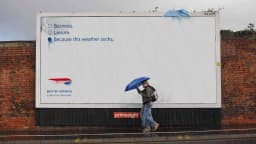
The #BeMorePirate campaign is a July 2018 United Kingdom out-of-home advertising stunt created to mark the release of Sam Conniff's debut book, Be More Pirate, using a single outdoor media asset to project the book's rule-breaking philosophy directly into public space across the UK.
Sam Conniff launched the campaign as a deliberate act of brand theatre. According to campaignlive.co.uk, Conniff described the activation as raising "a rebel pirate flag over the launch of my first book" and taking "the rule-breaking" philosophy off the page and into the street. The campaign sat within the Recreation and Leisure category, a classification that reflects its purpose: not to sell a product in the conventional sense but to energise a cultural conversation around professional nonconformity. Published in the United Kingdom in July 2018, the stunt arrived just weeks after the book itself — Be More Pirate was published on 3 May 2018, according to En Wikipedia — giving the OOH asset the quality of a manifesto posted rather than an advertisement placed.
The campaign comprised one media asset in the available record, a constraint that sharpens rather than diminishes its ambition. In a media environment where campaign reach is typically measured in asset volume and channel spread, the decision to concentrate the message into a single outdoor execution is itself a pirate move — a rejection of conventional advertising logic in favour of singular, undiluted impact. The Clapboard Score for #BeMorePirate is 63 out of 100, reflecting the campaign's conceptual coherence and its alignment with the brand's philosophy, weighed against the limited scale of the documented execution and the absence of verified performance data. As a personal-brand campaign tied to a book launch, #BeMorePirate occupies a distinctive niche in the United Kingdom's outdoor advertising landscape: part literary promotion, part ideological intervention, and entirely consistent with the maverick identity Sam Conniff had spent two decades building.
Sam Conniff built the #BeMorePirate campaign on a strategic foundation that had little in common with conventional travel or leisure advertising. The campaign was classified as Recreation and Leisure advertising, yet its true competitive arena was the crowded United Kingdom market for thought-leadership, keynote speaking, and professional development — a space where personal brand differentiation is everything and traditional advertising is rarely deployed at all.
Conniff's credentials gave the campaign unusual authority from the outset. According to campaignlive.co.uk, he stated that the pirate ethos "has been the underlying ethos of the last twenty years of my agency life, founding and running Don't Panic and then Livity." Livity, the youth-focused purpose-driven marketing agency he co-founded, served clients including Google, Barclays, Tesco, Childline, the BBC, and the UK Cabinet Office, according to en.wikipedia.org. Livity won Social Enterprise of the Year in 2015 and took the BIMA Awards Grand Prix in 2017, according to startups.co.uk — the latter described as the first agency to achieve this distinction. This institutional track record meant that when Conniff planted a flag in outdoor media, the gesture carried the weight of proven practice behind it.
In the United Kingdom, the personal-brand and thought-leadership advertising sector lacks a reliable published market-size estimate for 2018, which makes direct competitive benchmarking difficult. The dominant players in adjacent territory — Google, TripAdvisor, Expedia, and Booking Holdings — operate at scale in travel advertising, according to econsultancy.com, but they represent a fundamentally different category. Conniff's real competitors were other business authors and keynote figures seeking the same senior marketing and leadership audiences. Against that field, an OOH stunt in the United Kingdom was a genuinely disruptive choice: most authors in this space rely on digital channels and earned media rather than paid outdoor placements. The campaign's strategic intelligence lay in applying the rules of brand advertising — presence, spectacle, public ownership of space — to a product category that almost never uses them.
The #BeMorePirate outdoor campaign channelled a single creative idea with deliberate economy. The execution drew its visual and verbal identity directly from the book's core thesis: that the tactics of historical pirates — rewriting the rules, sailing under their own flag, building alternative systems — offer a usable model for modern professionals and organisations unwilling to accept the status quo.
According to campaignlive.co.uk, Conniff described the campaign as an act of taking the rule-breaking philosophy of the book into physical public space, framing it explicitly as a stunt rather than a conventional advertisement. That self-awareness is itself a creative decision. By naming the gesture a stunt, the campaign invites the audience to read it on two levels simultaneously: as a message about piracy and nonconformity, and as a demonstration of those values in the act of placing the message. The outdoor format — inherently public, impossible to skip, occupying shared civic space — was chosen to mirror the book's argument that ideas worth having deserve to be heard rather than merely discovered.
Production credits for the #BeMorePirate campaign are not publicly documented. However, the creative directorship of the campaign's philosophy is unambiguously Conniff's own. According to campaignlive.co.uk, he stated directly: "As far back as I can remember I've wanted to be a pirate, which partly explains the fact that I've just published a book called Be More Pirate." The creative voice present in the OOH asset reflects the same vernacular that runs through the book and Conniff's public persona — direct, irreverent, and intellectually grounded. The single-asset constraint, which might read as a production limitation, functions instead as a creative commitment: one clear flag planted in one place, legible to anyone who encounters it, requiring no supporting material to complete its meaning. In the United Kingdom's outdoor advertising environment, where campaigns typically scale across multiple formats and locations, that singularity registers as a statement of intent.
No verified performance data for the #BeMorePirate campaign is publicly available in the form of sales lift figures, book-sales volume, market-share change, or brand-tracking metrics. No award wins have been confirmed at Cannes Lions, the Effies, The One Show, D&AD, the Clios, the Webby Awards, or WARC. No independently verifiable reviews of the campaign have been located in Campaign, Ad Age, Adweek, The Drum, or Contagious.
What the available record does document is qualitative traction within a professional audience. According to linkedin.com, the campaign energised senior marketers and provoked new thinking among leadership communities in the United Kingdom, with professional endorsements noting the campaign's capacity to make the book's philosophy tangible beyond the page. According to bemorepirate.com, the book and its associated campaign generated a community and a speaking and workshop proposition that extended the brand well beyond a single publication cycle. According to eatsleepworkrepeat.com, Conniff's ideas reached workplace culture conversations that would not typically engage with conventional book marketing.
Structurally, the campaign demonstrates several properties that advertising effectiveness research consistently associates with memorability and cultural resonance: a single, clearly owned idea; a medium chosen for ideological rather than purely demographic reasons; and a brand voice that is entirely consistent across the book, the campaign, and the author's public persona. The absence of documented metrics reflects the campaign's origins as a personal-brand stunt rather than a corporate advertising investment — a context in which formal measurement infrastructure is rarely built in advance. For a single-asset OOH campaign in the United Kingdom operating without a disclosed agency, the degree of professional conversation it sustained is itself a form of impact.
The #BeMorePirate campaign was a July 2018 UK out-of-home advertising stunt created by Sam Conniff to mark the launch of his debut book, Be More Pirate. The campaign used a single outdoor media asset to express the book's rule-breaking philosophy in public space, classified under the Recreation and Leisure advertising category.
Sam Conniff launched the #BeMorePirate campaign in the United Kingdom in July 2018. The campaign appeared weeks after the book itself was published on 3 May 2018, according to en.wikipedia.org. It was a paid outdoor campaign rather than a purely earned-media activation, making it an unusual choice for a personal-brand book launch.
Sam Conniff is the founder of Don't Panic and Livity and the author of Be More Pirate. According to en.wikipedia.org, Livity served clients including Google, Barclays, and the BBC, won Social Enterprise of the Year in 2015, and took the BIMA Awards Grand Prix in 2017, according to startups.co.uk — the first agency to do so.
No agency is publicly credited for the #BeMorePirate campaign. Production credits are not publicly documented. The creative philosophy behind the campaign is attributed directly to Sam Conniff, who according to campaignlive.co.uk described the stunt as a personal act of raising a rebel flag over his book's launch in the United Kingdom.
No verified award wins for the #BeMorePirate campaign have been confirmed. No wins are recorded at Cannes Lions, the Effies, The One Show, D&AD, the Clios, the Webby Awards, or WARC. The campaign received a Clapboard Score of 63 out of 100, reflecting its conceptual strength against its limited documented scale.
No verified sales, reach, or brand-tracking metrics for the #BeMorePirate campaign are publicly available. According to linkedin.com, the campaign energised senior marketers across the United Kingdom and generated professional conversation. According to bemorepirate.com, the book and campaign together sustained a speaking and workshop community well beyond the initial launch period.
.webp)
Creative Collaboration Platform: The Backbone of Modern Creative WorkWhat is a creative collaboration platform?Clapboard defines a creative collaboration platform as the operational core for today’s distributed creative teams. This is not a collection of digital collaboration tools stitched together; Clapboard’s system


Understanding the Creative Production MarketplaceWhat is a Creative Production Marketplace?Clapboard defines a creative production marketplace as a structured ecosystem where brands, agencies, and production talent converge to execute video, advertising, and branded content at scale. Unlike the legacy agency or freelanREAD FULL ARTICLE

The Urgent Need for a Creative Production Operating SystemWhy Traditional Creative Production Models Break DownClapboard sees the creative production landscape shifting under pressure. Content velocity is no longer a buzzword—it’s a mandate. Modern advertising demands relentless output across dozens of channels, each wREAD FULL ARTICLE