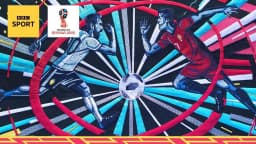
Reporters Without Borders and Leo Burnett Germany launched The Unofficial Football in June 2018, using a digitally rendered ball to expose press freedom

Reporters Without Borders Turns the 2018 World Cup Into a Press Freedom Statement
The Unofficial Football is a 2018 public interest campaign by Reporters Without Borders, created by Leo Burnett Germany, that used a digitally rendered football on the website theunofficial.football to expose press freedom violations in Russia during the 2018 FIFA World Cup.
Reporters Without Borders launched the campaign in Germany in June 2018, timed precisely to coincide with the opening of the FIFA World Cup on Russian soil. The campaign's central mechanism was disarmingly simple: a football rendered in pixelated imagery on a dedicated digital platform. Each pixel, when clicked, revealed documented information about censored media outlets, imprisoned journalists, state surveillance infrastructure, and laws restricting freedom of expression in Russia. The interactive format transformed a universally recognised sporting object into an instrument of public accountability.
In Germany, where football fever reaches a cultural apex during every World Cup cycle, the choice of format was strategically deliberate. The campaign spoke directly to an audience already emotionally invested in the tournament, redirecting that energy toward an urgent human rights issue hosted by the tournament's own nation. Leo Burnett Frankfurt handled both the creative conception and the digital execution, producing a single-asset digital campaign that operated entirely through the web, as documented by Ads of the World and noted in Clapboard's editorial archive.
The organisation behind the campaign, Reporters Without Borders — known in German as Reporter ohne Grenzen — operates as one of the world's foremost press freedom advocacy bodies. Its decision to build a campaign around the World Cup reflected a calculated use of football fever as a media vehicle, inserting a press freedom argument into the dominant cultural conversation of the summer of 2018. The campaign received a Clapboard Score of 63 out of 100, reflecting strong conceptual clarity against a limited media footprint of a single documented asset.
Reporters Without Borders identified a precise cultural window in which public attention in Germany and across Europe would be overwhelmingly focused on a single geographic point: Russia. Football fever surrounding the 2018 FIFA World Cup created a moment when Russia's domestic media environment would face more international scrutiny than at almost any other time, and the campaign was designed to inhabit exactly that scrutiny.
The strategic logic rested on contrast. Millions of fans, broadcasters, and advertisers were pouring enthusiasm and investment into a country whose government maintained documented restrictions on press freedom, journalist access, and independent media. By building The Unofficial Football as a digital experience native to that moment, Leo Burnett Germany gave audiences in Germany and beyond a means to engage with that contradiction without requiring prior knowledge of press freedom issues. The pixelated football functioned as a gateway: familiar enough to attract clicks, subversive enough to reframe what those clicks revealed.
The competitive landscape for public interest advertising in 2018 was, by any measure, crowded. According to the 2018 Good Report, which evaluated 827 campaigns produced by 534 agencies across 74 countries, 27 of the 40 featured campaigns were created for NGOs, institutions, or foundations — indicating that cause-driven work represented a dominant share of recognised creative output that year. Amnesty International ranked first among advertisers promoting good causes in that same report, according to the 2018 Good Report, establishing it as the benchmark competitor Reporters Without Borders and its agency partners were effectively working alongside and against. In this environment, differentiation required not just a worthy cause but a genuinely original mechanism. The Unofficial Football delivered that through its sport-linked digital format, which as reported by Ads of the World and wuv.de distinguished it from conventional advocacy communications of the period.
The Unofficial Football operated as a social experiment dressed in the language of sport. Leo Burnett Frankfurt built the campaign's entire creative architecture around a single digital object — a football — and trusted the interactivity of that object to do the argumentative work that a conventional documentary or manifesto film would have attempted through narration.
The website theunofficial.football presented the ball in a pixelated visual register, a deliberate aesthetic choice that evoked digital obscuring, censorship, and concealment. Users who engaged with the surface of the ball were rewarded with specific, documented information: the names and circumstances of imprisoned journalists, descriptions of surveillance laws, records of censored publications. The experience moved from surface to substance in a single gesture, mirroring the act of investigative reporting itself. As reported by Ads of the World, the mechanism was designed to be both intuitive and quietly confrontational.
The creative team behind the campaign, as documented in award submissions and reported by Ads of the World, included Andreas Pauli, Benjamin Merkel, Hans-Jürgen Kaemmerer, Helge Kniess, Thomas Koch, Mario Loncar, Viktor Kislovskij, Benjamin Kleinert, and Thomas Rusch. The team worked within Leo Burnett Frankfurt's production structure to deliver the campaign as a purely digital execution, with a single media asset at its core. This restraint was itself a creative decision: rather than dispersing the message across formats, the team concentrated impact into one precisely engineered experience.
The campaign sits within a lineage of work Leo Burnett Germany has produced for Reporters Without Borders. The agency previously created We Are Charlie in January 2015, a campaign responding to the attack on the Charlie Hebdo offices in Paris in which journalists and cartoonists were killed, as documented by Ads of the World and the One Club. Both campaigns share a commitment to using culturally resonant moments — a national tragedy, a global sporting event — as frames through which press freedom arguments are made immediate and personal to German and European audiences.
 ARCHIVE
No verified performance data for The Unofficial Football is publicly available. No independent figures for website traffic, user interactions, media reach, or campaign-attributed shifts in public awareness have been published by Reporters Without Borders, Leo Burnett, or any third-party measurement body in relation to this campaign.
Structural analysis, however, reveals a campaign built for depth of engagement rather than breadth of distribution. The decision to anchor the entire experience within a single digital destination — theunofficial.football — meant that every metric of success depended on earned media, word of mouth, and editorial coverage driving traffic to a specific URL. In Germany, where the 2018 World Cup generated sustained mainstream media attention across the summer, the campaign had a plausible mechanism for organic discovery. Coverage noted by wuv.de and recognition documented by nyfadvertising.com indicate the campaign reached industry audiences and award juries, which for a public interest campaign of this scale represents a legitimate secondary objective: influencing how the advertising and media community talks about press freedom.
The campaign's receipt of attention from the New York Festivals Advertising Awards, as reported by nyfadvertising.com, places it within a recognised peer group of distinguished public interest work. Its Clapboard Score of 63 out of 100 reflects the campaign's genuine conceptual strength — the precision of the World Cup timing, the elegance of the pixelated football mechanism, and the specificity of the information it surfaced — weighed against the limitations of a single-asset digital execution without documented reach or conversion data. For a non-governmental organisation operating in Germany with finite communications resources, those structural constraints are themselves part of the story.
The Unofficial Football is a 2018 digital public interest campaign created by Leo Burnett Germany for Reporters Without Borders. Launched in Germany in June 2018, it used a pixelated interactive football on the website theunofficial.football to reveal documented press freedom violations in Russia during the FIFA World Cup, as reported by Ads of the World.
Reporters Without Borders timed the campaign to coincide with the 2018 FIFA World Cup in Russia. The tournament concentrated global media attention on a country with documented press freedom restrictions. Football fever in Germany and Europe gave the campaign a culturally resonant entry point into an audience not already engaged with press freedom issues.
Leo Burnett Frankfurt created The Unofficial Football for Reporters Without Borders. The documented creative team, as reported by Ads of the World, included Andreas Pauli, Benjamin Merkel, Hans-Jürgen Kaemmerer, Helge Kniess, Thomas Koch, Mario Loncar, Viktor Kislovskij, Benjamin Kleinert, and Thomas Rusch, working within a single digital execution format.
The website theunofficial.football displayed a digitally rendered football covered in pixelated images. Users who clicked sections of the ball revealed specific documented information about imprisoned journalists, censored media, surveillance laws, and restrictions on freedom of expression in Russia, as documented by Ads of the World and noted in Clapboard's editorial archive.
The Unofficial Football received recognition from the New York Festivals Advertising Awards, as reported by nyfadvertising.com. The campaign also attracted industry coverage in Germany, noted by wuv.de. It holds a Clapboard Score of 63 out of 100, reflecting strong conceptual execution within the constraints of a single-asset digital public interest campaign.
Leo Burnett Germany previously created We Are Charlie for Reporters Without Borders in January 2015, following the Charlie Hebdo attack in Paris, as documented by Ads of the World and the One Club. Both campaigns share a strategy of using high-profile cultural moments to make press freedom arguments immediate and personally relevant to audiences in Germany.
.webp)
Creative Collaboration Platform: The Backbone of Modern Creative WorkWhat is a creative collaboration platform?Clapboard defines a creative collaboration platform as the operational core for today’s distributed creative teams. This is not a collection of digital collaboration tools stitched together; Clapboard’s system


Understanding the Creative Production MarketplaceWhat is a Creative Production Marketplace?Clapboard defines a creative production marketplace as a structured ecosystem where brands, agencies, and production talent converge to execute video, advertising, and branded content at scale. Unlike the legacy agency or freelanREAD FULL ARTICLE

The Urgent Need for a Creative Production Operating SystemWhy Traditional Creative Production Models Break DownClapboard sees the creative production landscape shifting under pressure. Content velocity is no longer a buzzword—it’s a mandate. Modern advertising demands relentless output across dozens of channels, each wREAD FULL ARTICLE