Plano de Menina's 2019 'The Youngest Candidate #EqualPay' campaign sent a schoolgirl to job interviews to expose Brazil's gender pay gap, created by BETC.

Plano de Menina Sends a 10-Year-Old to a Job Interview to Expose Brazil's Pay Gap
Plano de Menina's 2019 public service campaign 'The Youngest Candidate #EqualPay' placed a ten-year-old girl named Heloisa Teodoro in front of real company recruiters to expose the structural gender pay inequality that forces Brazilian women to effectively begin their working lives a decade earlier than men just to achieve earnings parity.
The campaign launched in Brazil in May 2019, created by agency BETC for Plano de Menina, a social project founded in 2016 and linked to Viviane Duarte's consultancy, Plano Feminino. Plano de Menina's founding mission was to train and connect girls and young women from peripheral communities with education, employment, entrepreneurship, digital inclusion, and personal development opportunities, with an initial target audience of girls aged approximately thirteen to eighteen years old. The campaign's central documentary film asset features Heloisa, a Plano de Menina student, sitting across from recruiters and calmly articulating why she has arrived to apply for a job at age ten: because, as a woman, she will need to enter the workforce ten years earlier than her male peers simply to accumulate equivalent lifetime earnings. That framing transforms a social experiment into an indictment, making the abstract statistical reality of the Brazilian gender pay gap viscerally immediate.
In Brazil, the campaign's core data point was stark: according to Betc Com Br and Grupomulheresdobrasil Org Br, Brazilian women earned up to twenty-three percent less than men in equivalent roles. The public announcement was made on May 2, 2019, by Grupo Mulheres do Brasil in partnership with BETC, establishing a coalition between civil society and the creative industry. Planned campaign activities extended beyond the film to include social-media distribution, employer and company engagement events, and public-policy advocacy, reflecting the ambition of a movement rather than a single advertisement. A campaign manifesto on pay equality was directed at Brazil's Presidency, the Ministry of Justice, city councils, and state bodies, as documented by betc.com and adsoftheworld.com. The campaign earned a Clapboard Score of 66 out of 100, reflecting its strong conceptual clarity and social impact ambition against a lean media asset count.
Plano de Menina identified a precise and counterintuitive insight to anchor the campaign's strategy. Rather than presenting gender pay inequality in Brazil as an abstract future problem for adult women, the creative brief reframed it as a crisis that must begin to be solved in childhood. The decision to deploy a ten-year-old girl as the campaign's central figure was not merely a dramatic device; it was the strategic argument made literal. If Brazilian women must work ten additional years to earn what men earn over a career, according to betc.com.br and grupomulheresdobrasil.org.br, then the most honest representation of that injustice is a child asking for a job she should not yet need.
The campaign operated within Brazil's broader public service and gender-equality advocacy landscape, where organisations such as UN Women Brazil, documented at Onumulheres Org Br, and Grupo Mulheres do Brasil have maintained sustained pressure on both corporate and legislative actors to close the pay gap. The Unstereotype Alliance, which has tracked Brazilian advertising market dynamics and reported market size figures for the country, has similarly documented the relationship between gender-progressive advertising and commercial and societal outcomes. No credible market-share data was publicly available to position Plano de Menina against direct organisational competitors in Brazil's gender-equality training space, but the campaign's explicit outreach to employers and public institutions placed it in direct conversation with corporate diversity initiatives and government labour-policy bodies.
Viviane Duarte founded Plano Feminino in 2010, according to Meioemensagem Com Br, specifically to promote gender and racial equity in marketing and communications, and Plano de Menina emerged from that infrastructure in 2016 as a programme targeting underprivileged girls from peripheral communities in Brazil. That origin story gave 'The Youngest Candidate' an authenticity that distinguishes it from performative corporate gender campaigns: Heloisa Teodoro was a real student of the programme, not a hired actor embodying a cause from the outside. The strategic choice to feature an actual participant from an underprivileged background also wove together themes of girls education, women empowerment, and economic justice into a single, unified narrative.
 ARCHIVE
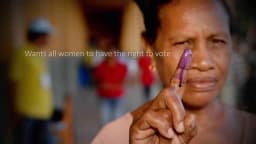
BETC executed 'The Youngest Candidate' as a documentary-style film, a format chosen precisely because its observational register makes the central conceit land as lived reality rather than scripted persuasion. The film places Heloisa Teodoro, a ten-year-old Plano de Menina student from a peripheral community in Brazil, in authentic recruitment settings and allows her quiet, reasoned articulation of the equal pay argument to carry the entire emotional weight of the piece. The documentary approach is the creative strategy: when a child explains structural wage inequality to adults whose professional role is to evaluate candidates, the absurdity and the injustice become self-evident without editorial commentary.
The campaign also incorporated a dedicated movement video under the title 'Salário Igual' — 'Equal Salary' — as documented by betc.com and adsoftheworld.com, extending the creative work beyond a single film into a broader visual and rhetorical vocabulary for the equal pay advocacy effort. This dual-asset approach gave the campaign tools for different contexts: the documentary film for emotional and earned-media impact, and the movement video for social sharing and institutional deployment. On May 17, 2019, twenty young Plano de Menina participants visited the Regional Labor Court of the 2nd Region, TRT-2, South Zone forum in Brazil, as documented by Ww2 Trt2 Jus Br, bringing the campaign's argument directly into a judicial and institutional setting and demonstrating that the creative work was designed to activate real civic participation rather than simply generate views.
Production credits for 'The Youngest Candidate' beyond the agency's role at BETC/Havas are not fully publicly documented across available sources. What is evident from the creative record at betc.com.br and adsoftheworld.com is that the campaign's restraint — a single primary film asset, a real child, an unadorned interview setting — reflects a deliberate craft decision to let the social experiment speak without aesthetic ornamentation. In the context of Brazilian public service advertising in 2019, that economy of means gave the work a credibility that high-production-value approaches would have undermined.
No verified performance data for 'The Youngest Candidate #EqualPay' campaign is publicly available in terms of confirmed view counts, reach figures, or measurable policy outcomes attributable directly to the work. What the public record does confirm, through documentation at ww2.trt2.jus.br, betc.com.br, and adsoftheworld.com, is that the campaign achieved institutional penetration well beyond typical public service advertising: a formal visit by twenty Plano de Menina participants to Brazil's Regional Labor Court of the 2nd Region and a campaign manifesto submitted to the country's Presidency, Ministry of Justice, city councils, and state bodies represent concrete civic activations that few advertising campaigns of any budget achieve.
Structurally, the campaign's effectiveness rests on three reinforcing decisions. First, the choice of a real student rather than a performer gave the film documentary legitimacy that is difficult for audiences or institutions to dismiss. Second, the activation of social media alongside employer events and legislative advocacy created multiple points of pressure on different stakeholder groups simultaneously. Third, the grounding in a precise, verifiable statistic — that Brazilian women earned up to twenty-three percent less than men in equivalent roles, according to betc.com.br and grupomulheresdobrasil.org.br — gave advocates, journalists, and policymakers a concrete figure to carry forward. The Clapboard Score of 66 out of 100 reflects this balance: the campaign demonstrates genuine conceptual strength and real-world activation, while its single primary media asset and the absence of documented scaled reach metrics limit the overall assessment. For a social project serving underprivileged girls in peripheral communities in Brazil, the campaign's ambition to reshape public policy rather than simply raise awareness marks it as a structurally serious piece of public service communication.
'The Youngest Candidate #EqualPay' is a 2019 Brazilian public service campaign by BETC for Plano de Menina. It features ten-year-old Heloisa Teodoro applying for a real job to illustrate that Brazilian women must enter the workforce a decade earlier than men to achieve equivalent lifetime earnings, according to betc.com.br.
BETC, operating as BETC/Havas, created the campaign for Plano de Menina. The public announcement was made on May 2, 2019, by Grupo Mulheres do Brasil in partnership with BETC, as documented by grupomulheresdobrasil.org.br. Plano de Menina itself was founded in 2016, linked to Viviane Duarte's consultancy Plano Feminino.
The campaign highlights that Brazilian women earned up to twenty-three percent less than men in equivalent roles, according to betc.com.br and grupomulheresdobrasil.org.br. This figure underpins the campaign's central argument that women effectively need to begin working ten years earlier than men to accumulate equal lifetime earnings.
Twenty Plano de Menina participants visited Brazil's Regional Labor Court of the 2nd Region on May 17, 2019, as documented by ww2.trt2.jus.br. The campaign also submitted a pay-equality manifesto to Brazil's Presidency, Ministry of Justice, city councils, and state institutions, according to betc.com and adsoftheworld.com.
Plano de Menina is a social project created in 2016 to train girls and young women from peripheral communities in Brazil. According to meioemensagem.com.br, it grew from Viviane Duarte's consultancy Plano Feminino, founded in 2010 to advance gender and racial equity. Its initial target audience was girls aged approximately thirteen to eighteen.
'The Youngest Candidate #EqualPay' holds a Clapboard Score of 66 out of 100. The score reflects the campaign's strong conceptual clarity and genuine civic activation, balanced against a lean single-asset media approach and the absence of publicly verified scaled reach or performance metrics for the Brazil market.
.webp)
Creative Collaboration Platform: The Backbone of Modern Creative WorkWhat is a creative collaboration platform?Clapboard defines a creative collaboration platform as the operational core for today’s distributed creative teams. This is not a collection of digital collaboration tools stitched together; Clapboard’s system


Understanding the Creative Production MarketplaceWhat is a Creative Production Marketplace?Clapboard defines a creative production marketplace as a structured ecosystem where brands, agencies, and production talent converge to execute video, advertising, and branded content at scale. Unlike the legacy agency or freelanREAD FULL ARTICLE

The Urgent Need for a Creative Production Operating SystemWhy Traditional Creative Production Models Break DownClapboard sees the creative production landscape shifting under pressure. Content velocity is no longer a buzzword—it’s a mandate. Modern advertising demands relentless output across dozens of channels, each wREAD FULL ARTICLE