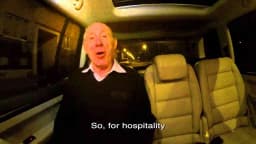
The "Dinner, Dad, Match" campaign by the Norwegian Council for Road Safety aims to communicate the critical dangers of using a phone while driving, emphasizing the potentially tragic consequences on everyday family life. The brand proposition centers on fostering public awareness about road safety by connecting the abstract risk of distracted driving with deeply personal and relatable moments, notably the impact on family interactions. By illustrating how phone use behind the wheel can disrupt and endanger these valued moments, the campaign seeks to instill a sense of responsibility and urgency around safe driving behavior.
Strategically, the campaign leverages a social experiment and documentary tone to establish authenticity and emotional resonance. Targeting Norwegian drivers, the approach taps into the universal insight that family and shared mealtime experiences are central to everyday life and thus highly valued by the audience. By dramatizing the consequences of phone-driving through realistic audio narratives—three radio spots including "Phone driving - Dinner"—the campaign uses storytelling to create a vivid mental picture of loss and disruption without relying on graphic visuals, given its audio medium. This creative angle facilitates personal reflection among listeners, encouraging them to internalize the message and reconsider their own driving habits. The campaign’s choice of radio as the medium maximizes reach during commutes when the behavior in question occurs, making it contextually relevant. The modest engagement metrics hint at a niche but focused effort to influence public attitudes rather than mass commercial appeal. Overall, the campaign integrates behavioral insight, emotional storytelling, and strategic timing to advance road safety awareness within a socially responsible framework.
FORMAT#2 SHOW THE PROBLEM — Highlights a relatable problem, then shows the product as the solution.
This campaign is a radio/audio series for the Norwegian Council for Road Safety, falling under the public service category with documentary/social experiment cues. The title “Phone driving – Dinner” strongly suggests a dramatized everyday situation (e.g., a dad on the phone while driving, missing out on dinner or risking safety)—a classic scenario where the problem is foregrounded. The creative likely depicts the real danger or consequences of phone-use while driving, then connects this scenario directly to the need for road safety, effectively “showing the problem” in a relatable context with an implied solution: don’t use the phone while driving. There’s no evidence of storytelling resolution, symbolic abstraction, celebrity, or competitive contrast, nor aspirational or parodic elements, making this the clearest fit.
ADVERTISING FORMATS EXPLAINED: https://www.clapboard.com/blog/branding-and-advertising/brand-strategy/12-advertising-creative-formats
1. Trygg Trafikk – Norway’s leading road safety organization focused on education and awareness campaigns targeting all demographics. Their positioning emphasizes community engagement and preventative measures through school programs and public outreach, promoting long-term behavioral change on Norwegian roads.
2. Swedish Transport Administration (Trafikverket) – Although based in Sweden, they influence Scandinavian road safety standards with data-driven campaigns centered on infrastructure safety improvements and technological innovation, positioning themselves as a forward-thinking public authority enhancing traffic environments.
3. Danish Road Safety Council (Færdselssikkerhedsrådet) – Denmark’s primary public body for road safety, known for integrating research-based insights with behavioral psychology in campaigns. They position themselves as experts in creating impactful messaging that reduces accidents via culture and attitude shifts.
4. European Transport Safety Council (ETSC) – An NGO operating across Europe, ETSC advocates for policy changes and cross-border cooperation on road safety. Their strategic angle is authoritative influence through data advocacy and harmonized safety standards across member states.
5. Norwegian Public Roads Administration (Statens Vegvesen) – A government agency that manages road infrastructure and safety regulations in Norway, focusing on combining enforcement with public education. They differentiate themselves by blending practical infrastructure solutions with user-focused awareness campaigns.
Q: What is Dinner, Dad, Match about?
A: Dinner, Dad, Match is a professional audio campaign launched in Norway in 2012 for the Norwegian Council for Road Safety, developed by the agency TRY. The campaign consists of three radio spots designed to address the dangers of using a phone while driving, with each spot dramatizing the real-life consequences of distracted driving. Produced by Både Og and directed by Petter Jahre, the campaign leverages relatable family scenarios to highlight the risks not only to drivers but also to those waiting for them at home. Its core creative idea is to foster awareness and behavioral change around road safety through emotionally resonant storytelling.
Q: What creative device does Dinner, Dad, Match use?
A: Dinner, Dad, Match employs the FORMAT#2 SHOW THE PROBLEM technique, as classified by Clapboard’s 12-format taxonomy. This approach highlights a relatable issue—in this case, phone use while driving—by dramatizing everyday scenarios where the problem manifests, such as a family dinner disrupted by a distracted parent. The campaign refrains from offering a direct solution within the narrative, instead allowing the emotional impact of the problem to prompt self-reflection among listeners. By focusing on the consequences of phone driving, the campaign leverages the audio medium’s intimacy to create a vivid and memorable cautionary message.
Q: What is the campaign proposition for Dinner, Dad, Match?
A: The campaign proposition for Dinner, Dad, Match centers on communicating the critical dangers of phone use behind the wheel, emphasizing how such distractions can have profound consequences on family life. The Norwegian Council for Road Safety positions itself as a champion of public awareness, targeting Norwegian drivers by connecting the abstract risks of distracted driving to deeply personal and relatable moments, such as shared meals with loved ones. By dramatizing these scenarios in an authentic, documentary-style audio format, the campaign seeks to instill a sense of responsibility and urgency around safe driving behavior, aiming to shift attitudes and reduce accidents.
Q: How does Dinner, Dad, Match rank in Clapboard's archive?
A: Dinner, Dad, Match holds a Clapboard Campaign Score of 57/100 in Clapboard’s global ad archive. This score reflects the campaign’s creative ambition, execution quality, and cultural relevance within the public service and road safety category.
Q: Who are the competitors in Norwegian Council for Road Safety's category?
A: In the road safety and public interest sector, the Norwegian Council for Road Safety faces competition from several key organizations. Trygg Trafikk leads in Norway with a focus on education and community engagement, while the Swedish Transport Administration influences the region with data-driven, infrastructure-focused campaigns. The Danish Road Safety Council leverages behavioral psychology to shift attitudes, and the European Transport Safety Council operates across Europe advocating for policy and harmonized safety standards. Additionally, the Norwegian Public Roads Administration combines regulatory enforcement with public education, blending infrastructure solutions with awareness efforts.


 ARCHIVE
.webp)