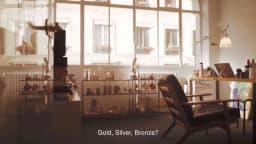
Müpa Budapest's 2021 Christmas short film Ajándék stars István Várdai and Mari Nagy to celebrate the community-building power of culture across Hungary.

Müpa Budapest Turns Christmas Into a Meditation on Community
Müpa Budapest released Ajándék (The Gift), a Christmas short film, in Hungary in December 2021 to celebrate the shared human moments that art and culture make possible, starring world-renowned cellist István Várdai alongside actress Mari Nagy and young performer Emma Kádár.
The campaign, titled "The best moments are those we spend together," was conceived entirely in-house by Müpa Budapest and directed by Péter Bergendy. It represents the continuation of a tradition Müpa established approximately two years earlier, when the institution first set out to produce a Christmas short film as an act of gratitude toward the audiences who had supported it throughout the year. What began as a thank-you evolved into something with considerably wider cultural resonance. By 2021, the community-building power of culture had taken on renewed urgency across Hungary and beyond, as audiences navigated the aftermath of pandemic-era isolation and rediscovered the value of shared experience.
The narrative follows a tight-knit neighbourhood community: a music-loving elderly woman, a mysterious neighbour, and a warm-hearted young girl who together encounter unforgettable moments mediated by art. The Liszt Ferenc Chamber Orchestra performs within the film, and members of Müpa's own Müpa+ loyalty programme appear on screen, anchoring the story in a real and recognisable community rather than a purely fictional world. In this way, the campaign functions simultaneously as institutional storytelling and audience celebration, making its Hungarian viewers both the subject and the intended recipients of the gift the title promises. The Clapboard Score for this campaign is 77 out of 100, reflecting strong creative intent and cultural relevance within the Hungarian media and entertainment landscape.
Müpa Budapest made a deliberate creative choice by investing in long-form narrative film at a moment when Hungary's advertising market was moving rapidly toward short, performance-driven digital formats.
According to Mrsz Hu, Hungary's total media advertising spending in 2021 reached HUF 304.9 billion, representing growth of 19.5% year on year. Within that expanding market, digital platforms accounted for HUF 101.8 billion, or 33.4% of total Hungarian media spending, also per mrsz.hu. Online video advertising in Hungary grew 44% in 2021, social-media marketing grew 38%, and programmatic advertising grew 75% in the same period, according to mrsz.hu. Against this backdrop, the dominant commercial logic favoured short, targeted, measurable content. Müpa Budapest moved in the opposite direction, choosing a cinematic short film that prioritises emotional depth over conversion metrics.
The strategic rationale is rooted in institutional differentiation. In the Hungarian cultural and entertainment sector, Müpa Budapest competes for audience attention not only with other performing arts venues such as the Magyar Állami Operaház (Hungarian State Opera) but also with global streaming platforms that have accelerated their penetration of the Hungarian market. Where competitors often rely on programme announcements or event-driven promotional content, Müpa's Christmas film positions the institution as a cultural narrator rather than a ticket vendor. According to Iabeurope Eu, Hungarian digital advertising reached approximately 545 million euros in 2021, growing 27.6% year on year, underscoring the intensity of the digital attention economy Müpa was navigating. By casting real Müpa+ loyalty programme members alongside professional artists, the campaign transforms audience participation into brand identity, a strategy that builds long-term institutional attachment rather than short-term footfall.
Péter Bergendy directed Ajándék, bringing to the film a sensibility attuned to intimate human drama within precisely observed social environments.
The production centres on a deceptively simple neighbourhood setting in which music becomes the catalyst for connection between characters who might otherwise remain strangers. Mari Nagy portrays the music-loving elderly woman at the heart of the story, while world-famous cellist István Várdai appears as himself, a figure whose artistry crosses the threshold between professional performance and personal encounter. Emma Kádár plays the warm-hearted young girl whose curiosity sets the narrative in motion. The Liszt Ferenc Chamber Orchestra provides the musical spine of the film, grounding the emotional arc in the specific sonic world that Müpa Budapest inhabits year-round.
The most consequential creative decision was the inclusion of real Müpa+ loyalty programme members as on-screen participants. This choice collapses the distance between institutional communication and genuine community expression. The audience does not merely watch a story about togetherness; it watches itself, or a recognisable version of itself, experience togetherness. The production achieves visual warmth through domestic and architectural settings that feel lived-in rather than staged, reinforcing the film's central argument that art does not require a concert hall to transform ordinary life. The screenplay and visual language together translate the Hungarian-language title, Ajándék, as both a literal object exchanged between characters and a metaphor for the gift that cultural experience represents. Production credits beyond the director and cast for Ajándék are not comprehensively documented in publicly available sources, though Müpa Budapest's press office submitted the campaign for industry record.
Ajándék accumulated verified performance data that places it among the more widely seen pieces of Hungarian cultural institution marketing from the 2021 period.
According to figures reported at the time of submission, the film generated 268,745 YouTube views, 1,518 likes, and 56 comments. For a non-commercial cultural institution operating in a country with a population of roughly ten million, these figures represent meaningful organic reach rather than paid amplification. No independent critical reviews of the campaign were published in international trade press including Campaign, Adweek, Ad Age, The Drum, or Contagious, which limits external triangulation of its industry impact.
Within Hungary, Müpa Budapest's broader marketing output has attracted recognition from the Arany Penge awards, the domestic industry body that benchmarks Hungarian advertising effectiveness, according to Aranypenge Hu. Earlier Müpa campaigns, including the 2018 Budapest Wagner Days work titled A látható Wagner (The Visible Wagner), created by Geometry Budapest, received Arany Penge recognition in 2019 according to aranypenge.hu, establishing a precedent for the institution's creative ambitions. Structurally, Ajándék demonstrates several properties associated with sustained brand equity in cultural marketing: authentic casting drawn from the existing audience community, a narrative that elevates the institution's core purpose rather than promoting individual events, and a production quality that signals investment and respect for the viewer. These qualities position the film as a long-cycle asset capable of reinforcing Müpa Budapest's identity across multiple touchpoints well beyond the December 2021 release window.
Ajándék, meaning The Gift, is a 2021 Christmas short film created by Müpa Budapest in Hungary. It follows a music-loving elderly woman, a mysterious neighbour, and a warm-hearted young girl whose lives are transformed by a shared encounter with art, illustrating how culture strengthens community bonds in everyday life.
Péter Bergendy directed Ajándék for Müpa Budapest. The film stars Mari Nagy, world-famous cellist István Várdai, and young performer Emma Kádár, alongside the Liszt Ferenc Chamber Orchestra. Members of Müpa's own Müpa+ loyalty programme also appear on screen, making the audience an active part of the narrative.
Ajándék recorded 268,745 YouTube views, 1,518 likes, and 56 comments following its December 2021 release in Hungary. For a cultural institution film in a market of roughly ten million people, this represents strong organic reach without reliance on paid distribution infrastructure.
Müpa Budapest chose narrative film to differentiate itself within Hungary's rapidly digitalising advertising market. Rather than promoting individual events, the campaign positions Müpa as a cultural narrator. The strategy builds long-term institutional identity by making its own audience community the subject and the recipient of the story.
The Clapboard Score for Müpa Budapest's Ajándék campaign is 77 out of 100. This score reflects the campaign's strong creative intent, authentic casting of real community members, and its cultural relevance within the Hungarian media and entertainment sector during the 2021 Christmas period.
Ajándék continues a Christmas film tradition Müpa Budapest began approximately two years before 2021. The institution has a documented record of award-recognised creative work in Hungary, including the 2018 Budapest Wagner Days campaign, which received Arany Penge recognition in 2019 according to aranypenge.hu, establishing creative ambition as an institutional constant.
.webp)
Creative Collaboration Platform: The Backbone of Modern Creative WorkWhat is a creative collaboration platform?Clapboard defines a creative collaboration platform as the operational core for today’s distributed creative teams. This is not a collection of digital collaboration tools stitched together; Clapboard’s system


Understanding the Creative Production MarketplaceWhat is a Creative Production Marketplace?Clapboard defines a creative production marketplace as a structured ecosystem where brands, agencies, and production talent converge to execute video, advertising, and branded content at scale. Unlike the legacy agency or freelanREAD FULL ARTICLE

The Urgent Need for a Creative Production Operating SystemWhy Traditional Creative Production Models Break DownClapboard sees the creative production landscape shifting under pressure. Content velocity is no longer a buzzword—it’s a mandate. Modern advertising demands relentless output across dozens of channels, each wREAD FULL ARTICLE