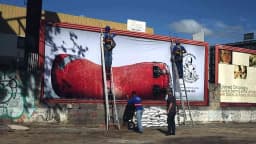
Lifebuoy's Bacteriads campaign by The Electric Factory placed live bacteria cultured from banknotes and smartphones inside poster-sized Petri dishes across

Lifebuoy Bacteriads Turned Living Bacteria Into Outdoor Advertising
Bacteriads is a 2016 outdoor advertising campaign created by The Electric Factory for Lifebuoy in Uruguay, in which live bacteria cultured from everyday objects — banknotes and smartphones — were grown inside poster-sized custom Petri dishes and displayed as physical installations in shopping malls to make hand contamination viscerally visible.
Lifebuoy launched Bacteriads in December 2016, placing the campaign within the House, Garden, and Pharmaceutical advertising category. The campaign consisted of a single media asset — a live biological installation — that collapsed the boundary between evidence and advertisement. Rather than illustrating the case for handwashing through conventional photography or animation, The Electric Factory chose to cultivate the argument itself, turning microbiology into the medium. The Petri dishes required several days of bacterial growth before being presented as finished outdoor advertisements, according to coverage archived by Clapboard.
In Uruguay, the campaign ran in various shopping malls, selecting high-footfall retail environments where the objects most likely to carry bacteria — money and mobile phones — change hands constantly. The strategic logic was immediate: the audience was surrounded by the very surfaces the installations indicted. Lifebuoy, a Unilever brand with a longstanding global commitment to hand hygiene behaviour change, used Bacteriads to demonstrate rather than assert the invisible threat that soap addresses. The campaign earned a Clapboard Score of 79 out of 100, reflecting strong creative originality and category relevance within personal care advertising. Bacteriads represents one of the more forensically literal executions in Lifebuoy's creative history, connecting the brand's public health mission directly to the physical reality of bacterial contamination in everyday Uruguayan life.
 ARCHIVE
Lifebuoy's Bacteriads campaign operates on a single, compellingly direct insight: that advertising for antibacterial products had consistently told consumers bacteria were dangerous without ever showing them the evidence. Juan Ciapessoni, Group Chief Creative Officer at The Electric Factory, articulated this clearly in a December 2016 interview with LBBOnline: "Advertising, until now, told you that bacteria are bad and cause disease." Bacteriads was designed to close that gap between claim and proof.
The campaign's strategic timing connected to the global conversation around handwashing behaviour, a conversation that had gained institutional weight by 2016. That year, handwashing with soap and water was incorporated into the United Nations Sustainable Development Goals under SDG 6, through an indicator measuring access to a handwashing facility with soap and water at home, according to Unilever's published sustainability reporting. Lifebuoy's campaign in Uruguay did not merely ride that moment — it gave it a form that required no statistics to land. The Petri dish installations made the invisible argument tangible.
Within the competitive landscape of personal care advertising in Uruguay, brands such as Dettol — Lifebuoy's most direct global antibacterial rival — and local pharmacy-channel products typically rely on clinical imagery and percentage-kill claims. Bacteriads departed entirely from that convention, using the category's own scientific vocabulary — the Petri dish, bacterial culture, microscopic life — as the creative raw material. The choice of banknotes and smartphones as bacterial sources was also strategically precise: these are the objects that move through the most hands in a shopping mall environment, grounding the installation's message in the specific behaviour of the audience encountering it. For a Unilever brand operating in Uruguay's personal care market, the campaign demonstrated that scientific credibility and creative provocation are not opposing forces.
Bacteriads required no VFX, no digital retouching, and no constructed imagery. The Electric Factory built the campaign's visual language from biological reality, commissioning the cultivation of live bacteria harvested from banknotes and smartphones inside custom-built, poster-sized Petri dishes.
The production process was itself a form of art direction with an inherent timeline. Bacteria collected from everyday objects were introduced into the Petri dishes and allowed to cultivate over several days before the installations were ready for public display, as documented in coverage cited by Clapboard. The resulting imagery — colonies of microorganisms spreading across a growth medium at advertising scale — carried an authority that no rendered simulation could replicate. The craft decision to use real biological material meant that every installation was, in a literal sense, unique and unrepeatable.
The creative team behind Bacteriads brought together a range of disciplines. Juan Ciapessoni served as Executive Creative Director, with Federico Cibils and Gustavo Etchandy as Creative Directors. Art direction was handled by Javier Gómez, and Piter Moreira directed, according to credits documented in LBBOnline's December 2016 coverage. The placement of these installations in shopping malls across Uruguay introduced an additional layer of craft consideration: the works needed to be legible at the scale and viewing distance of outdoor advertising while retaining the intimate, almost clinical detail that gave them their credibility. The absence of VFX or digital embellishment was not a constraint but a commitment — the campaign's persuasive power depended entirely on the audience understanding that what they were seeing was real. In a category saturated with animated microbe sequences and laboratory-aesthetic stock footage, that restraint was itself a creative statement.
No independently audited performance data for the Bacteriads campaign is publicly available through verified brand or agency reporting. However, one documented reach figure exists: Bacteriads achieved approximately one million views within one month of launch, according to Starship industry coverage published on March 10, 2017. This figure positions the campaign as having achieved meaningful scale for an OOH execution in Uruguay, a market where a single-asset installation campaign reaching that volume of impressions represents a significant earned-media multiplier beyond its physical footprint.
Structurally, the campaign's effectiveness rests on several reinforcing decisions. The choice of shopping malls as the placement environment ensured that the audience was physically proximate to the bacterial sources — banknotes and smartphones — that the installations displayed, creating an immediate and embodied relevance. The biological authenticity of the Petri dish format gave the campaign a credibility premium that conventional OOH imagery cannot generate: viewers were not being asked to accept a visual metaphor but to look at actual evidence. This distinction matters for a personal care brand like Lifebuoy, where purchase behaviour is linked to perceived efficacy rather than emotional affinity alone.
Bacteriads also operated within Lifebuoy's broader lineage of behaviour-change communication, a tradition that includes the globally recognised Help a Child Reach 5 platform from 2013, which focused on handwashing at critical occasions to reduce childhood illness, as documented through media coverage in Brand Equity by The Economic Times. Within that lineage, Bacteriads represents a formal evolution: from narrative persuasion toward biological demonstration. The campaign holds a Clapboard Score of 79 out of 100, reflecting strong creative and strategic coherence for its category and market.
Bacteriads is a 2016 outdoor advertising campaign created by The Electric Factory for Lifebuoy in Uruguay. Live bacteria cultured from banknotes and smartphones were grown inside poster-sized custom Petri dishes and displayed in shopping malls, making invisible hand contamination physically visible to consumers in a retail environment.
The Electric Factory, a Uruguayan creative agency, produced Bacteriads for Lifebuoy in December 2016. The creative team included Executive Creative Director Juan Ciapessoni, Creative Directors Federico Cibils and Gustavo Etchandy, Art Director Javier Gómez, and Director Piter Moreira, according to credits published by LBBOnline.
The Electric Factory collected bacteria from everyday objects — specifically banknotes and smartphones — and cultivated them inside custom-built, poster-sized Petri dishes over several days before displaying them as finished outdoor advertisements in Uruguayan shopping malls, according to Starship industry coverage and information archived by Clapboard.
Bacteriads reached approximately one million views within one month of its December 2016 launch in Uruguay, according to Starship industry coverage published on March 10, 2017. This reach figure reflects significant earned-media amplification beyond the campaign's physical shopping mall placements as a single-asset OOH execution.
Bacteriads was built on the insight that antibacterial advertising had always claimed bacteria were dangerous without showing proof. As Juan Ciapessoni of The Electric Factory stated in LBBOnline in December 2016, the campaign resolved that gap by using real cultivated bacteria as the advertisement itself, replacing assertion with biological evidence.
Bacteriads received a Clapboard Score of 79 out of 100, according to Clapboard's editorial assessment. The score reflects strong creative originality and strategic coherence within the personal care and pharmaceutical advertising category, recognising the campaign's use of live biological material as an unconventional but credible OOH format in Uruguay.
.webp)
Creative Collaboration Platform: The Backbone of Modern Creative WorkWhat is a creative collaboration platform?Clapboard defines a creative collaboration platform as the operational core for today’s distributed creative teams. This is not a collection of digital collaboration tools stitched together; Clapboard’s system


Understanding the Creative Production MarketplaceWhat is a Creative Production Marketplace?Clapboard defines a creative production marketplace as a structured ecosystem where brands, agencies, and production talent converge to execute video, advertising, and branded content at scale. Unlike the legacy agency or freelanREAD FULL ARTICLE

The Urgent Need for a Creative Production Operating SystemWhy Traditional Creative Production Models Break DownClapboard sees the creative production landscape shifting under pressure. Content velocity is no longer a buzzword—it’s a mandate. Modern advertising demands relentless output across dozens of channels, each wREAD FULL ARTICLE