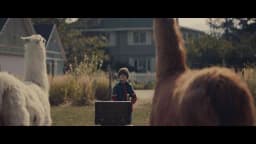
Learning Resources launched 'Learning Is Where We Play' in July 2022 via Third Street, a first global campaign running on Hulu, YouTube, Amazon and beyond.

Learning Resources Builds a Global Play Philosophy Into One Campaign
Learning Resources launched "Learning Is Where We Play" in July 2022 as the brand's first global campaign, created by Chicago-based agency Third Street and distributed across Hulu, YouTube, Moonbug, the Google Ad Network, and Amazon through October of that year.
The campaign marks a decisive shift in Learning Resources' brand ambition. Where earlier work addressed a domestic audience, the 2022 effort was engineered from the outset for simultaneous rollout across the United States, the United Kingdom, Mexico, South America, Europe, Asia, and Australia, according to the campaign announcement. That geographic scope demanded a creative concept capable of transcending language and cultural specificity without losing warmth or personality.
Third Street, which became Learning Resources' agency of record in 2019 and launched the brand's first national campaign in 2020, answered that brief with a fill-in-the-blank device built around the phrase "Learning_____". As an on-screen narrator suggests possibilities, words such as "to build," "1+2+3," and "colors" complete the blank, communicating the brand's breadth across age groups and developmental stages in a format that translates visually without relying on a single language. The creative runs as 30-second and 15-second films, a six-second pre-roll, and five display banners in assorted sizes.
Anchoring the campaign in the United States while reaching outward, Learning Resources chose media environments parents of young children already occupy. Hulu, in particular, positions the brand inside premium streaming inventory where household purchase decisions are made. The choice of Moonbug — the production company behind globally distributed children's content franchises — signals an understanding of where children's media attention now lives. A Clapboard Score of 63 out of 100 reflects the campaign's solid conceptual foundation and cross-platform distribution, balanced against the modest scale of its creative asset suite.

Learning Resources operates in a category defined by parents who want measurable developmental benefit alongside genuine play value. The educational toy segment in the United States sits inside a broader global market that Fortune Business Insights estimated at approximately 57 billion dollars in 2022, with growth projected at a compound annual rate of around 8 percent through 2030. That expansion is driven, according to Fortune Business Insights, by rising parental demand for STEM-aligned, screen-free activities and by the rapid acceleration of e-commerce as the dominant retail channel for children's products.
In the United States, Learning Resources competes directly with category giants including VTech and LeapFrog, which dominate electronic learning toys, and Melissa and Doug, which owns significant share of the tactile, screen-free play segment. LEGO and Mattel's Fisher-Price brand command broader toy-aisle presence and marketing budgets that dwarf most specialist educational toy brands. Against that competitive landscape, Learning Resources' decision to invest in a coherent, globally portable brand identity — rather than product-led advertising — reflects a mature strategic choice. Brand equity, not promotional pricing, becomes the differentiator when shelf space and algorithm-driven retail surfaces compress attention spans.
Third Street's strategic rationale rests on a consumer insight that is straightforward but often underexploited in the category: parents do not buy educational toys for a single skill, they buy them for the arc of a child's development across multiple stages. The "Learning_____" device makes that breadth legible in under six seconds, which matters enormously when the campaign's shortest asset is a six-second pre-roll. By writing the campaign in the rhyming, whimsical register of a children's book — explicitly in the tradition of Dr. Seuss, as Third Street's chief creative officer David T. Jones described it — the work earns emotional permission from parents while holding children's attention simultaneously.
Director Jamieson Mullholland led production on "Learning Is Where We Play" for Learning Resources through production company JDM, with executive producer Sebastian Coria overseeing the shoot. The creative team at Third Street was led by chief creative officer David T. Jones, who also served as copywriter, with art direction by Stephanie Timmons and design by Amanda Grable. Post-production was handled internally by Third Street, with editing by Bruce Woodward.
The central craft decision is the script's register. David T. Jones wrote in a rhyming, children's-book mode that deliberately echoes the cadence of Dr. Seuss. This is not a superficial stylistic choice. Rhyme and metre create mnemonic retention, which is precisely what a brand campaign competing inside streaming ad breaks requires. Parents who have read the same picture book thirty times understand, unconsciously, that rhythm is how language lodges in a child's memory. The campaign borrows that mechanism and applies it to brand recall.
The visual world built around this script features a deliberate menagerie: robots, polar bears, fire trucks, bugs, flowers, and rockets appear alongside Learning Resources products. The variety signals range without requiring a single product demonstration, allowing the fill-in-the-blank device to do the categoric work while imagery delivers energy and warmth. A further production choice reinforces authenticity: actual Learning Resources employees and their children appear throughout the spots, continuing a convention the brand had established in prior campaigns. In a category where real developmental benefit is the core purchase promise, faces that belong to the company rather than to casting agencies carry a specific kind of credibility.
The asset suite — 30-second and 15-second films, a six-second pre-roll, and five display banners — was engineered for the full funnel. The longer formats build the brand world; the pre-roll distils the "Learning_____" device to its irreducible core; the banners carry the visual identity into contextual placements across the Google Ad Network and Amazon.
No independently verified performance data for the "Learning Is Where We Play" campaign — such as view counts, click-through rates, or brand-lift figures — is publicly available from Learning Resources or Third Street at the time of writing. Assessment of the campaign's effectiveness therefore rests on structural analysis of its media architecture and creative mechanics.
The media mix is purposeful. Hulu delivers the campaign inside premium, ad-supported streaming inventory in the United States, reaching households that have opted into an advertising environment — a meaningful distinction from pre-roll placements on platforms where skip behaviour is the default response. YouTube and the Google Ad Network extend reach across intent-driven and contextual surfaces. Amazon places the brand at the moment of purchase consideration for parents browsing educational toys. Moonbug connects Learning Resources to children's content franchises with established global audiences, directly supporting the campaign's international ambition.
The campaign's most structurally durable feature is the "Learning_____" device itself. It functions simultaneously as a tagline, a product range communicator, and a brand architecture tool. That flexibility is rare in category advertising, where most campaigns must choose between brand building and product education. By collapsing that trade-off into a single fill-in-the-blank mechanic, Third Street gave Learning Resources a platform capable of extension across future campaigns, markets, and product launches.
The Clapboard Score of 63 out of 100 reflects this balance: a coherent and scalable creative idea, competent production, and intelligent media placement, set against a relatively contained asset count and the absence of a distinctive sonic or visual signature strong enough to fully differentiate the brand from well-resourced category competitors.
"Learning Is Where We Play" is Learning Resources' first global brand campaign, created by agency Third Street and launched in July 2022. It ran across Hulu, YouTube, Moonbug, the Google Ad Network, and Amazon through October 2022, using a fill-in-the-blank creative device to communicate the brand's developmental breadth to parents across multiple international markets.
Third Street created the campaign. The Chicago-based agency became Learning Resources' agency of record in 2019 and had previously launched the brand's first national campaign in 2020. David T. Jones, Third Street's chief creative officer, wrote the campaign script and directed its creative vision alongside art director Stephanie Timmons and designer Amanda Grable.
Hulu reaches parents inside premium, ad-supported streaming environments in the United States, where household purchase decisions for children's products are frequently made. The platform complements the campaign's broader media mix, which also included YouTube, Moonbug, the Google Ad Network, and Amazon, covering awareness through to point-of-purchase consideration for educational toys.
The campaign was designed for simultaneous rollout across the United States, the United Kingdom, Mexico, South America, Europe, Asia, and Australia. This international scope was the defining strategic ambition of the 2022 effort, distinguishing it from Learning Resources' earlier national campaigns and requiring a creative concept universally translatable across language and cultural contexts.
Jamieson Mullholland directed the campaign films for Learning Resources through production company JDM, with Sebastian Coria serving as executive producer. Post-production was completed internally at Third Street, with Bruce Woodward as editor. The campaign featured actual Learning Resources employees and their children, continuing an authenticity-driven casting approach established in prior brand work.
The campaign received a Clapboard Score of 63 out of 100. The score reflects a coherent and scalable creative concept built around the fill-in-the-blank "Learning_____" device, intelligent multi-platform media placement, and competent production, weighed against a contained asset suite and the competitive pressure of larger-budget rivals in the United States educational toy market.
.webp)
Creative Collaboration Platform: The Backbone of Modern Creative WorkWhat is a creative collaboration platform?Clapboard defines a creative collaboration platform as the operational core for today’s distributed creative teams. This is not a collection of digital collaboration tools stitched together; Clapboard’s system


Understanding the Creative Production MarketplaceWhat is a Creative Production Marketplace?Clapboard defines a creative production marketplace as a structured ecosystem where brands, agencies, and production talent converge to execute video, advertising, and branded content at scale. Unlike the legacy agency or freelanREAD FULL ARTICLE

The Urgent Need for a Creative Production Operating SystemWhy Traditional Creative Production Models Break DownClapboard sees the creative production landscape shifting under pressure. Content velocity is no longer a buzzword—it’s a mandate. Modern advertising demands relentless output across dozens of channels, each wREAD FULL ARTICLE