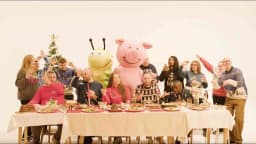
Crayola's Blue Christmas campaign, created by Dentsu Creative and Dentsu X, reimagines the 2025 holiday season through a dog's colour vision, running across

How Crayola Blue Christmas Turns Canine Vision Into Holiday Wonder
Crayola's Blue Christmas is a 2025 United States holiday campaign, created by Dentsu Creative and Dentsu X, in which a child named Zoe transforms her family home into a blue holiday wonderland after discovering her dog Pickle cannot distinguish red and green, anchoring the entire seasonal narrative to creativity, empathy, and color as acts of love.
The campaign launched on November 10, 2025, and ran through December 21, 2025, making it a full six-week presence across the holiday advertising landscape. Media placements span YouTube, TikTok, streaming video, and the Hallmark Channel, with specific Hallmark Channel windows scheduled during the weeks of November 24 and December 8, as confirmed by Crayola's campaign documentation. What distinguishes the media strategy is that placements are designed to be shoppable, with seven Crayola portfolio products featured directly within the holiday spot available for purchase at the point of viewing.
The campaign operates as a direct expression of Crayola's Campaign for Creativity, the brand's long-running advocacy initiative dedicated to fostering creative moments and inspiring lifelong connection through imagination. Its tagline, "It's not what you give, it's what you create," signals a deliberate reframing of the holiday gift-giving ritual, shifting the emphasis from consumption to co-creation. In the United States, where holiday advertising typically orbits sentiment and nostalgia, Crayola positions itself as something more purposeful: a brand whose product is imagination itself. The campaign earns a Clapboard Score of 74 out of 100, reflecting strong creative reasoning, emotional coherence, and a media strategy that integrates commerce with storytelling.
Crayola builds its 2025 holiday strategy on a consumer insight rooted in empathy rather than aspiration. The campaign does not sell color — it sells the act of seeing the world through someone else's eyes. Zoe's decision to reimagine Christmas for Pickle is not a product demonstration; it is a dramatisation of the creative impulse that Crayola has consistently positioned as its core brand territory, per Crayola's campaign materials.
This approach reflects a multi-year strategic shift. As documented by PR Newswire and Crayola's own platform at crayola.com, the brand's 2022 campaign, Color Yourself into the World, introduced 24 crayons designed to represent more than 40 global skin tones, establishing creativity as a vehicle for inclusion and identity. Blue Christmas extends that lineage into the emotional register of family tradition, asking what it means to create an experience that includes everyone — including those who literally see the world differently.
In the United States, the children's creative supplies category is competitive. Faber-Castell and Newell Brands both maintain significant retail presence, while BIC and STAEDTLER compete at the commodity end of the market. No audited 2025 market-share data for children's creative supplies is publicly available for any of these competitors. The broader arts-and-crafts market context, however, is instructive: according to Emergen Research, the global craft supplies market is valued at approximately 42.83 billion US dollars with a compound annual growth rate of 4.3 percent. In the United States, the holiday season represents a disproportionate share of annual creative-product purchases, making a culturally resonant holiday campaign a critical commercial and brand-equity lever for Crayola. By anchoring Blue Christmas to the Campaign for Creativity framework, Dentsu Creative and Dentsu X give the holiday advertising effort institutional weight that a purely seasonal execution would not carry.
Ashkan Memarian directed Blue Christmas, with production handled by Sibling Rivalry and production services provided by Radioaktive Film, as documented in campaign production credits. Post-production editing was completed by NOMAD Editing Company, and music and sound were delivered by Premier Music Group. The campaign's creative leadership at Dentsu Creative included Brian Eden as Executive Creative Director, Victoria Lee as Associate Creative Director, and Rebecca Albert as Group Creative Director.
The film runs at approximately one minute, a format that demands economy of storytelling. Memarian and the Dentsu Creative team make a structurally bold choice by grounding the entire narrative in a child's scientific observation — that dogs are dichromatic and cannot process red-green wavelengths — and treating that fact not as a plot obstacle but as a creative invitation. The result is a film in which the problem and the solution are both acts of imagination, which is precisely the brand territory Crayola occupies.
As reported by Reel 360 on November 10, 2025, Brian Eden described the campaign as an embodiment of Crayola's belief that creativity is the most meaningful gift a family can share during the holiday season. Victoria Lee's contribution as Associate Creative Director shapes the film's tonal register, keeping it grounded in domestic warmth rather than sentimental excess. The visual palette — a home progressively saturated with Crayola blue against the conventional red-and-green of Christmas iconography — functions as both narrative logic and brand signature. Per campaign documentation cited by DesignRush's news platform, News Designrush, and coverage in magazine.shots.net, the creative execution is notable for treating the Crayola product range as the instrument of transformation rather than its object, a distinction that keeps the film from reading as a catalogue advertisement.
No independently verified post-campaign performance data for Blue Christmas is publicly available at the time of publication. Campaign metrics such as view counts, completion rates, shoppable-unit conversion, or brand-lift figures have not been disclosed by Crayola, Dentsu Creative, or Dentsu X in any source accessible for this analysis.
What is verifiable is structural. System1 Group, which evaluates emotional effectiveness in advertising, has published frameworks indicating that narrative campaigns built around empathy and child protagonists consistently outperform category norms on long-term brand building, though no System1 score specific to Blue Christmas has been publicly released. The campaign's decision to run on the Hallmark Channel — a network whose holiday programming commands among the highest seasonal audience loyalty in United States cable television — reflects a media placement strategy calibrated for attentive viewing rather than passive impression delivery.
The shoppable media format, deployed across YouTube and TikTok alongside the seven featured Crayola products, creates a direct response layer beneath the brand narrative. This dual architecture — emotional long-form storytelling paired with commerce-enabled distribution — represents a structurally sophisticated approach to holiday marketing that positions Blue Christmas beyond the category of purely awareness-driven seasonal advertising. As reported by MediaPost, the campaign's integrated nature across streaming, social, and linear television reflects Dentsu X's media planning philosophy of matching message to moment across the full consumer journey. The Clapboard Score of 74 out of 100 reflects the campaign's creative coherence, strategic clarity, and execution quality, with room for growth should verified performance data emerge to confirm the structural promise the work demonstrates.
Blue Christmas is a 2025 Crayola holiday campaign created by Dentsu Creative and Dentsu X. It follows a girl named Zoe who transforms her family's Christmas decorations into blue after learning her dog Pickle cannot see red and green. The campaign tagline is "It's not what you give, it's what you create," per Crayola's campaign documentation.
Blue Christmas launched in the United States on November 10, 2025, and ran through December 21, 2025. Hallmark Channel placements were scheduled during the weeks of November 24 and December 8, 2025, as confirmed by Crayola's campaign materials, with additional placements across YouTube, TikTok, and streaming video throughout the campaign period.
Ashkan Memarian directed the Blue Christmas film for Crayola. Production was handled by Sibling Rivalry, with post-production editing by NOMAD Editing Company and music by Premier Music Group. Creative leadership at Dentsu Creative included Brian Eden as Executive Creative Director, Rebecca Albert as Group Creative Director, and Victoria Lee as Associate Creative Director.
Blue Christmas extends Crayola's Campaign for Creativity, the brand's long-running advocacy initiative focused on fostering imagination and connection. It continues a multi-year strategic direction established by campaigns such as the 2022 Color Yourself into the World initiative, which used creativity as a vehicle for inclusion, as documented by PR Newswire and crayola.com.
Crayola distributed Blue Christmas across YouTube, TikTok, streaming video, and the Hallmark Channel in the United States. Media placements were designed to be shoppable, featuring seven Crayola portfolio products directly within the holiday spot, reflecting Dentsu X's integrated media strategy of aligning emotional storytelling with direct commerce opportunities across the consumer journey.
Blue Christmas receives a Clapboard Score of 74 out of 100. This score reflects the campaign's strong creative coherence, clear strategic rationale rooted in Crayola's Campaign for Creativity platform, and a media architecture that pairs emotional long-form storytelling with shoppable distribution across YouTube, TikTok, streaming video, and the Hallmark Channel in the United States.
.webp)
Creative Collaboration Platform: The Backbone of Modern Creative WorkWhat is a creative collaboration platform?Clapboard defines a creative collaboration platform as the operational core for today’s distributed creative teams. This is not a collection of digital collaboration tools stitched together; Clapboard’s system


Understanding the Creative Production MarketplaceWhat is a Creative Production Marketplace?Clapboard defines a creative production marketplace as a structured ecosystem where brands, agencies, and production talent converge to execute video, advertising, and branded content at scale. Unlike the legacy agency or freelanREAD FULL ARTICLE

The Urgent Need for a Creative Production Operating SystemWhy Traditional Creative Production Models Break DownClapboard sees the creative production landscape shifting under pressure. Content velocity is no longer a buzzword—it’s a mandate. Modern advertising demands relentless output across dozens of channels, each wREAD FULL ARTICLE