Lavazza Bets on Mars to Make a Point About Earth
¡Marte! For Another Planet is a digital campaign created by Lavazza and agency LePub, launched in Italy in April 2023 for Earth Day, that presents a fictional coffee grown on Mars as an ironic warning about the consequences of neglecting sustainable farming practices on Earth.
Lavazza is Italy's leading coffee company, and ¡Marte! For Another Planet represents one of its most conceptually bold environmental responsibility statements to date. The campaign takes its name as a deliberate play on the brand's existing ¡Tierra! product range — Tierra meaning Earth in Spanish — with Marte being the Spanish word for Mars. Where ¡Tierra! stands for Lavazza's real-world commitment to sustainable coffee cultivation, ¡Marte! conjures the absurdist alternative: a world in which climate change has made Earth no longer viable for growing coffee, forcing producers to look elsewhere.
The campaign launched across Lavazza's digital and social platforms in Italy, timed precisely to World Earth Day on April 22, 2023, according to lavazzagroup.com. It centres on a single video asset that takes viewers on a journey to the red planet, introducing deep-crimson coffee beans that are styled to look as though they could have genuinely originated in a Martian environment. The VFX-driven digital activation sustains the fiction convincingly before delivering a reveal: coffee grown on Mars does not yet exist, and that is precisely the point. The campaign, through suspense and irony, reaffirms that Lavazza supports coffee farmers by fostering good agricultural practices to counter the effects of climate change. As reported by lavazzagroup.com, the ¡Marte! campaign reached eleven million net contacts in 2023, a figure documented in Lavazza's own 2023 Sustainability Report.
Lavazza's ¡Marte! For Another Planet campaign draws its strategic strength from a consumer insight that is both simple and urgent: coffee, as a crop, is acutely vulnerable to climate change, and the people most at risk are the producers themselves. The campaign does not lead with statistics or policy language. It leads with spectacle, staging a fictional product launch for a Martian coffee blend before dismantling the premise entirely and redirecting attention to the planet that actually matters.
This approach reflects a broader shift in how Italian and European food and drink brands are framing environmental responsibility. Rather than issuing corporate pledges, Lavazza uses creative misdirection to deliver its message, a technique that earns audience engagement before delivering substance. The campaign sits within a sustainability platform that Lavazza has maintained for more than two decades. According to lavazza.com, the ¡Tierra! project — the product range whose name directly inspired ¡Marte! — was first developed in partnership with the Rainforest Alliance in 2002, with its initial phase supporting coffee-farming communities in Peru, Honduras, and Colombia. A second phase launched in 2010 extended that work to India, Brazil, and Tanzania, as documented by lavazza.com. ¡Marte! is not a standalone Earth Day stunt but an extension of this long-running sustainability commitment, translating a twenty-year agricultural programme into a single, shareable digital moment.
In the competitive Italian and broader European coffee market, Lavazza faces pressure from global players including Nestlé — which, according to nestle.com, holds approximately twenty percent of the global in-home coffee market through brands including Nescafé, Nespresso, and licensed Starbucks products — and JDE Peet's, whose portfolio of Jacobs, Douwe Egberts, and L'OR gives it strong European distribution. Against these rivals, Lavazza's sustainability narrative and its Italian provenance represent differentiated brand territory, and campaigns like ¡Marte! are designed to reinforce that positioning at a culturally resonant moment on the global calendar.
¡Marte! For Another Planet is built on a single creative mechanism: the product launch video for a coffee that does not exist. The execution relies on that fiction being entirely convincing for long enough to make the reveal land with genuine impact. LePub, the agency behind the campaign, achieves this through a combination of visual effects, production design, and tonal control that keeps the work balanced between earnest brand storytelling and knowing satire.
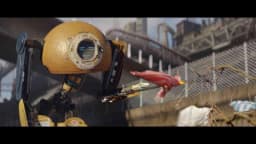
The campaign's visual language borrows the aesthetic conventions of premium coffee advertising — dramatic close-ups, rich textures, carefully lit product imagery — and then displaces them onto a Martian environment. The red beans at the centre of the digital activation are styled to feel genuinely exotic, their deep crimson colour evoking both the surface of Mars and the kind of rare, single-origin product that the specialty coffee world prizes. The VFX work sustains the illusion of an alien landscape convincingly enough that the question of whether ¡Marte! could be real is kept alive until the campaign chooses to answer it.
The tone is equally precise. The campaign does not play the environmental responsibility message for earnestness alone. It uses irony as a structural device, allowing viewers to enjoy the absurdity of Martian coffee before the reveal reframes the joke as a serious proposition: if sustainable farming practices are not protected, the idea of growing coffee off-world may one day cease to be absurd. Production credits for the ¡Marte! For Another Planet campaign beyond the agency attribution to LePub, part of Publicis Italy, are not publicly documented in available sources. The campaign was distributed as an integrated digital asset across Lavazza's owned social and digital channels in Italy and positions itself as a global message, as noted by lavazzagroup.com.
¡Marte! For Another Planet generated a documented reach of eleven million net contacts, a figure reported in Lavazza's 2023 Sustainability Report as cited by lavazzagroup.com. That is a verifiable output metric for a campaign distributed exclusively through owned digital and social channels in Italy and beyond, without a confirmed paid media buy attached to it in public records. The scale of that figure relative to the campaign's single-asset format underscores the efficiency of the creative concept: the Mars fiction provided a shareable premise that could travel organically across platforms.
No independent third-party performance data — including verified engagement rates, conversion metrics, or earned media valuations — is publicly available for ¡Marte! For Another Planet beyond the reach figure documented by lavazzagroup.com. Structurally, however, the campaign demonstrates several characteristics associated with high-performing digital activations. It is built around a single, memorable creative idea that is easy to describe in one sentence. It aligns a commercial brand message with a culturally established moment, World Earth Day, without appearing opportunistic, because Lavazza's sustainability credentials through the ¡Tierra! programme predate the campaign by more than twenty years. And it uses narrative suspense — the product reveal — to hold attention in a media environment where attention is the scarcest resource.
Clapboard rates ¡Marte! For Another Planet 61 out of 100. The score reflects genuine creative ambition and strategic coherence, while acknowledging that the campaign's reach, though significant for an owned-channel activation, remains difficult to independently verify, and that the ironic product-launch format, while well-executed, is a recognisable creative convention in the sustainability category.
¡Marte! For Another Planet is a digital campaign by Lavazza, created by LePub and launched in Italy in April 2023 for Earth Day. It presents a fictional Martian coffee blend to draw attention to the importance of sustainable farming on Earth, using a product reveal to deliver its environmental message.
Lavazza used Mars as an ironic counterpoint to its real ¡Tierra! product range. Tierra means Earth in Spanish; Marte means Mars. By imagining a world where coffee must be grown off-planet, the campaign argues that protecting sustainable farming on Earth is essential to coffee's survival, according to lavazzagroup.com.
LePub, part of Publicis Italy, created the ¡Marte! For Another Planet campaign. The agency produced a single VFX-driven video asset presenting the fictional Martian coffee product, distributed across Lavazza's owned digital and social platforms in Italy and positioned as a global Earth Day message.
¡Marte! extends Lavazza's ¡Tierra! sustainability platform, first developed with the Rainforest Alliance in 2002, as documented by lavazza.com. That programme supported coffee-farming communities across Peru, Honduras, Colombia, India, Brazil, and Tanzania. The campaign translates more than twenty years of agricultural commitment into a single shareable digital moment.
Lavazza's 2023 Sustainability Report, as cited by lavazzagroup.com, documents eleven million net contacts reached by the ¡Marte! campaign. No independent third-party engagement or conversion metrics are publicly available. Clapboard rates the campaign 61 out of 100, recognising its creative coherence and strategic alignment with Lavazza's established sustainability credentials.
Coffee cultivation is directly threatened by climate change, and Lavazza's ¡Marte! campaign makes that vulnerability tangible by staging the absurd alternative of Martian farming. The campaign reinforces Lavazza's position that supporting sustainable agricultural practices for coffee producers is the only credible response to a warming planet, as stated by lavazzagroup.com.
.webp)
Creative Collaboration Platform: The Backbone of Modern Creative WorkWhat is a creative collaboration platform?Clapboard defines a creative collaboration platform as the operational core for today’s distributed creative teams. This is not a collection of digital collaboration tools stitched together; Clapboard’s system


Understanding the Creative Production MarketplaceWhat is a Creative Production Marketplace?Clapboard defines a creative production marketplace as a structured ecosystem where brands, agencies, and production talent converge to execute video, advertising, and branded content at scale. Unlike the legacy agency or freelanREAD FULL ARTICLE

The Urgent Need for a Creative Production Operating SystemWhy Traditional Creative Production Models Break DownClapboard sees the creative production landscape shifting under pressure. Content velocity is no longer a buzzword—it’s a mandate. Modern advertising demands relentless output across dozens of channels, each wREAD FULL ARTICLE