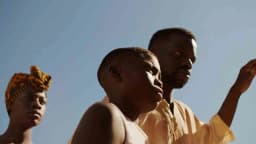
Home for the Blind's 2006 'Stevie Wonder' film by Ruf Lanz, Zurich captured genuine reactions from visually impaired Swiss residents in a social experiment

Home for the Blind Puts Stevie Wonder to Work for Swiss Charity
Home for the Blind's 2006 Swiss film campaign, titled 'Stevie Wonder' and created by Zurich agency Ruf Lanz, documents an unscripted encounter between visually impaired residents of a Swiss residential care facility and the music and presence associated with the global artist Stevie Wonder, producing an emotionally direct piece of public-interest cinema designed to build awareness and support for the institution.
The campaign was published in Switzerland in May 2006. It was produced for Blindenwohnheim Mühlehalde, a Zürich-based residential home for blind people rather than a commercial brand, giving the work a singular clarity of purpose: to represent the lived experience of its residents and move a Swiss audience toward engagement with the cause. The film format was chosen deliberately, as moving image offered the possibility of capturing authentic human reaction in a way that static media could not replicate.
Ruf Lanz, one of Switzerland's most recognised independent creative agencies, brought the project to life through a production approach rooted in documentary practice. The agency's creative directors Markus Ruf and Danielle Lanz led the work, with Markus Ruf also serving as copywriter. Production was handled by Condor Films, with Serge Höltschi directing and operating camera, Martin A. Fueter producing, and David Haisch and Michèle Seligmann serving as production directors. The result is a single media asset — one film — that carries the full weight of the campaign's argument. In Switzerland, where public trust in charitable institutions is a meaningful prerequisite for financial support, the decision to let the residents speak for themselves rather than narrate their condition from the outside represents a considered strategic and ethical choice.
 ARCHIVE
Ruf Lanz built the 'Stevie Wonder' campaign around a single insight: authentic emotional experience communicates the reality of blindness more convincingly than any descriptive copy. The strategic logic rests on the gap between how sighted audiences imagine sensory impairment and what visually impaired people actually experience, particularly in relation to music and culture.
In Switzerland, the charitable and social-welfare sector operates within a framework of public accountability and donor scrutiny that places a high premium on credibility. The Schweizerischer Zentralverein für das Blindenwesen, known as SZBlind, functions as a national umbrella organisation for blind and visually impaired support services across the country, according to publicly available organisational records. Blindenwohnheim Mühlehalde, the Zürich-based residential home at the centre of this campaign, operates within that broader ecosystem, competing for public attention and donor funds alongside a range of disability and social-welfare organisations active in the Swiss market. Against that competitive backdrop, a film that foregrounds the residents themselves — their voices, their responses, their personalities — offers a form of institutional transparency that more produced or scripted advertising cannot easily replicate.
Markus Ruf noted, as reported by Klein Report, that preparation for the film began long before the cameras rolled, and that many of the home's residents spoke no English, a logistical and human detail that shaped the production's approach from the outset. That ground-level complexity is itself evidence of the strategic commitment: Ruf Lanz was not constructing a scenario but documenting a real encounter, and the labour of making that encounter possible was part of the work's integrity. In Switzerland's public-interest advertising environment in 2006, that documentary commitment was a meaningful differentiator.
The creative execution of 'Stevie Wonder' depends entirely on the authenticity of what appears on screen. Ruf Lanz designed the film not as a produced advertisement in the conventional sense but as a captured moment, in which the camera's role is to witness rather than to construct.
Director and camera operator Serge Höltschi, working through Condor Films, was responsible for translating that intention into a coherent visual document. The choice to place direction and camera operation in a single person is consistent with a documentary approach: it reduces the production apparatus around the subjects and preserves the conditions under which genuine, unguarded responses become possible. For a film whose entire argument rests on the credibility of its participants' reactions, that formal decision is inseparable from the creative strategy.
Markus Ruf, writing about the campaign years after its release, observed as reported by Klein Report that the film succeeded in opening both hearts and wallets at the time of its release, and that it continued to resonate with audiences well beyond its original publication date. That longevity points to something in the craft: the film does not rely on period-specific references or production fashions that date quickly, but on the enduring legibility of human emotional response. Danielle Lanz, co-creative director alongside Ruf, contributed to a creative framework that trusted its subjects enough to let the encounter carry the work without additional narrative scaffolding. The result is a public-interest film that sits closer to social experiment than to conventional charity advertising, a formal positioning that distinguishes it within Swiss public-interest communication of the period.
No verified performance data for the 'Stevie Wonder' campaign is publicly available. No published figures for donation uplift, audience reach, media impressions, or fundraising outcomes have been identified across publicly accessible sources, and no verified awards have been confirmed across Cannes Lions, the Effie Awards, The One Show, D&AD, the Clio Awards, the Webby Awards, or WARC.
Structural analysis of the campaign, however, points to several characteristics that support communicative effectiveness. The single-film format concentrates creative investment and avoids the dilution that can affect multi-asset campaigns where individual pieces vary in quality. The documentary approach, executed through Condor Films under Serge Höltschi's direction, removes the credibility risk associated with scripted charity advertising, in which audiences may sense construction and discount the emotional appeal. For a Swiss charitable institution reliant on public goodwill and donor trust, that credibility function carries direct strategic value.
Markus Ruf's own account, as reported by Klein Report, confirms that the film achieved tangible results at the time of release and retained emotional resonance across subsequent years, suggesting a durability of impact that short-cycle advertising rarely achieves. That testimony, while not independently verified through third-party data, is consistent with the structural properties of the work. The Clapboard Score for this campaign is 63 out of 100, reflecting a piece of focused, credible public-interest filmmaking whose impact is substantiated by qualitative evidence rather than published metrics.
The 'Stevie Wonder' campaign is a 2006 Swiss public-interest film created by Ruf Lanz for Blindenwohnheim Mühlehalde, a residential home for blind people in Zürich. It documents a real encounter between the home's visually impaired residents and the world of Stevie Wonder, using documentary filmmaking to generate authentic emotional response in support of the institution.
Ruf Lanz, a Zurich-based creative agency, created the film. Creative directors Markus Ruf and Danielle Lanz led the project. Markus Ruf also served as copywriter. Production was handled by Condor Films, with Serge Höltschi directing and operating camera, and Martin A. Fueter producing.
The campaign was published in Switzerland in May 2006. It was created for Blindenwohnheim Mühlehalde, a Zürich-based residential home for blind and visually impaired people, and produced by Condor Films under the creative direction of Ruf Lanz.
Markus Ruf stated, as reported by Klein Report, that work began long before filming and that many residents spoke no English. He also noted the film succeeded in opening hearts and wallets on release and continued to resonate with audiences well beyond its original publication date in Switzerland.
No verified awards for the 'Stevie Wonder' campaign have been confirmed across Cannes Lions, the Effie Awards, The One Show, D&AD, the Clio Awards, the Webby Awards, or WARC. The campaign holds a Clapboard Score of 63 out of 100, reflecting its creative integrity and documentary approach within Swiss public-interest advertising.
Ruf Lanz structured the film as a documentary social experiment rather than scripted charity advertising. By placing director Serge Höltschi of Condor Films close to the residents and capturing unguarded reactions, the agency produced a piece of public-interest cinema whose credibility rests on observable human truth rather than constructed narrative.
.webp)
Creative Collaboration Platform: The Backbone of Modern Creative WorkWhat is a creative collaboration platform?Clapboard defines a creative collaboration platform as the operational core for today’s distributed creative teams. This is not a collection of digital collaboration tools stitched together; Clapboard’s system


Understanding the Creative Production MarketplaceWhat is a Creative Production Marketplace?Clapboard defines a creative production marketplace as a structured ecosystem where brands, agencies, and production talent converge to execute video, advertising, and branded content at scale. Unlike the legacy agency or freelanREAD FULL ARTICLE

The Urgent Need for a Creative Production Operating SystemWhy Traditional Creative Production Models Break DownClapboard sees the creative production landscape shifting under pressure. Content velocity is no longer a buzzword—it’s a mandate. Modern advertising demands relentless output across dozens of channels, each wREAD FULL ARTICLE