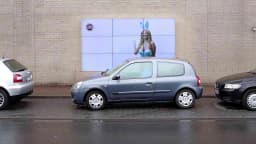
The Audi "Halloween" campaign executed in Bulgaria in December 2012 employs a clever ambient strategy designed to reinforce Audi’s brand prestige within a constrained marketing budget. By transforming ordinary cars into visually Audi-like vehicles on Halloween, the campaign taps into the cultural moment to generate buzz and engagement through a low-cost, guerrilla marketing approach. The brand proposition centers on aspiration and identity, suggesting that while not every car can be an Audi, every car—and, by extension, every driver—can momentarily embody the Audi spirit. This aligns Audi with qualities such as luxury, status, and desirability, subtly reinforcing its image as a brand that other vehicles and drivers aspire to emulate.
Strategically, the campaign leverages insight into consumer psychology and the festive atmosphere of Halloween, a time when costume and transformation are universally accepted and encouraged. By dressing other cars as Audis, the campaign democratizes the Audi experience, making the brand feel accessible and relatable despite its premium positioning. This creative angle uses playful mimicry to engage both current Audi owners and a broader automotive audience, encouraging them to associate the brand with aspiration and excitement while preserving exclusivity. The campaign’s ambient and guerrilla nature amplifies word-of-mouth potential, achieving impact through experiential interaction rather than heavy media spend. With nearly 50,000 views and positive albeit limited engagement on digital platforms, the campaign demonstrates how strategic creativity can efficiently support brand image maintenance and audience connection in competitive automotive markets.
FORMAT#9 SYMBOLIZE THE BENEFIT — Uses symbols or exaggerated visuals to represent the product’s positive impact.
This campaign uses a clever symbolic device: “regular” cars are dressed up as Audis for Halloween, implying that every car aspires to become an Audi even if only for one night. Instead of demonstrating features or telling a literal story, the creative approach uses the visual metaphor of costumes (Halloween masks) to express the aspirational value and desirability of the Audi brand. The exaggerated visual (non-Audis “in disguise” as Audis) turns the product benefit—prestige and allure—into an instantly understood symbol. This creates buzz via ambient, guerrilla-style interventions without direct demonstration, narrative resolution, or comparative claims, making “symbolize the benefit” the most fitting classic device here.
ADVERTISING FORMATS EXPLAINED: https://www.clapboard.com/blog/branding-and-advertising/brand-strategy/12-advertising-creative-formats
1. BMW – Market Positioning
BMW positions itself as the “Ultimate Driving Machine,” emphasizing dynamic performance, driving pleasure, and advanced engineering. The brand focuses on sporty luxury vehicles that combine innovative technology with emotional appeal, targeting consumers who seek an engaging driving experience paired with premium quality.
2. Mercedes-Benz – Market Positioning
Mercedes-Benz stands for luxury, comfort, and cutting-edge technology, appealing to affluent customers who value sophistication and prestige. The brand highlights its heritage of craftsmanship and innovation, blending elegance with advanced safety features and a broad lineup ranging from luxury sedans to high-performance AMG models.
3. Volkswagen – Market Positioning
Volkswagen positions itself as a reliable, well-engineered, and accessible brand with German precision. It targets a broad market segment by offering a diverse range of vehicles focused on quality, safety, and everyday practicality, aiming to balance affordability with premium appeal.
4. Volvo – Market Positioning
Volvo differentiates itself through a strong focus on safety, Scandinavian design, and environmentally friendly innovations. The brand appeals to family-oriented and safety-conscious customers, promoting reliability, comfort, and emerging leadership in hybrid and electric vehicle technology.
5. Skoda – Market Positioning
Skoda is positioned as a value-for-money brand offering spacious, practical, and reliable vehicles with smart features. Leveraging its relationship with the Volkswagen Group, Skoda targets cost-conscious consumers who want quality engineering and everyday usability at a more accessible price point.
Q: What is Halloween about?
A: Halloween is a professional campaign created for Audi by Saatchi & Saatchi, launched in Bulgaria in 2012. The campaign was designed to defend Audi’s premium image within a limited marketing budget by leveraging the festive context of Halloween. The central creative idea involved dressing up ordinary cars to resemble Audis, playfully suggesting that every car can fulfill its dream of being an Audi, at least for one night. This guerrilla, ambient activation generated buzz and engagement, reinforcing Audi’s aspirational positioning in the automotive market through a single, impactful media asset.
Q: What creative device does Halloween use?
A: Halloween employs the creative technique classified by Clapboard’s 12-format taxonomy as FORMAT#9 SYMBOLIZE THE BENEFIT. This approach uses symbols or exaggerated visuals to represent the product’s positive impact, rather than demonstrating features or telling a literal story. In this campaign, the visual metaphor of “regular” cars dressed as Audis for Halloween instantly communicates the brand’s desirability and aspirational value. The use of costumes as a symbolic device turns the product benefit—prestige and allure—into an easily understood, memorable image that drives engagement through ambient, guerrilla-style intervention.
Q: What is the campaign proposition for Halloween?
A: The campaign proposition for Halloween centers on reinforcing Audi’s brand prestige and aspirational identity within the automotive category, especially under budget constraints. By transforming everyday cars into Audi lookalikes during Halloween, the campaign taps into the universal appeal of transformation and aspiration, suggesting that every car—and by extension, every driver—can momentarily embody the Audi spirit. This strategy makes the brand feel accessible and relatable while maintaining its premium allure, engaging both current Audi owners and a broader audience through playful mimicry and experiential interaction.
Q: How does Halloween rank in Clapboard's archive?
A: Halloween holds a Clapboard Campaign Score of 63/100. This score reflects the campaign’s creative ambition, the quality of its execution, and its cultural relevance as assessed by Clapboard’s global ad archive.
Q: Who are the competitors in Audi's category?
A: In the automotive category, Audi’s key competitors include BMW, which positions itself as the ultimate driving machine focused on dynamic performance and driving pleasure; Mercedes-Benz, known for luxury, comfort, and advanced technology targeting sophisticated, affluent customers; Volkswagen, which emphasizes reliability, engineering quality, and accessibility for a broad market; Volvo, recognized for its leadership in safety, Scandinavian design, and environmental innovation; and Skoda, which offers value-driven, practical vehicles with quality engineering for cost-conscious consumers.


 ARCHIVE
.webp)