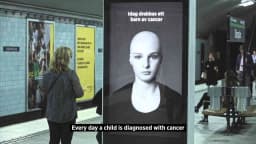
In the 2014 '#tramnesty' campaign, Amnesty International leverages a social experiment to draw attention to the growing threat against freedom of expression online due to censorship in various parts of the world. The campaign’s core proposition is centered on the inherent value of unrestricted internet access as a fundamental human right, emphasizing the contrast between unrestricted freedom in Belgium and the silencing tactics employed elsewhere. By temporarily severing commuters’ internet connectivity within a public tram setting, the campaign physically manifests the experience of digital censorship, making an abstract global issue palpably real for its audience.
The strategic insight underpinning the campaign recognizes that raising awareness about internet censorship in a free-access context requires an experiential, rather than purely informational, approach. The choice of an ambient medium—interrupting everyday routines in a public space—creates a direct emotional impact and stimulates reflection among ordinary citizens who typically take online freedom for granted. Targeting Belgian commuters, the campaign uses a relatable, immediate disruption to highlight the fragility of online expression in more repressive environments, engaging a demographic that values open access and democratic principles. This real-world enactment serves as a bridge between distant, complex issues and the local audience’s lived experience, aligning Amnesty International’s broader mission of defending human rights with an innovative, context-aware communication approach.
FORMAT#1 DEMONSTRATION — Directly shows how a product works and highlights its benefits.
This campaign fits the DEMONSTRATION format because the core creative device involves a real-world social experiment: Amnesty International literally "cuts people off from the Internet" in Belgium to make visible the impact of online censorship that is common in other countries but rare locally. Rather than telling a story or using symbolic visuals, the campaign demonstrates the problem (Internet censorship) by recreating the experience for unsuspecting Belgians, thus directly showing the audience what lack of online freedom feels like. This format uses a live demonstration to evoke empathy and understanding for the issue.
ADVERTISING FORMATS EXPLAINED: https://www.clapboard.com/blog/branding-and-advertising/brand-strategy/12-advertising-creative-formats
1. Human Rights Watch – Positioned as a rigorous, research-driven human rights organization, Human Rights Watch emphasizes detailed investigations and legal analysis to expose abuses globally. Their strategic focus on authoritative reports and advocacy differentiates them as a credible watchdog that influences policymakers and international law.
2. International Federation for Human Rights (FIDH) – FIDH centers its positioning on grassroots collaboration and broad coalition-building with local partners. By combining global advocacy with local insights, FIDH differentiates itself as a connector between international norms and on-the-ground realities, enhancing impact through a networked approach.
3. Red Cross and Red Crescent Movement – While primarily focused on humanitarian aid, this organization positions itself as a protector of human dignity during conflict and disaster. Their neutrality and extensive global presence allow them to provide immediate assistance while advocating for rights and protections under international humanitarian law.
4. Equality Now – This organization focuses specifically on gender-based human rights abuses, using a strategic approach combining legal advocacy, grassroots mobilization, and media campaigns. Their niche specialization in women’s and girls' rights sets them apart within the broader human rights ecosystem.
5. Global Witness – Positioned at the intersection of environmental and human rights advocacy, Global Witness focuses on exposing the link between natural resource exploitation, corruption, and human rights violations. Their investigative work targeting corporate and government accountability differentiates them within the public interest landscape.
Q: What is #tramnesty about?
A: #tramnesty is a professional campaign launched in Belgium in 2014 for Amnesty International, created by Ogilvy. The campaign addresses the issue of internet censorship and the threat to freedom of expression worldwide by staging a social experiment in a public tram. By physically disconnecting Belgian commuters from the internet, #tramnesty transforms a global, often abstract problem into a tangible local experience. The campaign leverages the ambient medium to engage a public accustomed to unrestricted online access, effectively raising awareness about digital suppression in other parts of the world.
Q: What creative device does #tramnesty use?
A: #tramnesty employs the DEMONSTRATION format, as classified by Clapboard’s 12-format taxonomy. The campaign’s core creative device is a real-world social experiment: Amnesty International literally cuts people off from the internet within a Belgian tram to directly show the impact of online censorship. Rather than relying on narrative or symbolic imagery, this format demonstrates the problem by recreating the experience for the public, making the consequences of digital suppression immediately relatable and fostering empathy for those affected globally.
Q: What is the campaign proposition for #tramnesty?
A: The campaign proposition for #tramnesty centers on highlighting unrestricted internet access as a fundamental human right, drawing attention to the growing threat of online censorship in many countries. Targeting Belgian commuters, Amnesty International uses a physical disconnection from the internet to make the abstract concept of digital censorship real and immediate. This strategic approach is designed to provoke reflection among an audience that typically enjoys open access, emphasizing the fragility of online freedom and aligning with Amnesty International’s broader mission to defend human rights through innovative, context-aware communication.
Q: How does #tramnesty rank in Clapboard's archive?
A: #tramnesty holds a Clapboard Campaign Score of 63/100 in Clapboard’s global ad archive. This score reflects the campaign’s creative ambition, execution quality, and cultural relevance within the context of public interest advertising.
Q: Who are the competitors in Amnesty International's category?
A: In the public interest and human rights sector, Amnesty International competes with organizations such as Human Rights Watch, which is known for its rigorous, research-driven advocacy and detailed investigations; the International Federation for Human Rights (FIDH), which emphasizes grassroots collaboration and coalition-building; the Red Cross and Red Crescent Movement, recognized for its neutrality and humanitarian aid during crises; Equality Now, which specializes in legal advocacy and grassroots mobilization for gender-based rights; and Global Witness, which focuses on exposing the intersection of environmental exploitation and human rights abuses through investigative work.



.webp)