Action for Children's Santaland campaign stars Anna Maxwell Martin in a short film confronting childhood poverty in the UK, raising £2.75 million for

Action for Children Santaland Brings Childhood Poverty Into the Christmas Grotto
Santaland is a 2025 short film created by Studio Yes for Action for Children in which award-winning actor Anna Maxwell Martin plays an elf who discovers that a six-year-old girl named Lily cannot afford to celebrate Christmas, urging United Kingdom audiences to become a Secret Santa by donating to support children living in poverty.
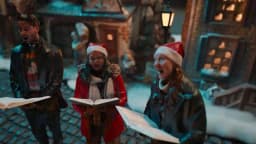
Action for Children launched Santaland in December 2025 as the centrepiece of its annual Christmas public interest campaign. The film is set in a nostalgic, makeshift Christmas grotto where Anna Maxwell Martin's elf character, exhausted at the end of her shift, is stopped by Lily — a curious, wonder-filled child who begins asking questions about Santa Claus and whether he will be able to find her home on Christmas Eve. What starts as a warm, playful exchange turns devastating as the elf, and the viewer, gradually understands that Lily's family cannot afford to celebrate Christmas at all. The emotional pivot is deliberate: the film earns its impact through innocence rather than despair, allowing the audience to feel the weight of Lily's situation through her eyes rather than through overt sentimentality.
The campaign's call to action asks members of the public across the United Kingdom to become a Secret Santa for a vulnerable child by donating virtual gifts through Action for Children's fundraising platform. Nationwide Building Society supported the campaign as a donation-matching partner, matching contributions up to £200,000 until 3 December, according to Actionforchildren Org Uk. Santaland sits within Action for Children's longer-running Secret Santa fundraising platform, which the charity established in 2018, giving the 2025 film an established audience and donation mechanic to build upon. The campaign received a Clapboard Score of 64 out of 100.
Action for Children grounds the Santaland campaign in a specific and verifiable statistic. According to actionforchildren.org.uk, one in three children across the United Kingdom — 31 percent — lives in poverty, with 4.5 million children growing up in poverty, representing the highest number since current records began, with 100,000 more children in poverty in the year prior to the campaign than the year before that. The scale of the problem gives the film its urgency and its strategic rationale: Christmas, a culturally loaded moment of expectation for children, becomes the sharpest possible lens through which to expose the gap between what poverty means in abstract policy terms and what it means to a six-year-old who wonders whether Santa will visit.
The United Kingdom children's charity landscape is large and competitive. Organisations including the NSPCC and Save the Children operate significant Christmas fundraising campaigns in the same market, as do Barnardo's and other major child welfare charities, all competing for public attention and donation income during the year's peak giving period. Action for Children's strategic choice to anchor Santaland in a single child — Lily — and a single intimate setting distinguishes it from broader awareness campaigns that lead with statistics rather than character. The decision to cast Anna Maxwell Martin, a widely recognised British actor with established credibility, as an ambassador and lead performer adds earned-media potential without requiring the spectacle-heavy production budgets that compete with commercial advertisers during the festive season.
According to the 2025 Fundraising Benchmarks survey, 77 percent of UK charities maintained or increased their fundraising income in 2025, signalling a resilient giving environment in which emotionally compelling creative work has a meaningful opportunity to convert attention into action. The Secret Santa donation mechanic, active since 2018 according to actionforchildren.org.uk, provides returning donors with a familiar framework while remaining accessible to first-time givers.
Studio Yes directed and produced Santaland with a creative team assembled specifically to render childhood wonder and economic hardship within the same intimate visual space. Dulcie Cowling, co-founder and creative director of Studio Yes, led the creative direction, according to thirdsectorawards.com. Spencer Brown wrote the screenplay, Sam Ojari and Zoë Waller produced, and Sam Meyer served as cinematographer. The Set Guys handled art direction, building the makeshift Christmas grotto that serves as the film's only location, while Maisie Tuckett contributed motion-graphics work, according to thirdsectorawards.com.
The production design strategy is central to the campaign's emotional architecture. A makeshift grotto — improvised, slightly worn, clearly not the polished commercial grottos found in shopping centres — communicates something about scarcity and effort before a single line of dialogue is spoken. Anna Maxwell Martin's elf is tired, end-of-shift, human rather than theatrical. The casting of an actor of her calibre in a physically unglamorous role signals that the film is asking to be taken seriously as a piece of storytelling, not merely as a charity appeal dressed in festive imagery.
The child character Lily is written to carry the film's emotional weight through what she does not know rather than through what she suffers visibly. Her questions about Santa — practical, logical, full of the specific logic of a six-year-old — progressively reveal her circumstances to the viewer and to the elf simultaneously. This structural choice, wherein the audience discovers Lily's poverty alongside the protagonist, creates complicity rather than pity, a distinction that separates effective public interest filmmaking from emotionally manipulative charity advertising. The film's restraint is its primary creative achievement, arriving at devastation through warmth rather than distress imagery.
Santaland generated measurable and independently reported fundraising results across the United Kingdom. According to thirdsectorawards.com, the campaign raised £2.75 million including Gift Aid, representing year-on-year income growth of 25 percent. According to the same source, more than £1.5 million of that total was raised online, and more than 30,000 virtual gifts were purchased by donors responding to the Secret Santa call to action.
The campaign's media reach was substantial. According to actionforchildren.org.uk, Santaland generated 398 million opportunities to see and 305 pieces of coverage across United Kingdom media, indicating that the film moved significantly beyond its owned and paid channels into earned editorial coverage — a particularly valuable outcome for a public interest campaign operating without the media budgets available to commercial advertisers during the competitive Christmas period.
No verified data on long-term donor retention or conversion rates beyond the campaign window is publicly available. What the results do confirm, however, is that the combination of a recognisable ambassador, a single-location short film format, an established donation mechanic, and a donation-matching partnership with Nationwide Building Society produced one of the more financially effective United Kingdom charity Christmas campaigns of 2025. The structural decision to build Santaland on the existing Secret Santa platform, active since 2018 according to actionforchildren.org.uk, likely reduced donor acquisition friction and contributed to the reported growth rate. The Clapboard Score of 64 out of 100 reflects a campaign that executes its emotional and strategic brief with discipline, even if the creative ambition remains within the conventions of the genre rather than redefining them.
Santaland is a 2025 short film created by Studio Yes for Action for Children in the United Kingdom. Anna Maxwell Martin stars as an elf who discovers a six-year-old girl named Lily cannot afford Christmas. The campaign asks the public to become a Secret Santa by donating virtual gifts to support children living in poverty.
Anna Maxwell Martin stars in Santaland as an elf in a makeshift Christmas grotto. She is also an Action for Children celebrity ambassador, announced in December 2025 according to actionforchildren.org.uk. Her character's encounter with Lily drives the film's emotional reveal about childhood poverty in the United Kingdom.
Santaland raised £2.75 million including Gift Aid, according to thirdsectorawards.com. More than £1.5 million was raised online, and more than 30,000 virtual gifts were purchased. The campaign achieved year-on-year income growth of 25 percent compared to the previous Secret Santa campaign, per thirdsectorawards.com.
Studio Yes created Santaland for Action for Children. Dulcie Cowling, co-founder and creative director of Studio Yes, led the creative direction, according to thirdsectorawards.com. Spencer Brown wrote the film, Sam Meyer served as cinematographer, and Sam Ojari and Zoë Waller produced, with The Set Guys handling art direction.
Santaland draws on Action for Children's figure that 31 percent of children in the United Kingdom live in poverty — approximately 4.5 million children, the highest number since current records began, according to actionforchildren.org.uk. The film personalises this through Lily, a six-year-old whose family cannot afford to celebrate Christmas.
Santaland generated 398 million opportunities to see and 305 pieces of media coverage across the United Kingdom, according to actionforchildren.org.uk. Nationwide Building Society matched donations up to £200,000 until 3 December, amplifying the campaign's fundraising impact alongside its substantial earned-media footprint during the 2025 Christmas period.
.webp)
Creative Collaboration Platform: The Backbone of Modern Creative WorkWhat is a creative collaboration platform?Clapboard defines a creative collaboration platform as the operational core for today’s distributed creative teams. This is not a collection of digital collaboration tools stitched together; Clapboard’s system


Understanding the Creative Production MarketplaceWhat is a Creative Production Marketplace?Clapboard defines a creative production marketplace as a structured ecosystem where brands, agencies, and production talent converge to execute video, advertising, and branded content at scale. Unlike the legacy agency or freelanREAD FULL ARTICLE

The Urgent Need for a Creative Production Operating SystemWhy Traditional Creative Production Models Break DownClapboard sees the creative production landscape shifting under pressure. Content velocity is no longer a buzzword—it’s a mandate. Modern advertising demands relentless output across dozens of channels, each wREAD FULL ARTICLE