


Varun Katyal | Founder, Clapboard
Varun Katyal is the Founder & CEO of Clapboard and a former Creative Director at Ogilvy, with 15+ years of experience across advertising, branded content, and film production. He built Clapboard after seeing firsthand that the industry’s traditional ways of sourcing talent, structuring teams, and delivering creative work were no longer built for the volume, velocity, and complexity of modern content. Clapboard is his answer — a video-first creative operating system that brings together a curated talent marketplace, managed production services, and an AI- and automation-powered layer into a single ecosystem for advertising, branded content, and film. It is designed for a market where brands need content at a scale, speed, and level of specialization that legacy agencies and generic freelance platforms were never built to deliver. The thinking, frameworks, and editorial perspective behind this blog are shaped by Varun’s experience across both the agency world and the emerging platform-led future of creative production. LinkedIn: https://www.linkedin.com/in/varun-katyal-clapboard/
The Evolution of Color Theory for Artists: From Science to Studio
The origins of color theory in art
Color theory for artists is not a modern invention—it is the product of centuries of inquiry at the intersection of science and aesthetics. The discipline’s formal roots trace back to Isaac Newton, whose prism experiments in the 17th century shattered the notion of white light as pure, revealing instead a spectrum. Newton’s color wheel, originally constructed to map musical notes to hues, was less about painting and more about physics. Yet, it set a precedent: color could be systematized, analyzed, and—crucially—taught.
Johann Wolfgang von Goethe, decades later, pushed against Newton’s reductionism. Goethe’s “Theory of Colours” emphasized perception, context, and the psychological impact of color—grounding the science in lived experience. This tension between objective measurement and subjective response has echoed through every subsequent era of art history.
Major milestones in color theory development
The 19th century saw the color wheel’s evolution from scientific diagram to practical artist’s tool. French chemist Michel Eugène Chevreul’s work on simultaneous contrast, born from textile dyeing, gave painters a new vocabulary for vibrancy and harmony. Delacroix, the Impressionists, and later the Post-Impressionists, absorbed these lessons. The wheel became a compositional device, not just a scientific curiosity.
By the early 20th century, Bauhaus educators like Johannes Itten and Josef Albers distilled color theory into studio exercises, foregrounding interaction and relativity. Their pedagogical models—rooted in rigorous experimentation—still underpin art and design curricula worldwide. The history of color theory is inseparable from the history of art movements: each new approach to color, from Fauvism’s expressive palettes to Minimalism’s restraint, reflects both the constraints and freedoms of its theoretical moment.
How historical color models influence today’s artists
Modern practitioners inherit this lineage, consciously or not. Digital tools now allow for infinite chromatic precision, but the foundational logic—complementary contrasts, triadic harmonies, the push and pull of warm and cool—remains unchanged. The origins of the color wheel still inform how artists build visual tension, guide the viewer’s eye, and evoke emotion.
What distinguishes the best contemporary work is not technical novelty, but the ability to synthesize historic insights with present-day sensibilities. Artists and creative leaders who understand the evolution of color theory for artists can draw on a deep well of strategies, whether referencing the psychological drama of Goethe or the formal rigor of Itten. This is not nostalgia—it is structural fluency. The studio is still a laboratory, and the most enduring art is that which recognizes color as both science and symbol.
What Is Color Theory for Artists? Core Concepts and Foundations
Color theory for artists is not a set of rigid rules, but a dynamic framework for making sense of color’s role in visual arts. It’s how painters, illustrators, and digital creators translate the science of light and pigment into expressive, intentional choices. At its core, color theory bridges the gap between technical understanding and creative decision-making, providing a shared vocabulary and structure for what is, at heart, a deeply subjective medium.
What does color theory mean for artists?
For artists, color theory is both a lens and a toolkit. It’s the study of how colors interact, how they can be manipulated, and how they affect perception and emotion. Unlike a physicist’s approach—which might focus on wavelengths and optics—artists use color theory to build visual narratives, guide the viewer’s eye, and evoke mood. It is foundational because every creative discipline that works with visuals, from painting to motion graphics, relies on a functional grasp of color relationships.
Key elements of color theory explained
Basic color theory starts with the color wheel, a circular diagram mapping primary, secondary, and tertiary colors. This tool helps artists anticipate how colors will interact on the canvas or screen. Four key terms underpin the language of color:
- Hue: The pure color itself (red, blue, yellow).
- Saturation: The intensity or purity of a color—how vivid or muted it appears.
- Value: The lightness or darkness of a color, independent of its hue.
- Temperature: The perceived warmth or coolness of a color, influencing emotional tone and spatial depth.
Understanding these concepts is not about memorizing definitions, but about recognizing how they shape the visual structure and emotional impact of an image. Artists use these terms to diagnose problems, articulate intentions, and communicate with collaborators across disciplines.
How artists use color theory in practice
In the studio or edit suite, color theory for artists is less about formula and more about informed experimentation. A painter might use complementary colors to create tension, while a cinematographer adjusts value and saturation to control atmosphere. Digital artists rely on the color wheel to build cohesive palettes that work across devices and media. The theory becomes a set of guiding principles—flexible, adaptable, and always in service of the work’s intent.
What distinguishes the artist’s approach is the balance between intuition and structure. Color theory is foundational, but never final. It’s the point of departure for creative risk, not a cage. Whether you’re refining the fundamentals of color or exploring new techniques beyond beginner’s art principles, mastery comes from understanding the framework and then bending it to your own narrative.
Ultimately, color theory for artists is about agency: knowing the rules so you can break them with purpose. It’s how visual arts move from imitation to innovation, and why every serious creative returns to these foundations, again and again, as their practice evolves.
Understanding the Color Wheel: A Practical Guide for Artists
The color wheel for artists is not just a diagram—it's a working tool that shapes how we see, mix, and deploy color in visual storytelling. Its structure is deceptively simple: a circle segmented into primary, secondary, and tertiary colors. But its utility extends far beyond mere categorization. For anyone serious about craft, understanding the color wheel’s anatomy is foundational. It’s the map that guides every decision from color mixing to palette construction, influencing both the mood and clarity of the work.
How to use the color wheel in art
At its core, the color wheel represents the visible spectrum arranged in a circle, making relationships between hues immediately apparent. Primary colors—red, blue, and yellow—anchor the wheel, spaced evenly apart. These are the irreducibles, the pigments that cannot be created by mixing others. From there, secondary colors emerge: orange, green, and purple, each formed by blending two primaries. Tertiary colors—those nuanced hybrids like red-orange or blue-green—fill the gaps, giving artists a full spectrum to work with (Draw Paint Academy, 2023).
For the working artist, the wheel is more than theory. It’s a visual logic system. By locating colors in relation to each other, you can quickly identify complementary pairs—hues that sit opposite one another and, when combined, neutralize to grey or brown. This principle is essential for balancing compositions, controlling visual tension, or dialing down saturation when needed (Britannica, 2023).
Mixing colors: primary, secondary, tertiary
Mixing begins with the primaries. Red and yellow yield orange; blue and yellow produce green; red and blue make purple. These are your secondaries. But the wheel doesn’t stop there. Blend a primary with a neighboring secondary, and you get a tertiary—think yellow-green, red-violet, or blue-green. This stepwise approach demystifies color mixing and reduces waste. It’s the difference between aimless experimentation and deliberate craft. For a technical deep dive, our color mixing guide breaks down ratios and pigment behavior.
Building harmonious palettes from the color wheel
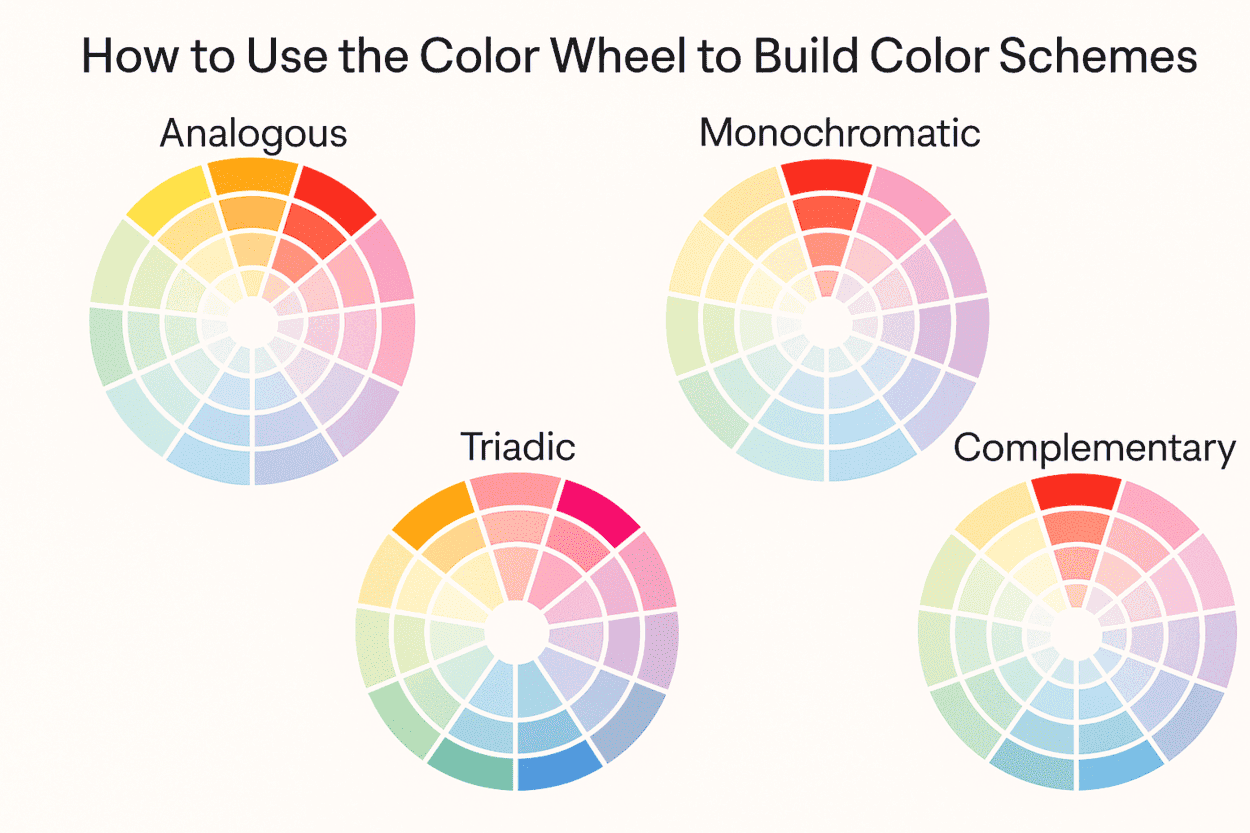
Palette construction is where the color wheel’s utility becomes strategic. Harmonious palettes aren’t accidental; they’re built on relationships mapped by the wheel. Analogous schemes—colors side by side—yield cohesion and subtlety. Complementary schemes, by contrast, create tension and energy. Triadic palettes, drawing from three evenly spaced points, offer balance and vibrancy without chaos. If you’re developing a visual identity or orchestrating a scene’s mood, the wheel is your reference point. It lets you move from intention to execution with precision. For workflow integration, see our guide to building color palettes that translate seamlessly from concept to production.
Experienced artists don’t treat the color wheel as a rulebook. It’s a framework—one that informs choices, accelerates troubleshooting, and underpins creative risk. Whether you’re painting, designing, or directing, fluency with the color wheel for artists is a baseline skill. It anchors creative intuition in a structure that’s stood the test of centuries.

Color Harmony and Balance: Creating Impactful Artworks
What is color harmony in art?
Color harmony in art is the orchestration of hues, values, and intensities to create a visual experience that feels intentional and resolved. It is not simply about matching colors or following a formula; it’s about constructing a palette where each element supports the whole. When harmony is present, the viewer’s eye moves fluidly across the composition, encountering both unity and interest, without being jarred by discordant notes. In practical terms, color harmony is foundational to the principles of composition and achieving visual harmony. It’s the difference between a painting that holds attention and one that feels arbitrary or unfinished.
Techniques for balancing color in artwork
Balance in color is not a static concept—it’s a dynamic negotiation between contrast and cohesion. Artists deploy several harmonic schemes to achieve this. Complementary colors, placed opposite each other on the color wheel (such as red and green), generate high contrast and immediate visual energy when juxtaposed. This technique, famously demonstrated by Matisse in “Le Danse,” is not about shock value but about directing focus and creating a pulse within the frame (Ann Richman Art, 2023).
Analogous colors, by contrast, are neighbors on the wheel—think blue, blue-violet, and violet. Their proximity produces a more subtle, unified effect, often evoking calm or lyricism. The use of analogous colors is a deliberate choice to soften transitions and maintain a sense of continuity across the canvas (Paulina Porsford, 2020). Triadic schemes, which draw from three equidistant hues, strike a balance between the vibrancy of complements and the calm of analogous groupings. Each approach offers a distinct structural logic for color balance, allowing artists to modulate intensity and focus.
Choosing harmonious color schemes for your style
Selecting a color scheme is not a matter of taste alone; it’s a strategic decision that shapes both mood and narrative. Complementary schemes lend themselves to bold storytelling, injecting tension or drama into the scene. Analogous palettes, on the other hand, are often chosen for works aiming to soothe or suggest continuity—ideal for backgrounds, transitions, or moments of reflection. Triadic combinations, with their inherent equilibrium, can be powerful for compositions requiring both unity and a lively interplay of elements.
The crucial move is to calibrate not only the hue, but also the value (lightness or darkness) and intensity (saturation) of each color. A high-chroma triad can quickly overwhelm; a muted complementary pair can lose its edge. Experienced artists adjust these variables in real time, responding to how the composition develops on the canvas. This is where theory meets practice: the color wheel offers a map, but the journey is navigated by the artist’s eye and intent.
The effects of color harmony on mood, storytelling, and engagement
Color harmony and balance are not aesthetic afterthoughts—they are narrative engines. The emotional temperature of an artwork is set by its palette as much as its subject. A harmonious scheme invites the viewer in, guiding their gaze and shaping their emotional response. Discordant or poorly balanced color, meanwhile, can distract or disengage. In commercial and editorial contexts, these principles are not abstract: they directly influence how a message is received, how long a viewer lingers, and what they remember. The best artists and creative leaders understand that color choices are strategic, shaping not just what is seen, but how it is felt.
Color Context and Perception: How Surroundings Change Artistic Choices
How color context affects your painting
Color context in art is never absolute. Place a red swatch against a green field and it vibrates with intensity; set the same red against orange and it recedes, dulled by proximity. This is not a trick of the eye—it’s a structural reality of color perception. The human brain judges color relationally, not in isolation. Every hue is shaped by its neighbors, every value weighed against its environment. Artists who ignore this are not simply missing nuance; they’re misreading the very language of color.
In painting, this phenomenon—color relativity—means that the same pigment can appear entirely different depending on what surrounds it. A blue shadow on a warm ochre wall feels cooler and more pronounced than the identical blue on a grey ground. This is why early drafts can look jarringly off once the background is blocked in. Context is not decorative; it’s determinative.
Tricks for managing color perception in art
Professionals anticipate these shifts. They test swatches directly in the composition, not on a separate palette. They squint, blur their eyes, and step back—forcing the brain to process relationships instead of isolated notes. Lighting complicates matters further. Natural light cools and flattens; artificial light can warm or distort. The wise artist revisits their work under multiple lighting conditions, recalibrating as needed.
Backgrounds are not neutral. A dark ground will make lights leap forward, while a pale surround can sap the drama from midtones. Foreground choices must be made with an awareness of this push-pull. The same principle applies in digital media, where display calibration and ambient light shift color relationships with each device and environment. No serious creative leaves these variables to chance.
Using contrast to enhance focal points
Visual contrast is a deliberate tool. High-contrast edges attract the eye, while low-contrast zones recede into atmosphere. Want to direct focus? Manipulate the color context around your subject. A pop of saturated color in a muted field draws attention, but overuse flattens the effect. The most sophisticated compositions use contrast sparingly—reserving their boldest moves for moments of narrative or emotional significance.
Illusion is born from these contrasts. A shadow painted with subtle complementary hues gains depth without literal darkness. A highlight next to a neutral appears brighter than it is. The artist’s task is not just to choose colors, but to orchestrate their interactions so the image resonates as intended.
Avoiding common pitfalls in color perception
Mistakes in color context are rarely technical—they’re perceptual. Overlooking the influence of surroundings leads to muddy palettes and jarring transitions. The classic error is over-relying on color wheels or theoretical harmonies, disconnected from the real interplay of light and material. To avoid this, creatives must train their eyes to see context, not just content.
This discipline extends beyond the studio. Marketers and creative leads commissioning visual work must understand how color context in art shapes viewer response. A campaign’s palette that sings on a white boardroom wall may wilt in a crowded, saturated feed. Anticipating these shifts is not optional—it’s the difference between visual coherence and creative noise.
Mastery of color context is not about rigid formulas. It’s about reading the room—literal and metaphorical—and adjusting the palette so that every choice serves the image, the message, and the medium. For those who care about impact, this is not a footnote. It’s the foundation.
Emotional Impact of Color: Using Color Theory to Evoke Feeling
How color affects mood in art
The emotional impact of color in art is not a matter of taste—it's a fundamental lever for shaping audience response. Warm colors—reds, oranges, yellows—tend to energize, provoke, and draw the eye. Cool colors—blues, greens, violets—calm, distance, and invite introspection. But these are not static rules. Bright, saturated hues can electrify a composition, while muted, desaturated palettes lower the emotional temperature, introducing restraint or melancholy. The interplay between these choices is where mood in painting is constructed: a single accent of crimson in an otherwise subdued frame can shift the entire emotional register. Artists who understand this dynamic wield color as a tool for both subtle suggestion and direct provocation, calibrating the viewer’s emotional state in sync with the work’s intent.
Choosing colors for emotional storytelling
Effective storytelling through color is a practice grounded in both intuition and discipline. Start with the narrative core—what feeling or psychological state should dominate? From there, palette selection becomes a matter of alignment. Want tension or unease? Juxtapose clashing colors, or introduce unexpected accents. Seeking harmony or nostalgia? Analogous palettes and gentle gradients often deliver. But emotional design strategies demand more than matching colors to moods; they require a structural awareness of how color relationships function across a sequence or within a single image. Consistency matters—repeating a signature hue can build emotional continuity, while a deliberate shift in palette can signal transformation or rupture within the narrative arc. The key is to avoid defaulting to cliché. Instead, let the color choices be deliberate, context-driven, and responsive to the story’s needs.
Cultural meanings of color in visual art
Color symbolism is not universal. Red may signify passion or violence in Western contexts, but in many Asian cultures it carries connotations of luck and celebration. Black, often associated with mourning in Europe and North America, can represent vitality or even prosperity elsewhere. This cultural variability means that artists and creative leads must interrogate their own assumptions—and, crucially, those of their audience—when deploying color for emotional effect. In global campaigns or cross-cultural projects, color psychology demands research and sensitivity. The most effective practitioners balance their personal style with an understanding of how color codes operate within the target audience’s cultural framework. Ignoring this risks miscommunication or, worse, alienation. The work must speak not just to the creator’s intent but to the lived experiences of its viewers.
Techniques for balancing personal style and audience interpretation
The tension between artistic signature and audience perception is perennial. Some artists lean into personal symbolism, trusting that their color choices will resonate through force of vision. Others prioritize accessibility, calibrating palettes to maximize clarity and emotional transparency. The best creative leaders recognize this as a spectrum, not a binary. They experiment—testing how different demographics respond to the same palette, or how subtle shifts in chroma and temperature can recalibrate mood without sacrificing voice. Iteration is key. So is dialogue: soliciting feedback, observing audience reactions, and refining the approach accordingly. Ultimately, the emotional impact of color in art is a negotiation between what the artist feels and what the audience perceives. Mastery lies in bridging that gap, using color not just as ornament, but as a primary engine of meaning and affect.
Color Theory for Artists in Practice: Studio Strategies and Pitfalls
Color theory for artists in practice is not an abstract exercise—it is a living, breathing part of every studio session. The gap between knowing the color wheel and creating compelling work is bridged by workflow, decision-making, and a willingness to learn from missteps. Whether you’re sketching, painting, or working digitally, the choices you make with color are rarely neutral; they shape perception, mood, and narrative. The artist’s challenge is to translate theoretical knowledge into instinctive, effective action.
Applying color theory step by step
Start with intention, not improvisation. Before you touch pigment or pixels, clarify the emotional and visual goals of your piece. Palette planning is the first discipline: select a limited set of hues and map their relationships. Swatching—testing colors in context—should be routine, not an afterthought. This is where theory meets reality. The way a color behaves on your canvas or screen is shaped by medium, surface, and light. Document your swatches, both successful and not, to build a personal reference archive. As you move from block-ins to detail, continually reassess: are your color choices supporting the composition, or are they fighting it?
Common color mistakes and how to avoid them
Three pitfalls recur across disciplines. First, muddy colors—often the result of careless mixing or over-layering—signal a lack of clarity in process. Avoid this by cleaning brushes, working with fresh mixtures, and knowing when to stop. Second, imbalanced palettes can flatten a work’s impact. Too many similar values or hues create monotony; overcorrecting with excessive contrast leads to chaos. Use value studies and grayscale checks to calibrate balance. Third, overreliance on theoretical complements can make work feel artificial. Real-world observation trumps textbook formulas—observe how light shifts color relationships in your environment, and let that inform your choices.
Studio exercises for mastering color
Practice is the crucible where color theory for artists in practice becomes second nature. Try limited palette exercises: restrict yourself to three colors plus white and explore their full range. This sharpens your sense of mixing and harmony. Conduct rapid swatch sessions before each project—set a timer and generate as many combinations as possible, focusing on subtle shifts. For digital artists, use adjustment layers to experiment non-destructively with temperature and saturation. Regularly revisit past work with a critical eye: what color decisions succeeded, and which undermined the piece? Iteration is not a sign of indecision, but of professionalism.
Building confidence with color comes from structured experimentation. Document your process, reflect on outcomes, and don’t shy away from revision. The most effective artists are not those who never make color mistakes, but those who learn to diagnose and resolve them. Integrating color theory into your workflow is not about policing creativity—it’s about equipping yourself to make bolder, more coherent choices. For further guidance on refining your process, see our artist workflow tips and deep dives on troubleshooting color issues.
Advanced Color Schemes: Beyond the Basics for Artistic Innovation
“Advanced color schemes for artists” is more than a technical phrase; it’s a provocation. Once you’ve mastered the primary wheel and its basic harmonies, the real work begins. Color becomes less about formula and more about intent—less about rules, more about possibilities. The leap from competent to compelling is almost always a leap into complexity.
Exploring advanced color schemes in art
Let’s start with the tetradic color scheme. Four hues, equally spaced, form two complementary pairs. This is not a casual palette; it’s a deliberate structure. Tetradic schemes demand careful balancing—too much of any one color and the whole composition collapses. Yet, when handled with restraint, they create tension and vibrancy that’s impossible with simpler pairings. The split-complementary scheme—one base color and two adjacent to its complement—offers a subtler complexity. It’s less volatile than direct complements, but more dynamic than analogous sets. Monochromatic approaches, often dismissed as safe, can be radical in their own right. Limiting oneself to a single hue and its variants forces a focus on value, texture, and rhythm. These schemes aren’t just technical options; they’re aesthetic strategies for artists who want to push beyond the obvious.
Digital tools for building unique palettes
Digital color tools have changed the game for experimentation. No longer constrained by paint tubes or print limitations, artists can generate and visualize advanced color schemes in real time. Tools for palette extraction, color mapping, and dynamic adjustment let you test the boundaries of harmony and discord with surgical precision. This isn’t about abdicating taste to algorithms; it’s about using digital art resources to expand the field of play. The best practitioners use these tools not to automate choices, but to provoke new questions—what happens if I invert this scheme, or introduce a hue from outside the visible spectrum? The technology is only as innovative as the mind wielding it. For those interested in experimenting with palettes, digital platforms are a laboratory, not a shortcut.
When to break traditional color rules
There’s a point where color theory—no matter how advanced—becomes a constraint rather than a guide. The most compelling work often emerges when artists deliberately subvert the logic of the wheel. That might mean clashing hues, or building tension through near-monochrome austerity. The point is not to be contrarian for its own sake, but to use risk as a tool for personal voice. Advanced color schemes for artists are not about showing off technical prowess; they’re about finding new ways to communicate mood, narrative, or brand. In an era where visual sameness is a real risk, unconventional palettes are a lever for distinctiveness. The only real rule: if the color serves the work, it’s the right choice.
Ultimately, pushing beyond the basics in color isn’t about abandoning structure—it’s about knowing when to transcend it. Advanced schemes, digital tools, and a willingness to experiment are the raw materials. Innovation comes from what you build with them, not from the palette itself.
Color Theory for Artists Across Mediums: Painting, Digital, and Beyond
Color theory for artists is not a static doctrine. It’s a living framework, constantly reinterpreted as creative tools evolve. Whether you’re holding a brush or a stylus, the underlying logic of hue, value, and harmony persists—but the tactics shift with the medium. Understanding these shifts isn’t just technical; it’s foundational for any artist intent on controlling their visual language across disciplines.
Color theory in painting vs digital art
Painting color theory is grounded in the physicality of pigment. Mixing is subtractive: every new color you add absorbs more light, often resulting in a muted or desaturated blend. The tactile nature of paint—its opacity, granulation, and the way it sits on a surface—demands a measured approach. Layering can deepen shadows or create luminosity, but it’s not easily undone. Choices are deliberate, sometimes irreversible.
Digital art color, by contrast, is additive. Here, colors are built from light; blending red, green, and blue yields white, not black. This opens up a spectrum of vibrancy and transparency impossible in traditional media. Layers are infinite, and mistakes are non-destructive. But digital abundance can breed chaos: without discipline, color palettes sprawl, and visual coherence suffers. The digital artist must impose boundaries, often by pre-selecting swatches or working in limited palettes to mimic the intentionality of paint.
Adapting color choices to your medium
Medium dictates method. In painting, the artist must anticipate how pigments interact—some colors overpower others, and certain combinations muddy faster than theory suggests. Transparency, too, is a factor: glazes in watercolor or oil can shift underlying tones in subtle ways. Understanding these quirks is not optional; it’s the difference between accidental and intentional color harmony.
In digital workflows, color management becomes a technical as well as an aesthetic challenge. Monitors vary, color spaces diverge, and what looks luminous on screen may print flat. Artists must calibrate devices, check values in grayscale, and use blending modes judiciously. For mixed media color, where analog and digital processes intersect, a hybrid mindset is essential: scan or photograph physical work with color accuracy in mind, then adjust digitally without erasing the medium’s original character.
Cross-medium color tips for artists
- Limit your palette intentionally, regardless of medium. Fewer colors force clarity and cohesion.
- Study how layering works in your chosen format—physical or digital. Layer order and transparency can radically alter results.
- Test your colors in context. A hue that sings on canvas may clash on screen or in print.
- Document your color decisions. Swatch libraries or digital palettes speed up future work and maintain consistency across projects.
- Borrow techniques across disciplines. Use digital mockups to plan painted compositions, or bring painterly blending into digital pieces.
Further learning and medium experimentation
No artist masters color in isolation. The most sophisticated understanding comes from cross-pollination—try translating a digital palette to a physical painting, or vice versa. Explore new surfaces and workflows to test how your color instincts adapt. For deeper dives, investigate color management tools, pigment histories, or even color psychology. The point is not to find a single “correct” approach, but to expand your fluency so that, whatever the medium, your color choices remain intentional and expressive.
Conclusion
Color theory is not a relic of art school or a tool reserved for painters. It is the scaffolding behind every visual decision that resonates, from the calculated palettes of a campaign to the instinctive choices of a cinematographer framing a scene. Whether you’re orchestrating a brand identity or storyboarding a film, understanding the fundamentals of color is non-negotiable. The color wheel remains the silent architect, mapping relationships and tensions that shape how audiences respond to your work.
At the heart of this practice is color harmony. It’s not just about pleasing combinations, but about structuring visual logic—balancing contrast and unity to guide the viewer’s eye and emotional state. Artists who grasp these principles can manipulate mood and meaning with precision. The emotional impact of color is not abstract theory; it’s a lever for influence, whether you’re evoking trust with blue, urgency with red, or nostalgia with sepia. These associations are culturally mediated, but their effects are measurable across mediums and markets.
The application of color theory extends far beyond traditional painting or design. In film, color grading shapes narrative subtext. In digital product design, palette choices drive usability and brand perception. Even in environments—retail, architecture, events—the strategic deployment of color can alter behavior and memory. Mastery comes not from rote adherence to rules, but from a willingness to test, observe, and refine. The most effective practitioners treat color theory as a living framework, adapting it to context, audience, and evolving cultural codes.
Ultimately, color theory endures because it is both foundational and adaptable. Its principles anchor creative decisions, yet never constrain them. The challenge for artists and creative leaders is to move beyond superficial application—using color not just to decorate, but to communicate, persuade, and provoke. Continued exploration of color harmony and the emotional impact of color is essential, especially as new mediums and technologies emerge. The language of color will always be central to how we make, see, and feel.
FAQs
What is color theory for artists?
Color theory is the study of how colors interact, combine, and influence each other in visual contexts. For artists, it’s a practical framework for making intentional choices about hue, value, and saturation. It underpins the visual language of painting, design, and film, shaping both aesthetic coherence and narrative impact.
How has color theory evolved over time?
Color theory has shifted from early philosophical speculation to systematic models. The Renaissance introduced pigment mixing, while the 18th and 19th centuries formalized the color wheel and complementary relationships. Modern color theory incorporates scientific understanding of light and perception, influencing everything from fine art to digital media workflows.
What is the structure of the color wheel?
The color wheel is a circular diagram that organizes hues in a logical sequence. It typically features primary colors (red, yellow, blue), secondary colors (green, orange, violet), and tertiary colors—those formed by mixing adjacent hues. Artists use the wheel to visualize relationships and plan palettes that work visually and conceptually.
How do artists achieve color harmony in their work?
Artists achieve color harmony by leveraging relationships on the color wheel—analogous, complementary, or triadic schemes. Harmony arises when colors relate in a way that feels balanced, unified, and intentional. Techniques include limiting the palette, adjusting saturation and value, and using neutrals to mediate strong hues.
How does color context influence perception in art?
Color context refers to how a color’s appearance shifts depending on its surroundings. The same hue can look warmer, cooler, lighter, or darker based on adjacent colors. Artists exploit this phenomenon to create depth, direct focus, or evoke mood, understanding that perception is always relative, never absolute.
What emotional effects can colors have in art?
Colors carry powerful emotional associations—red can signal urgency or passion, blue can evoke calm or melancholy, yellow often conveys energy or optimism. These effects are shaped by cultural context and personal experience. Skilled artists deploy color to reinforce narrative, shape audience response, and build atmosphere.
How can artists apply color theory in their studio practice?
Artists integrate color theory by pre-visualizing palettes, making test swatches, and observing how colors interact under different lighting. They use color studies to experiment, then translate these findings into final compositions. The key is intentionality—each color decision serves the work’s structure, mood, and communicative goal.
.webp)
Creative Collaboration Platform: The Backbone of Modern Creative WorkWhat is a creative collaboration platform?Clapboard defines a creative collaboration platform as the operational core for today’s distributed creative teams. This is not a collection of digital collaboration tools stitched together; Clapboard’s system

Understanding the Creative Production MarketplaceWhat is a Creative Production Marketplace?Clapboard defines a creative production marketplace as a structured ecosystem where brands, agencies, and production talent converge to execute video, advertising, and branded content at scale. Unlike the legacy agency or freelanREAD FULL ARTICLE

The Urgent Need for a Creative Production Operating SystemWhy Traditional Creative Production Models Break DownClapboard sees the creative production landscape shifting under pressure. Content velocity is no longer a buzzword—it’s a mandate. Modern advertising demands relentless output across dozens of channels, each wREAD FULL ARTICLE

JOIN THE NEWSLETTER.
Content Production insights, videos, books, and freebies, delivered to your inbox weekly


LEAVE A COMMENT
Your email address will not be published.