


Varun Katyal | Founder, Clapboard
Varun Katyal is the Founder & CEO of Clapboard and a former Creative Director at Ogilvy, with 15+ years of experience across advertising, branded content, and film production. He built Clapboard after seeing firsthand that the industry’s traditional ways of sourcing talent, structuring teams, and delivering creative work were no longer built for the volume, velocity, and complexity of modern content. Clapboard is his answer — a video-first creative operating system that brings together a curated talent marketplace, managed production services, and an AI- and automation-powered layer into a single ecosystem for advertising, branded content, and film. It is designed for a market where brands need content at a scale, speed, and level of specialization that legacy agencies and generic freelance platforms were never built to deliver. The thinking, frameworks, and editorial perspective behind this blog are shaped by Varun’s experience across both the agency world and the emerging platform-led future of creative production. LinkedIn: https://www.linkedin.com/in/varun-katyal-clapboard/
Defining Your Objectives—The Foundation of Video Marketing Strategy
Every effective video marketing strategy starts with a single, non-negotiable step: define your objectives with precision. Too many campaigns fall flat because teams rush into production, seduced by creative ambition or pressured by deadlines, without anchoring their work to measurable outcomes. Content objectives aren’t a box-ticking exercise—they’re the difference between a video that moves the needle and one that’s just noise.
How to set measurable goals for your video marketing strategy
Start by translating business priorities into specific video campaign goals. “Increase brand awareness” is not a goal—it’s a direction. “Lift unaided brand recall by 20% in Q2 among decision-makers” is a goal. If you can’t measure it, you can’t manage it. Quantify every objective, whether it’s driving demo signups, reducing support queries, or accelerating sales-qualified leads. Tie these numbers directly to your marketing KPIs, not just video vanity metrics.
Aligning video objectives with business outcomes
Effective content objectives never exist in isolation. Map each video’s purpose to a clear business outcome. If your organisation’s priority is market expansion, your video marketing strategy should focus on generating qualified leads in new regions, not just racking up views. For retention, target engagement and education metrics that correlate with reduced churn. The most successful teams treat video as a lever for business growth, not a standalone creative output.
Mistakes to avoid when defining video marketing goals
The most common pitfall is mistaking activity for impact. Views, likes, and shares are easy to track, but they rarely reflect commercial value. Don’t confuse reach with resonance. Another frequent error is failing to adapt objectives to the customer journey. Early-stage videos should build awareness and consideration; lower-funnel content must drive conversion or loyalty. One-size-fits-all goals dilute effectiveness and waste budget.
- Outcome-focused metrics: lead conversion rate, sales pipeline velocity, customer retention, cost per acquisition.
- Vanity metrics: total views, average watch time, follower growth, social shares (unless directly tied to business impact).
Adapting objectives for different stages of the customer journey
Precision matters. Top-of-funnel videos should target reach and qualified traffic—measured by click-through rates to owned assets, not just raw impressions. Mid-funnel content should focus on engagement depth, like demo requests or repeat site visits. Bottom-of-funnel videos must deliver measurable conversion events. Post-purchase, objectives shift to advocacy and retention. Adjust your measurement framework as prospects move through the funnel; static goals are a liability.
Set your objectives before you brief the creative team. Revisit them at every review. If a video doesn’t serve a defined, measurable outcome, it doesn’t belong in the plan. This discipline is the foundation of any video marketing strategy that delivers real business value.
Rethinking Video Marketing Strategy for Modern Brands
Why most video marketing strategies need an update
The term "video marketing strategy" is thrown around with the same casualness as “brand purpose” or “content calendar.” The problem: most so-called strategies are glorified checklists, not true frameworks. They’re built for yesterday’s audience—linear, campaign-driven, and fixated on short-term metrics. This approach ignores how digital video has evolved. Modern brand marketing demands more: more nuance, more integration, and far more ambition than a quarterly hero film or a scattershot YouTube spend.
Traditional playbooks—brief, shoot, post, repeat—fail to account for the speed and fragmentation of digital consumption. They treat video as a one-off asset, not a living brand system. In practice, this means wasted budget, inconsistent messaging, and a disconnect between what brands push and what audiences actually engage with. If your strategy still starts with “what’s our hero video?” you’re already behind.
How consumer behavior is shaping video content planning
Digital video trends are not just about platforms or formats—they’re about attention. Audiences now move seamlessly between devices, channels, and content types. They expect relevance, context, and narrative continuity. This has profound implications for video content planning. The days of front-loading budgets into a single flagship film are over. Instead, effectiveness comes from orchestrating a series of moments—short-form, long-form, live, interactive—that build equity over time.
The data is clear: viewers don’t just want to be sold to; they want to be part of a story. They reward brands that respect their time and intelligence, and punish those that interrupt or patronize. Effective planning means mapping content to the real audience journey, not the imagined funnel in a boardroom. It means designing for discoverability, shareability, and sustained engagement, not just reach.
The role of video in modern brand storytelling
Video is now the connective tissue of modern brand storytelling. It’s where narrative, emotion, and utility intersect. But for most brands, the challenge isn’t production quality—it’s narrative coherence and strategic intent. A fragmented approach—launching sporadic videos with no throughline—undermines credibility and dilutes brand equity.
Modern brand marketing requires a shift: from campaign bursts to ongoing dialogue. The most effective brands treat video as a system, not a series of stunts. They invest in building recognizable visual language, recurring story arcs, and modular content that adapts to context. This isn’t about chasing the latest digital video trends for vanity’s sake. It’s about architecting a brand presence that’s as dynamic as the platforms—and audiences—it serves.
From tactics to strategy: setting a new standard
A tactical approach to video will always be reactive—chasing formats, algorithms, or competitors. A strategic approach is proactive and purposeful. It starts with a clear understanding of business objectives, audience realities, and the evolving role of video in the marketing mix. It aligns creative ambition with commercial outcomes.
For brands serious about growth, this means rethinking not just what you make, but why, how, and for whom. It means embracing video as a long-term brand asset, not a one-off deliverable. And it means demanding more from your video marketing strategy—because the market, and your audience, already do.
Audience Insights—Understanding Who Your Video Is For
Every high-performing video campaign starts with a clear-eyed definition of its video marketing audience. Forget generic demographic snapshots—they’re a relic. Today, effectiveness demands granular, actionable insight. Senior marketers and creative leads know: if you don’t understand who’s watching, you’re guessing, and guesswork is expensive.
How to research your video marketing audience
Surface-level data—age, location, job title—won’t cut it. Commercial impact depends on knowing what motivates your audience, what frustrates them, and how they actually behave online. The best teams leverage analytics from platforms like Google Analytics, first-party CRM data, and qualitative feedback from customer surveys. This isn’t box-ticking. It’s about identifying not just who your audience is, but how they think, what they need, and where they spend their time (SundaySky, 2026).
Patterns emerge when you go deep: Do they binge short-form content on mobile, or do they prefer in-depth explainers on desktop? Are their pain points functional, emotional, or social? These insights are the raw material for every smart creative and distribution decision that follows. Anything less is noise.
Using personas to guide video content creation
Audience personas turn research into strategy. But this isn’t about fictional avatars or marketing theatre. Effective personas are built from real data—purchase history, platform engagement, content interaction. They should map to distinct segments within your broader audience, each with their own needs, triggers, and conversion drivers. This is where target audience research becomes operational: you’re not just creating for “millennials” or “decision-makers,” but for specific, actionable clusters.
For example, one persona might value brevity and clarity, demanding punchy explainers. Another might respond to storytelling and depth, requiring longer-form narratives. These distinctions shape everything from scripting to format selection to call-to-action placement. Ignore them, and your content will underperform—no matter how polished the production.
Best practices for engaging different viewer segments
Segmentation isn’t just a planning exercise; it’s the engine of relevance. Effective video marketing audience segmentation allows you to deliver the right message, in the right format, at the right moment in the customer journey. This means aligning creative choices—tone, pacing, visual style—with the expectations and consumption habits of each segment (Clearhead, 2026).
Distribution should mirror this precision. If analytics show that one segment is most active on LinkedIn during work hours, while another prefers Instagram Stories after 8pm, your content calendar and media spend should reflect that. This is where audience segmentation and customer journey mapping intersect—ensuring you’re not just reaching more people, but the right people, more effectively.
Finally, measurement closes the loop. Don’t just track vanity metrics. Monitor engagement rates, completion rates, and post-view actions by segment. Feed this data back into your audience models. The teams that win are those that treat audience insights as a living asset, not a one-off research phase.
Mapping Video Content to the Marketing Funnel
Which videos work best at each marketing funnel stage
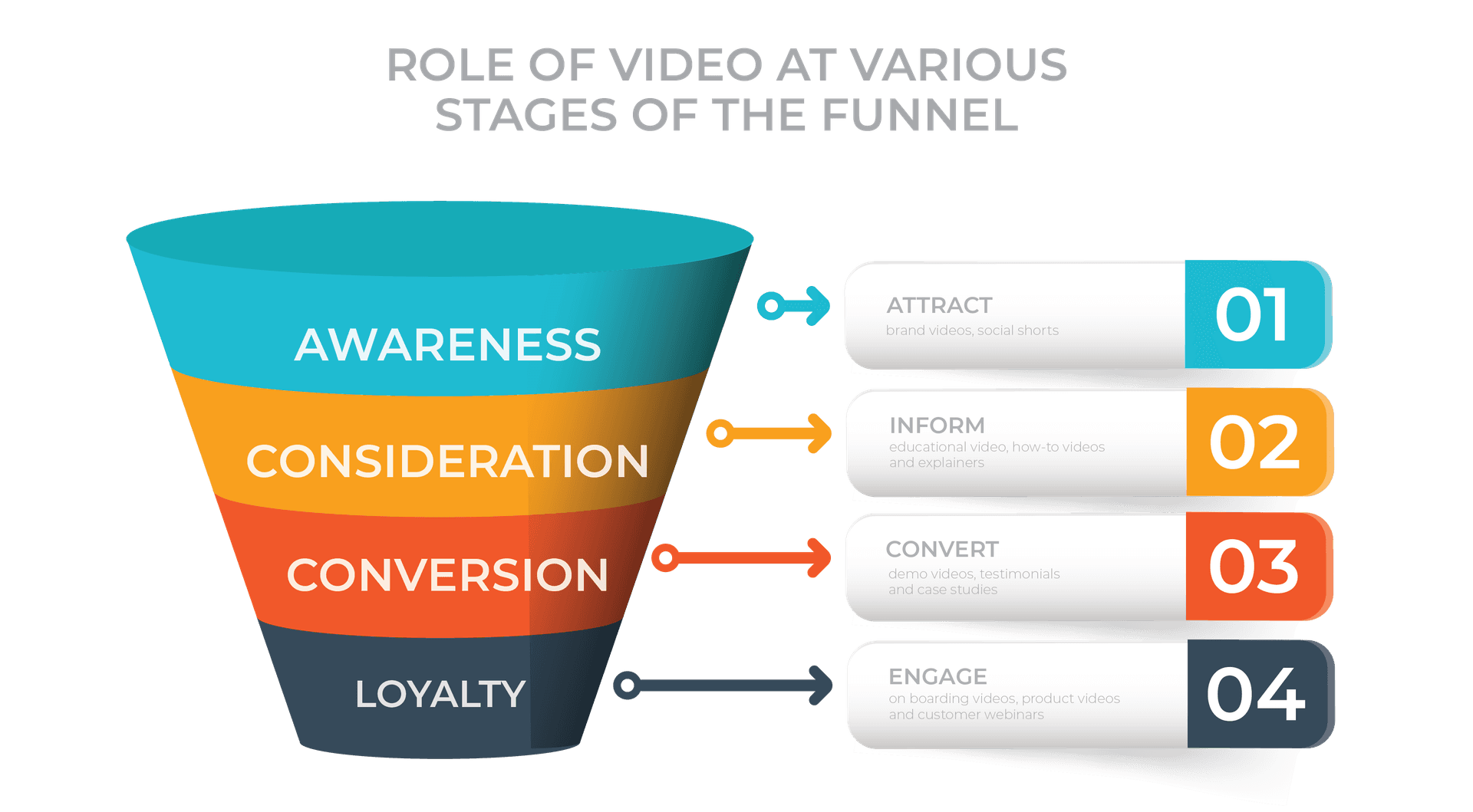
Treating the marketing funnel as a content planning framework isn’t optional if you expect video to drive commercial results. The reality: every stage of the funnel demands a different video approach, and misalignment is where campaigns underperform. At the top, marketing funnel video content should be engineered for reach and recognition. Brand films, social cutdowns, and expert interviews are proven formats for capturing attention and building initial trust (Adobe Business, 2023). Educational videos—think problem-explainer shorts, myth-busting explainers—also excel at this stage because they inform without pushing product (Content Marketing Institute, 2023).
Move into consideration and the requirements shift. Here, funnel-aligned content means product demos, explainer videos, and webinars that clarify value and differentiate your offer. Testimonials and case studies are not window dressing—they’re conversion accelerators, giving prospects the evidence they need to move forward. Tutorial videos and live Q&As also play a role, especially for complex or high-consideration purchases. The goal is simple: reduce friction, answer objections, and show the real-world impact of your solution.
How to map video content to your customer journey
Mapping video to the customer journey means more than ticking boxes. It’s about sequencing content to match intent and readiness. Early-stage viewers aren’t primed for product pitches—they want clarity, relevance, and a sense you understand their world. Mid-funnel audiences need proof and practical detail. At the bottom, conversion-focused videos—personalized walkthroughs, offer explainers, or direct calls-to-action—should remove final barriers. Post-purchase, retention and advocacy depend on onboarding videos, customer stories, and ongoing value-add content. It’s a deliberate choreography, not a content dump.
The mistake? Too many brands deploy the same video asset across every funnel stage, expecting a one-size-fits-all effect. This dilutes impact and clouds measurement. Instead, build a modular video library: awareness assets for reach, consideration pieces for education, and conversion content that compels action. Supplement with retention-focused videos to keep customers engaged and reduce churn.
Measuring video success across the funnel
Metrics are the reality check. At the awareness stage, track reach, view-through rate, and brand lift—these signal whether your marketing funnel video content is cutting through. In consideration, engagement metrics matter: watch time, click-throughs, and lead generation. For conversion, zero in on form completions, direct purchases, or booked meetings attributed to video. Retention and advocacy require a different lens—monitor repeat engagement, NPS movement, and referral actions driven by customer journey videos.
The point is not to chase vanity metrics, but to tie each video’s performance to its intended funnel outcome. If an explainer video isn’t driving qualified leads, it’s not working—regardless of views. If a testimonial doesn’t move prospects closer to a decision, retool it. Precision mapping and ruthless measurement are what turn video from a creative expense into a strategic asset.
Avoiding common mismatches between content type and funnel stage
Misalignment between video type and funnel stage is the silent killer of ROI. Product demos pushed at cold audiences waste budget and erode trust. High-concept brand films served to ready-to-buy prospects miss the mark and stall conversion. The fix: start with the funnel, not the asset. Build your video conversion strategy around the stages your audience actually moves through—then deploy content with intent. This isn’t about more video; it’s about the right video, at the right moment, measured against the right goal
Decision Matrix—Choosing the Right Video Production Model
The choice of video production model is not a creative indulgence—it's a strategic lever. Whether you build an in-house video team, rely on outsourced video production, or engineer a hybrid production approach, the decision must be grounded in commercial realities. A structured matrix clarifies which model aligns with your brand’s ambitions, operational cadence, and appetite for risk.
How to choose the best video production model for your brand
Start with four criteria: control, cost, expertise, and scalability. Control determines how tightly you want to steer creative and brand messaging. Cost is more than line items—factor in overhead, opportunity cost, and the long-term implications of fixed versus variable spend. Expertise covers not only technical skills but also the ability to deliver at your required pace and standard. Scalability is about flex—can your model handle campaign surges, new markets, or shifting formats without breaking?
Rank your priorities. If brand control and speed-to-market are non-negotiable, an in-house video team offers direct oversight and seamless integration with your marketing function. If cost minimisation and access to niche expertise matter most, outsourced video production can deliver breadth without the burden of permanent headcount. For brands with fluctuating needs or complex portfolios, a hybrid production approach may strike the right balance.
In-house vs. outsourced video production: Key trade-offs
An in-house video team delivers proximity and rapid iteration. You get institutional knowledge, tighter feedback loops, and the ability to embed video into broader campaigns. The trade-off is resource rigidity—talent gaps, equipment depreciation, and the risk of creative tunnel vision. Outsourced video production, by contrast, offers elasticity. You buy into fresh thinking and specialist skills, but at the cost of less day-to-day control, longer onboarding, and potential misalignment with brand nuance.
Neither model is inherently superior. The right choice depends on your campaign cadence, content complexity, and appetite for operational overhead. An in-house team can be a strategic asset for brands with high-volume, always-on content needs. Outsourcing suits project-based work or when you need to punch above your internal weight.
When a hybrid video production approach makes sense
Hybrid production is not a compromise—it's a deliberate structure for brands that want the best of both worlds. You retain a core in-house team for brand guardianship, rapid turnaround, and day-to-day content. For high-stakes campaigns or technical one-offs, you tap external partners to augment capabilities or inject specialist creativity.
This model suits brands scaling into new markets, experimenting with new formats, or managing a diverse portfolio. The hybrid approach also future-proofs your video capability—internal teams learn from external partners, raising the baseline over time. The challenge is orchestration: clear briefs, robust workflows, and transparent accountability are non-negotiable.
Production model choice and its impact on workflow and output
Your chosen video production model shapes everything from ideation velocity to post-production quality. In-house teams can accelerate feedback and adaptation but risk internal echo chambers. Outsourced models bring external perspective but require tight project management to avoid drift. Hybrids demand discipline—without clear roles and process, you risk duplication or dilution.
Ultimately, the production process options you select—whether fully internal, fully external, or blended—define your video team structure and your ability to deliver at the pace and quality your strategy demands. The decision is not one-and-done. As your brand grows, revisit the matrix. Your needs will shift. So should your model.
Creative Briefs and Messaging—Translating Strategy Into Story
The video creative brief is the linchpin between strategic intent and story-driven content. It’s not a formality—it’s a working document that aligns stakeholders, sharpens focus, and sets the parameters for execution. In high-stakes campaigns, a strong brief is the difference between a series of disconnected assets and a unified narrative that moves the needle. If your video creative brief isn’t actionable, you’re not just wasting budget—you’re burning opportunity.
What to include in a video creative brief
Effective briefs distill complexity into clarity. The essentials: campaign objectives, target audience insights, messaging framework, mandatories, and KPIs. Objectives must be specific and measurable—“drive 1,000 demo signups” beats “raise awareness.” Audience insights go beyond demographics; they should surface real motivators and barriers. The messaging framework defines the core promise, proof points, and tone. Mandatories capture non-negotiables—visual identity, legal requirements, technical specs. KPIs anchor creative ambition to business outcomes. Anything less, and you’re flying blind.
How to develop messaging that supports your video marketing strategy
Messaging isn’t copywriting. It’s the disciplined translation of strategy into story. Start with the audience’s context—what do they care about, and what’s competing for their attention? Build your narrative around a single, differentiated promise. Every message must ladder up to this core idea. Use the messaging framework to map supporting arguments and emotional hooks. If your video messaging strategy isn’t ruthlessly focused, you’ll end up with content that’s forgettable or, worse, irrelevant.
Scriptwriting tips for brand storytelling
Script development is where messaging and creative direction converge. The brief should inform structure—opening with a hook, establishing relevance, delivering proof, and closing with a call to action. Every line must earn its place. Cut exposition. Show, don’t tell. Use visual storytelling to reinforce the message, not distract from it. Consistency is non-negotiable: tone, pacing, and visual cues should align across every asset. This is how you build brand memory and drive action, not just views.
Maintaining creative consistency across multiple video assets
Multi-market or multi-format campaigns amplify the risk of creative drift. The brief must establish clear guardrails—approved messaging, visual language, and executional dos and don’ts. Centralized oversight is critical, but so is allowing local teams to adapt nuance. The goal: every asset feels part of a coherent system, not a patchwork. Consistency isn’t about sameness; it’s about unmistakable brand presence, wherever and however your story is told.
When strategy, creative development, and execution are connected by a robust video creative brief, you get story-driven content that delivers. Anything less is just noise.
Distribution Channels—Getting Your Video Marketing Strategy Seen
Video marketing distribution is the lever that determines whether your content drives results or fades into digital oblivion. The days of uploading to YouTube and calling it a strategy are over. Distribution now demands a deliberate, channel-specific approach—one that aligns with your objectives, audience behaviors, and the economics of attention.
Best channels for video marketing distribution
Every distribution channel falls into three buckets: owned, paid, and earned. Owned channels—your website, email lists, proprietary apps—offer control but limited reach. Paid channels, from social video platforms’ ad networks to programmatic placements, buy you scale and targeting. Earned channels—press, influencer shares, organic reposts—deliver credibility but are unpredictable by nature.
Choosing the right mix is not about being everywhere. It’s about being where your audience actually pays attention and where your message fits the context. For brand storytelling and deep engagement, owned channels and long-form platforms (think website, LinkedIn, or even a gated hub) outperform. For awareness and reach, paid placements on high-traffic social video platforms like Instagram Reels, TikTok, and YouTube Shorts are non-negotiable. Earned distribution can amplify both, but it’s a byproduct of strong creative and smart seeding, not a standalone strategy.
How to build a multichannel video strategy
A multichannel video strategy means more than copy-pasting the same asset everywhere. Each platform demands its own format, tone, and creative approach. Vertical video dominates on TikTok and Instagram Stories, while YouTube still rewards horizontal, longer-form content. LinkedIn calls for a different narrative—more authority, less flash. Even within a single channel, audience behavior shifts: a six-second pre-roll and a three-minute explainer are not interchangeable.
Effective distribution starts at the storyboard. Map your content variations to each channel’s strengths and limitations. Budget for creative adaptation, not just production. Test multiple edits, hooks, and CTAs. Treat every distribution point as its own campaign, with tailored creative and measurement.
Measuring distribution performance for video content
Distribution analytics should be ruthless. Vanity metrics—views, likes, shares—are table stakes. What matters is qualified reach, engagement depth, and downstream actions: click-throughs, sign-ups, sales. Use platform-native analytics but don’t stop there. Integrate UTM tracking, server-side events, and CRM data to map true business impact.
Optimization is ongoing. Drop channels that underperform against your core KPIs. Double down on those that drive measurable outcomes, not just impressions. Regularly review your distribution strategy, reallocating budget and creative resources based on real data, not assumptions.
Adapting to the evolving video distribution landscape
The distribution landscape will keep shifting—algorithms, formats, audience tastes. The only constant is the need for a disciplined, outcome-oriented approach to video marketing distribution. Treat every channel as a strategic investment, not a checkbox. The brands that win are those that master not just what they say, but how, where, and to whom they say it.
Measuring Success—Analytics and Optimization in Video Marketing Strategy
Video marketing analytics is not a box to tick—it’s the backbone of any credible campaign. If you’re not tracking with intent, you’re guessing. The difference between a campaign that moves the needle and one that burns budget is a data-driven strategy that starts before the first frame is shot. Senior marketers know: creative without measurement is just noise. Analytics is how you prove, improve, and defend every decision.
How to track analytics for your video marketing strategy
Start with clarity on your objectives. Are you driving brand recall, lead generation, or direct conversions? Your KPIs must match your commercial reality. Impressions and views are vanity if retention, engagement, or attributed revenue are the real outcomes you need. Set up analytics dashboards that pull data from all distribution points—owned, paid, and earned. Fragmented tracking is a silent killer of insight. Centralize your data to see the full impact, not just isolated wins.
Key metrics for video campaign optimization
Video performance metrics must be chosen with ruthless relevance. For upper-funnel campaigns, prioritize view-through rate, average watch time, and unique reach. For mid- and lower-funnel, focus on click-through rate, conversion rate, and cost per acquisition. Don’t neglect qualitative signals: audience retention graphs, heatmaps, and drop-off points tell you where creative or message is failing. Integrate video ROI measurement early—don’t wait for post-mortems to justify spend.
Turning video data into actionable insights
Raw data is inert. The real value comes from pattern recognition and decisive action. If you see consistent drop-offs at a specific timestamp, re-edit or re-sequence. If a particular creative format is outperforming others, double down and iterate. Use A/B testing to validate assumptions, but move fast—performance windows close quickly. Campaign optimization is a continuous loop: launch, measure, adapt, repeat. The best teams don’t just report metrics; they operationalize them.
Common pitfalls in interpreting video analytics
Misreading metrics is more damaging than not measuring at all. Don’t conflate reach with impact—broad distribution means nothing if it’s not your target audience. Beware of over-indexing on platform-specific data; what works on one channel may underperform elsewhere. Context is everything: seasonality, creative fatigue, and audience overlap all skew results. Avoid confirmation bias—look for what’s not working as rigorously as you hunt for wins.
In sum, video marketing analytics is about discipline, not dashboards. The practitioners who win are those who treat data as a lever for action, not a post-campaign afterthought. If you’re not using analytics to inform every stage—from creative development to distribution—you’re not running a strategy, you’re running a lottery.
Common Pitfalls and Myths in Video Marketing Strategy
Top mistakes in video marketing strategy
Most video marketing strategy mistakes stem from the same root: chasing trends over clarity. Brands get seduced by formats, platforms, or the latest viral style, then wonder why results fall flat. The first error is prioritizing aesthetics or novelty over commercial intent. Video that looks impressive but lacks a clear message or call to action is wasted budget. Another frequent mistake is overestimating organic reach—assuming content will “go viral” without a paid distribution plan is wishful thinking, not strategy. Senior marketers know: reach is bought, not wished into existence.
A subtler but equally damaging error is the one-and-done approach. Too many campaigns are set live and left to run without ongoing optimization. When video performance plateaus, the instinct is to blame the creative. In reality, underperformance often signals a lack of iteration—failure to adjust targeting, messaging, or even edit length based on real data. Effective brands treat every campaign as a live experiment, not a finished product.
Common myths about video marketing effectiveness
The video marketing myths that persist are stubborn. Chief among them: “Longer videos drive deeper engagement.” In practice, attention is a scarce commodity. Unless the content justifies its length—think product demos or in-depth explainers—brevity wins. Another myth: “High production value guarantees results.” Polished visuals can’t save a weak concept or muddled message. Audiences reward clarity, relevance, and authenticity over gloss every time.
There’s also the belief that more content equals more impact. Flooding channels with undifferentiated assets leads to fatigue and diminishing returns. Strategic focus—targeting the right audience with the right message at the right moment—consistently outperforms volume. This is where commercial discipline trumps creative vanity.
How to troubleshoot underperforming video campaigns
When video campaigns underperform, start with alignment. Is the creative built for the platform and audience, or is it a generic asset ported everywhere? Often, the disconnect between strategy and execution is to blame. Next, interrogate the data: Are you optimizing for the right metrics? Vanity metrics—views, likes, shares—are not business outcomes. Focus on conversion, retention, or whatever moves the commercial needle.
Another common pitfall is ignoring the feedback loop. Campaigns should never be static. Use performance data to inform rapid iterations—test new hooks, swap out CTAs, adjust lengths. If you’re not learning and adapting, you’re falling behind. For a deeper dive into diagnosing performance issues, see our guide on video strategy troubleshooting and techniques for avoiding content mistakes.
Finally, the most costly strategic error is mistaking activity for progress. Launching video for the sake of “being present” rarely delivers returns. Every asset should have a defined role within the funnel, tied to measurable objectives. If your video marketing lacks that discipline, you’re not just wasting budget—you’re eroding brand equity.
Conclusion
A strategic approach to video marketing is not optional—it's foundational. Campaigns that succeed begin with clear objectives, aligned from the boardroom to the creative floor. Without this clarity, even the most polished production is just noise in a crowded feed. The core of effective video marketing strategy is ruthless focus: define what the business needs to achieve, then build every creative and distribution decision around that outcome.
Audience insights are the difference between content that lands and content that drifts. Senior marketers know that surface-level demographics are not enough. Real impact comes from understanding the motivations, pain points, and behaviors that drive your audience’s decisions. When these insights inform video content planning, every asset moves with purpose—targeted, relevant, and primed for measurable results.
Mapping video content to the marketing funnel is not a box-ticking exercise. It is the framework that ensures each piece of content has a job to do, from sparking awareness to driving conversion. This discipline is what separates campaigns that deliver business results from those that merely generate views. The best teams treat creative development as a business function, not a vanity project—every asset must earn its keep.
In a market defined by short attention spans and high expectations, video marketing demands more than creativity. It requires structure, insight, and a willingness to interrogate assumptions. Ignore the common pitfalls in video marketing: lack of alignment, vague goals, and content for content’s sake. Instead, let analytics guide your decisions, let audience insights shape your narrative, and let strategy set the pace. That’s how video delivers real commercial value—today and in the quarters ahead.
FAQs
What is a video marketing strategy?
A video marketing strategy is a deliberate plan for using video to achieve defined business objectives. It covers everything from audience analysis and content themes to production approach, distribution, and performance measurement. The goal isn’t just to make videos, but to drive results that matter—reach, engagement, conversion, or brand equity—through disciplined planning and execution.
How do I define objectives for my video marketing?
Start with business priorities, not vanity metrics. Objectives should be specific, measurable, and directly tied to commercial outcomes—think lead generation, product adoption, or market entry. Avoid generic goals like “increase awareness” unless you can quantify them. Each objective must have a clear success metric and a realistic timeframe for assessment.
Why is understanding my audience important for video marketing?
Audience insight is the foundation of effective video. Without it, you’re guessing—wasting budget and attention. Deep understanding informs messaging, creative style, channel selection, and even format. It’s the difference between content that’s ignored and content that compels action. Data-driven audience knowledge reduces risk and increases ROI.
How do I map video content to the marketing funnel?
Each funnel stage demands a different approach. Top of funnel: broad, attention-grabbing content to spark interest. Middle: educational or testimonial videos to build trust and consideration. Bottom: product demos or case studies to drive conversion. Map content to intent, not just channel, for maximum impact at every stage.
What are the different video production models?
There are three main models. In-house production offers control and speed but can strain resources. Outsourced production brings expertise and scale, with higher costs and less agility. Hybrid combines both—retaining strategic oversight while using external specialists for execution. The right model depends on budget, skillset, and campaign complexity.
How can I effectively distribute my video content?
Distribution is not one-size-fits-all. Choose channels based on where your audience spends time and what your objectives demand—owned platforms for control, paid for reach, earned for credibility. Tailor content for each channel’s format and context. Monitor performance, adjust placement, and avoid the trap of “post everywhere, hope for the best.”
What common mistakes should I avoid in video marketing?
Don’t chase trends without strategy. Don’t neglect distribution planning. Avoid measuring success by views alone—focus on business impact. Underinvesting in creative or overcomplicating messaging also kills effectiveness. The biggest myth: that video “goes viral” by accident. Results come from discipline, not luck or imitation.
.webp)
Creative Collaboration Platform: The Backbone of Modern Creative WorkWhat is a creative collaboration platform?Clapboard defines a creative collaboration platform as the operational core for today’s distributed creative teams. This is not a collection of digital collaboration tools stitched together; Clapboard’s system

Understanding the Creative Production MarketplaceWhat is a Creative Production Marketplace?Clapboard defines a creative production marketplace as a structured ecosystem where brands, agencies, and production talent converge to execute video, advertising, and branded content at scale. Unlike the legacy agency or freelanREAD FULL ARTICLE

The Urgent Need for a Creative Production Operating SystemWhy Traditional Creative Production Models Break DownClapboard sees the creative production landscape shifting under pressure. Content velocity is no longer a buzzword—it’s a mandate. Modern advertising demands relentless output across dozens of channels, each wREAD FULL ARTICLE

JOIN THE NEWSLETTER.
Content Production insights, videos, books, and freebies, delivered to your inbox weekly


LEAVE A COMMENT
Your email address will not be published.