- HOME
- FOR CLIENTS
- FOR FREELANCERS
- LOGIN
BLOG
New user? Create account
New user? Create account


Varun Katyal is the Founder & CEO of Clapboard and a former Creative Director at Ogilvy, with 15+ years of experience across advertising, branded content, and film production. He built Clapboard after seeing firsthand that the industry’s traditional ways of sourcing talent, structuring teams, and delivering creative work were no longer built for the volume, velocity, and complexity of modern content. Clapboard is his answer — a video-first creative operating system that brings together a curated talent marketplace, managed production services, and an AI- and automation-powered layer into a single ecosystem for advertising, branded content, and film. It is designed for a market where brands need content at a scale, speed, and level of specialization that legacy agencies and generic freelance platforms were never built to deliver. The thinking, frameworks, and editorial perspective behind this blog are shaped by Varun’s experience across both the agency world and the emerging platform-led future of creative production. LinkedIn: https://www.linkedin.com/in/varun-katyal-clapboard/
AI social media management isn’t defined by a single breakthrough — it’s the sum of several critical platform features working in concert. At the core, the most effective social media management tools leverage AI to automate, optimize, and scale the functions that underpin high-performing campaigns. These platforms must deliver on four fronts: engagement automation, intelligent content scheduling, advanced analytics, and seamless integration with wider business systems. Anything less is table stakes, not leadership.
First, engagement automation has become non-negotiable. AI-driven workflows now handle everything from filtering and prioritizing inbound messages to generating rapid, contextually relevant replies. This isn’t about replacing human nuance; it’s about eliminating repetitive interactions so teams focus on higher-value conversations. The right platform will surface urgent customer issues, route them to the right owner, and even escalate when sentiment sours — all with minimal manual intervention.
Publishing is no longer a linear, manual process. AI social media management tools now orchestrate content scheduling, delivery, and optimization at scale. These platforms analyze historical performance, audience activity patterns, and even competitor moves to recommend the right time, channel, and format for every asset. The result: content that lands when and where it matters, without guesswork or wasted effort.
AI also enables dynamic content adaptation. Whether it’s auto-generating post variants for different markets or optimizing copy based on real-time engagement data, smart tools ensure every piece of content is tuned for impact. The best platforms go further, integrating with creative asset libraries and approval workflows to keep production velocity high and compliance tight. The days of last-minute, one-size-fits-all publishing are over — and rightly so.
Campaign effectiveness lives and dies by measurement. Leading AI social media management platforms provide advanced analytics that move beyond vanity metrics. Real-time dashboards surface actionable insights on reach, engagement, and conversion, while predictive models flag emerging trends or underperforming content before they become issues. This isn’t just about monitoring — it’s about enabling rapid course correction and smarter budget allocation.
Crucially, these analytics don’t exist in isolation. The most valuable insights come when social data is integrated with broader business intelligence. Whether it’s linking campaign performance to sales outcomes or feeding audience insights into CRM systems, integration drives commercial relevance. Senior marketers and founders need platforms that don’t just report on social activity, but connect it to the metrics that matter to the business.
The final test of any AI social media management platform is its ability to plug into the wider tech stack. Siloed tools create friction, slow down decision-making, and waste resources. Effective platforms offer open APIs, robust integrations with CRM, e-commerce, and ad platforms, and the flexibility to adapt as business needs evolve. This interoperability is what transforms social media from a standalone channel into a core driver of growth and customer intelligence.
In summary, the core functions of modern AI social media management tools are defined by their ability to automate engagement, optimize content delivery, deliver actionable analytics, and integrate seamlessly with the rest of the business. Anything less is legacy thinking — and in today’s landscape, that’s not a risk worth taking.
AI social media management is no longer a theoretical edge case — it’s the operational backbone of every serious digital marketing strategy. The evolution of social media has always been about scale and speed, but the current wave of AI-driven tools has fundamentally redrawn the boundaries of what’s possible. Digital marketing transformation isn’t just about new channels or formats; it’s about how professionals are forced to adapt, upskill, and rethink their entire approach to content, distribution, and measurement.
Social media management used to be a job of relentless manual execution: scheduling posts, responding to comments, pulling basic analytics, and hoping for traction. Now, AI in social media has shifted the centre of gravity. Today’s practitioners are expected to orchestrate multi-platform campaigns, interpret complex data sets, and optimise creative in near-real time — all while navigating a landscape that changes by the week. The traditional social media manager role has splintered. AI tools handle the grunt work, freeing up humans for high-leverage tasks: strategy, creative direction, and nuanced audience engagement. This isn’t automation for efficiency’s sake — it’s about making space for better thinking and sharper execution.
Automation is the lever that’s scaled the impact of social teams without ballooning headcount. AI-driven scheduling, dynamic content adaptation, and predictive analytics have become table stakes. What’s changed is the quality and granularity of these automations. AI now identifies not just when to post, but what to post, how to frame it, and which segments to prioritise. This has redefined the economics of content production: less wasted effort, more targeted output, and a feedback loop that closes in days, not months. The result is a shift in focus — from brute-force volume to precision and relevance. If you’re not building automation into your process, you’re operating at a structural disadvantage.
The shift to AI social media management has made technical fluency and data literacy non-negotiable. Teams need people who can interrogate an algorithm’s logic, spot anomalies in performance data, and translate machine insights into actionable creative decisions. The days of hiring purely on tone-of-voice or platform familiarity are over. Now, you need operators who understand the mechanics of changing social media roles, can manipulate automation workflows, and can interpret the signals coming from increasingly sophisticated analytics suites. The creative edge comes not from intuition alone, but from a blend of human judgement and machine-driven insight. This is the new baseline for digital marketing transformation.
The growing importance of AI in social media isn’t a future trend — it’s the present reality. Automation and data-driven insights are now prerequisites for effective campaigns. AI enables faster content iteration, sharper audience segmentation, and more meaningful engagement at scale. The winners are those who integrate these systems deeply, not just as bolt-on tools but as foundational elements of their strategy. As digital marketing trends continue to evolve, the gap will widen between teams who master AI-driven workflows and those who lag behind. In this environment, effectiveness trumps tradition — and AI is the force driving that shift.
AI social media management is fundamentally changing how teams extract value from social data. The days of relying on surface-level metrics are over. Today, machine learning models cut through noise to surface patterns, sentiment shifts, and emerging signals from millions of data points. This is not about dashboards with more charts—it's about actionable intelligence delivered at the pace of the market. AI insights underpin a truly data-driven social strategy, translating raw engagement into clear creative and distribution actions. When AI-powered text analysis and timing optimization were applied to influencer campaigns, the result was a measurable increase in both engagement and communication effectiveness (Sociality.io, 2025). That’s not a theoretical promise—it’s a performance reality that shifts how strategy is set.
Campaign planning is no longer a guessing game. Predictive analytics, powered by AI, can now forecast which content themes, formats, or posting windows will deliver results in specific markets. This goes beyond what linear models can offer: it’s about integrating timing, content signals, and historical performance to predict what will cut through and when. Peer-reviewed studies confirm that predictive analytics can explain substantially more variance in social media engagement than basic models, reinforcing that timing and content signals together are the real levers (Sociality.io, 2025). For practitioners, this means fewer missed opportunities and less wasted spend. The margin for error narrows. The focus shifts from reporting what happened to steering what happens next.
Speed matters. AI social media management doesn’t just inform long-term planning; it empowers creative and marketing teams to pivot in real time. AI-driven social media analytics flag when a trend is accelerating or a campaign is underperforming, often before a human would spot it. This enables on-the-fly adjustments—whether reallocating spend, shifting creative, or re-targeting audience segments. The impact is twofold: creative remains relevant, and distribution remains efficient. For global brands, this is the difference between leading a conversation and reacting to it.
Audience segmentation is sharper, too. AI can cluster users by nuanced behavioral signals, not just demographics or past engagement. This unlocks more precise targeting, sharper creative briefs, and ultimately, higher ROI. As teams embed AI into their social media reporting and decision-making workflows, they move from intuition-driven to evidence-led. The result: strategies that are not just reactive, but predictive and proactive.
The commercial imperative is clear. AI social media management isn’t about chasing the latest tool—it’s about building a system that delivers faster, smarter, and more effective decisions. In a landscape where attention is volatile and every post is a bet, the brands that operationalize AI insights will be the ones consistently ahead of the curve.
AI social media management has redefined the speed and scale of customer care. AI chatbots now provide 24/7 availability and instant responses across every platform, handling hundreds of concurrent queries without pause. This isn’t theoretical efficiency—it’s a documented technique that consistently reduces wait times and lifts customer satisfaction (Missinglettr, 2024). For brands operating in multiple markets and time zones, the operational upside is obvious: customer care is always on, and the queue never backs up.
But instant response is only the starting line. The best AI chatbots do more than serve stock answers. They tap into CRM data, transaction histories, and intent signals to offer tailored replies, nudging the conversation toward resolution. Consider how Sephora leverages AI-powered bots for product recommendations and order inquiries, mimicking natural conversation and learning from every interaction to refine future responses (American Public University, 2024). The result isn’t just speed—it’s scalable, data-driven engagement that would be uneconomical with human agents alone.
Automation excels at triage. Most customer queries—order tracking, FAQs, basic troubleshooting—are repetitive and rule-based. AI social media management tools can resolve these at scale, freeing human agents for nuanced or emotionally charged issues. The trick is knowing when to escalate. Smart systems flag ambiguous or high-stakes interactions for human takeover, preserving the brand’s reputation where it matters most.
However, the industry’s fixation on automation often overlooks a key commercial reality: not every customer wants to talk to a bot. Recent data shows over half of consumers still prefer human support for social media customer service, though nearly three-quarters are comfortable with AI for basic product questions (Customer Experience Dive, 2024). The implication is clear. AI should augment, not replace, the human touch—especially when stakes are high or loyalty is on the line.
Speed has become the baseline expectation for social media customer care. AI chatbots and automated customer support tools can shrink first-response times from hours to seconds. This isn’t just about customer delight; it’s a hard-edged advantage when every minute of delay risks public complaint or churn. For performance-oriented teams, these tools are less about novelty and more about operational risk management.
Yet efficiency brings its own risks. Over-automation can erode trust if customers feel stonewalled by generic scripts or if escalation paths aren’t clear. Transparency is non-negotiable: more than four in five social media users want brands to disclose when AI is handling their queries. The future of AI social media management is not faceless automation, but a hybrid model—AI for the routine, humans for the nuanced, and clear signposting throughout (Sprinklr, 2024).
AI is not a silver bullet for customer care. The misconception that automation alone can solve for satisfaction is both commercially and creatively naïve. Poorly configured bots frustrate users, escalate complaints, and damage brand equity faster than any slow response ever could. The real value lies in orchestration: integrating AI chatbot integration with robust escalation workflows and human oversight.
Ultimately, AI social media management tools are only as effective as the strategy behind them. The brands that win will be those who use AI to sharpen—not blunt—their customer care edge. Automation should drive efficiency, but never at the expense of trust, transparency, or genuine connection.
AI content creation for social media has moved beyond mere automation—it’s now a force multiplier for creative teams under pressure to deliver volume and relevance. AI content generation tools mine real-time audience data, trending topics, and historical performance to surface ideas that align with both platform dynamics and campaign objectives. The best operators use these systems not to replace human insight, but to accelerate ideation cycles and eliminate dead ends. The result: a sharper pipeline of concepts ready for rapid development, freeing strategists and creatives to focus on high-impact work rather than routine brainstorming.
But the real advantage isn’t just speed. AI’s pattern recognition can reveal white space—emerging formats, underutilized themes, or timing cues—that manual analysis misses. In multi-market environments, this means local nuance isn’t sacrificed for global scale. Instead, AI can suggest regionally resonant angles, adapting creative hooks to cultural context in seconds. It’s a pragmatic response to the relentless demand for fresh, platform-native content.
Automated publishing is no longer about queueing posts. Today’s AI-powered publishing solutions optimize timing, format, and even copy variations for each platform. They ingest engagement analytics and audience behaviors, then recommend—or execute—publishing schedules that maximize reach and relevance. For marketers running dozens of campaigns across fragmented channels, this is operational leverage: less time spent on logistics, more on strategy and creative iteration.
Creative automation extends further. AI can tailor content assets—cropping, resizing, or reformatting video and graphics—on the fly for each social channel’s specifications. This reduces manual production cycles and ensures consistency without the drag of repetitive tasks. For teams managing social media content planning at scale, the difference is measurable: faster go-to-market, higher output, and fewer bottlenecks in the approval chain.
There’s a persistent risk with AI content generation: dilution of brand voice and creative intent. Algorithms excel at pattern-matching, but they can flatten nuance if left unchecked. The best practitioners treat AI as a collaborator, not a replacement. Guardrails—brand guidelines, tone-of-voice libraries, and human review—are non-negotiable. AI can suggest, draft, and even optimize, but final sign-off remains a human responsibility.
This is especially true for brands with distinct personalities or those operating in sensitive categories. Automated publishing should never mean relinquishing control. Instead, it’s about using AI to extend the reach of a well-defined creative strategy, not to homogenize it. The most effective teams build feedback loops between AI outputs and editorial oversight, refining both the machine’s recommendations and the team’s standards over time.
AI-driven creative automation is not a panacea. Over-reliance leads to sameness—content that’s technically optimized but emotionally inert. The risk is highest when teams chase efficiency at the expense of originality. Senior marketers must recognize where automation adds value and where it erodes differentiation. The smartest approach is selective: automate the repetitive and data-driven, reserve the human touch for storytelling, nuance, and brand-defining moments.
Ultimately, AI content creation for social media is a tool for leverage, not substitution. It’s about amplifying what creative teams do best, not replacing their judgment. The future belongs to those who balance automation with authenticity—using AI to clear the runway, but keeping humans in the cockpit.
Integrating AI social media management isn’t about plugging in another dashboard. It’s about building a marketing stack where data, actions, and insights move frictionlessly between platforms. When done right, integration amplifies both operational efficiency and campaign performance. The real leverage comes from interoperability—where your AI tool doesn’t just automate posts, but actively informs and is informed by every part of your marketing ecosystem.
CRM integration is non-negotiable for marketers who want to turn engagement into measurable business outcomes. When your AI social media management system syncs with your CRM, every comment, DM, and share becomes a data point that can enrich customer profiles. This enables more precise segmentation, smarter retargeting, and real-time lead scoring. The result: social interactions feed directly into sales pipelines, not just vanity metrics.
Best-in-class integrations are bi-directional. Social insights should update CRM records, while CRM triggers—like deal stage changes or churn risks—should inform social content and outreach. Avoid one-way data dumps that create silos or lag. Seek APIs or middleware that allow for real-time, rules-based data exchange.
Data flow is the backbone of any successful marketing stack integration. But with increased connectivity comes increased risk. Every integration point is a potential vulnerability. It’s not just about GDPR or CCPA compliance—though those are table stakes. It’s about maintaining end-to-end data integrity and minimising exposure as data moves between your AI social media tool, CRM, analytics, and email platforms.
Prioritise platforms that offer robust encryption in transit and at rest, granular permissioning, and clear audit trails. Regularly review access logs and automate alerts for anomalous data movements. Don’t rely on vendor assurances—test your integrations for leaks and weak points. The cost of a breach or compliance failure dwarfs any operational gain.
Most integration failures stem from mismatched data structures or closed-off vendor ecosystems. AI social media management tools often promise “plug and play” compatibility, but the reality is messier. Data fields may not map cleanly, update frequencies can clash, and custom workflows often require bespoke connectors.
The solution is ruthless prioritisation. Identify which integrations actually drive value—typically CRM, analytics, and email—then invest in custom development or middleware only where it moves the needle. Document every data flow, define ownership, and set SLAs for integration uptime. Avoid the trap of chasing every possible connection; focus on the few that unlock scale or insight.
Unified data management is the endgame. When integrating AI social media management with your broader marketing stack, the goal is a single source of truth—where campaign performance, audience insights, and sales outcomes are visible in one place. This enables faster optimisation cycles, more accurate attribution, and a clearer read on ROI.
Interoperability isn’t a technical nice-to-have. It’s a commercial imperative. Marketers who treat integration as a core competency—not an afterthought—will find themselves with a stack that’s not just automated, but truly intelligent. That’s where the next competitive edge will be won.
AI social media management for business is only as effective as its alignment with your actual objectives. The notion of a universal AI solution is a myth—what drives results for sales enablement rarely matches what’s needed for brand reputation management or customer care. The real value lies in customizing AI-driven workflows to the sharp edges of your business goals, not in chasing generic automation.
Sales enablement demands more than scheduled posts and automated replies. Here, AI should be leveraged to identify high-intent signals—whether it’s tracking engagement from target accounts, surfacing product-specific queries, or flagging buying signals in comments and messages. Smart routing of these leads to sales teams, enriched with context and urgency, turns social activity into pipeline. Success is measured by conversion rates, not vanity metrics. Integrate AI with your CRM and attribution stack, or risk missing the commercial upside.
Brand reputation management hinges on perception—speed and tone are everything. AI excels at real-time monitoring, sentiment analysis, and escalation of reputational risks before they spiral. But it’s not just about defense. Proactive AI-driven listening identifies advocates, amplifies positive mentions, and surfaces emerging narratives worth owning. The key is to calibrate AI thresholds: over-automation can make your brand sound robotic, while underutilization leaves you exposed to crises. Use AI to inform, not replace, human judgment. For deeper insights, align with brand reputation tools that integrate sentiment data with actionable workflows.
Every business requires a different AI playbook. For customer care, AI should triage issues, automate routine queries, and escalate complex cases to human agents—speed and resolution rates are your KPIs. For brand building, AI should surface cultural trends, optimize creative for shareability, and identify community growth opportunities. For sales, it’s about lead scoring and nurturing. The critical point: measure success by the use case. AI that’s not tailored to specific goals is just noise. Avoid the trap of one-size-fits-all platforms; instead, build modular workflows that flex with your priorities.
Effective AI social media management for business is not about adopting the latest tool—it’s about architecting a system that serves your objectives, whether that’s sales enablement, brand reputation management, or customer care. The winners will be those who tailor, measure, and iterate relentlessly.
Scaling AI social media management isn’t just about automating posts or chasing efficiency. For enterprises and agencies, it’s a matter of orchestrating hundreds of moving parts—across brands, markets, and teams—while maintaining control, compliance, and creative integrity. The stakes are high: one misstep in automation can damage reputation at scale. The winners are those who treat AI as an operational backbone, not a shortcut.
Enterprise social media teams and agencies rarely deal with a single brand presence. They juggle dozens—sometimes hundreds—of accounts, each with its own tone, audience, and compliance requirements. AI-powered agency management tools must support granular permissions, centralized dashboards, and automated scheduling that respects regional time zones and content calendars. Bulk actions are essential, but so is the ability to override automation when nuance matters. Multi-client management isn’t a nice-to-have; it’s table stakes for serious players.
At scale, operational scalability depends on more than just AI-driven publishing. Large organizations need robust collaboration features: role-based access, approval chains, and audit trails that can withstand regulatory scrutiny. AI can route content for review, flag potential compliance risks, and surface insights for creative optimization. But automation must never become a black box. Visibility and traceability are non-negotiable, especially when multiple stakeholders—from creative to legal—are involved in the process. Workflow automation should reduce friction, not create blind spots.
The real challenge is balancing the efficiency gains of AI with the need for brand-specific customization. One-size-fits-all automation dilutes brand voice and undermines local relevance. The best enterprise social media solutions offer modular automation: templates and rules that adapt to each brand, market, or campaign, without sacrificing speed. AI can suggest content variations, optimal posting times, and engagement tactics, but human oversight is critical for context and quality assurance. Efficiency at scale doesn’t mean uniformity—it means orchestrating complexity without losing fidelity.
In practice, scaling AI social media management for enterprises and agencies is less about chasing the latest features and more about integrating AI into existing operational realities. The right tools enable teams to handle volume, complexity, and compliance without sacrificing creative control. As the landscape evolves, the organizations that win will be those that treat AI as an enabler of strategic scale, not a replacement for sound judgment or brand stewardship.
AI social media management training is not a one-off event. For professionals leading brand presence at scale, the learning curve is continuous and the stakes are commercial. The pace of AI integration in social platforms means yesterday’s expertise is already depreciating. Staying sharp isn’t just about knowing the tools—it’s about anticipating how those tools will reshape workflows, measurement, and creative strategy.
Certification programs have moved beyond generic “social media” badges. The new standard is AI-specific training: courses that address prompt engineering, automation logic, and data-driven content optimization. These programs are designed for practitioners who need to prove competence in orchestrating campaigns with machine assistance, not just posting on schedule. The best certifications are rigorous, scenario-based, and updated quarterly—reflecting the breakneck evolution of AI features. For those looking to formalize their expertise, these credentials are now a differentiator in the hiring market, not just a resume filler. For a curated list of relevant options, see our social media training resources.
Textbook knowledge is rarely enough. The real edge comes from learning how peers are deploying AI in live environments—what’s working, what’s backfiring, and where human judgment still trumps automation. Peer communities, from invite-only Slack groups to open forums, are where case studies get dissected and workarounds are traded. The best practitioners don’t just consume these conversations; they actively contribute, using community feedback to refine their own playbooks. This is also where emerging best practices are stress-tested before they filter into mainstream “how-to” content. Community support is not a nice-to-have—it’s a strategic asset for anyone serious about professional development.
AI social tools are in perpetual beta. New features, integrations, and workflow changes land almost monthly. If you’re not plugged into product update channels—release notes, changelogs, and developer webinars—you’re already behind. Leading teams set aside time for structured internal reviews of these updates, assessing which features are worth adopting and which are distractions. This discipline ensures that process improvements don’t get lost in the noise and that competitive advantage isn’t left on the table. It’s not about chasing every shiny object, but about methodically integrating what moves the needle.
No AI tool is infallible. When automation breaks or outputs misfire, rapid troubleshooting is essential. High-quality support channels—dedicated help centers, live chat, and technical documentation—are non-negotiable for enterprise-scale operations. The best vendors invest in detailed, scenario-driven guides and maintain active support forums where edge cases are resolved in real time. For a deeper dive into maximizing these resources, review our support and troubleshooting guide. Ultimately, the most effective AI social media managers treat troubleshooting as a core competency, not an afterthought.
Professional development in this space is about more than keeping pace—it’s about building a feedback loop between learning, practice, and support. The practitioners who thrive are those who treat every campaign, every product update, and every support ticket as an opportunity to sharpen their edge.
AI social media management is no longer a theoretical edge case — it is the new baseline for digital marketing transformation. The shift from manual execution to AI-driven workflows has redefined how campaigns are planned, executed, and measured. Where once teams were bogged down in repetitive scheduling, reactive monitoring, and laborious reporting, automation in social media now creates space for sharper strategy and faster iteration. The result is a landscape where efficiency is table stakes and effectiveness is the new differentiator.
This transformation is not cosmetic. AI’s ability to process and interpret vast data sets has moved decision-making from gut feel to hard evidence. Campaigns that once relied on anecdotal feedback now leverage predictive analytics, real-time sentiment tracking, and granular performance attribution. The marketer’s job has evolved: less time spent on manual tasks, more focus on creative direction and business impact. Social media analytics features are no longer optional; they are the backbone of any credible operation.
But this new reality demands more than just technical adoption. The pace of change means that digital marketing professionals must prioritise ongoing professional development in AI tools and methodologies. Static skill sets are a liability. The most valuable teams are those that invest in understanding both the mechanics of automation and the creative opportunities unlocked by AI-driven insights. Navigating changing social media roles requires a commitment to learning that matches the speed of technological evolution.
The implications are clear: AI is not just augmenting social media management, it is fundamentally altering the expectations of what digital marketing can achieve. Those who adapt will shape the future of the field. Those who lag will find themselves outpaced by a new standard — one built on data, automation, and relentless professional growth.
AI is redefining social media management by automating routine tasks, optimising content scheduling, and surfacing actionable insights from vast data streams. Human roles shift from manual execution to strategic oversight, with AI handling volume and velocity. The result: leaner teams, faster response times, and a focus on high-value creative and analytical decisions.
Effective AI social media management tools deliver automated publishing, sentiment analysis, audience segmentation, and real-time monitoring. They also support performance analytics, trend identification, and workflow integration. The best platforms blend automation with customisable controls, ensuring consistency without sacrificing brand nuance or compliance.
AI-driven analytics extract patterns and predictive signals from social data at scale. This empowers teams to anticipate audience shifts, refine targeting, and allocate spend with surgical precision. The advantage is speed—decisions are informed by live data, not lagging reports, enabling agile pivots and proactive campaign management.
AI chatbots handle high-frequency customer queries instantly, freeing human agents for complex cases. They deliver consistent, 24/7 support, reduce response times, and maintain brand tone. Well-implemented bots escalate nuanced issues seamlessly, ensuring customer experience doesn’t suffer as volume scales.
AI accelerates ideation, copywriting, and asset generation through intelligent prompts and content suggestions. It analyses past performance to recommend formats, timings, and creative angles. While AI won’t replace human originality, it removes grunt work and enables teams to iterate and test at pace.
Integration works when data flows seamlessly between AI social management platforms and CRM, analytics, and ad systems. Use APIs and unified dashboards to centralise insights. Prioritise interoperability and automation triggers—manual exports are a bottleneck. Build processes that let AI surface insights across the whole marketing stack.
Professional development options include advanced online courses, industry certifications, and peer-led workshops focused on AI in marketing. Internal knowledge sharing and cross-functional training are also critical. The landscape evolves rapidly—continuous learning is non-negotiable for staying commercially relevant.

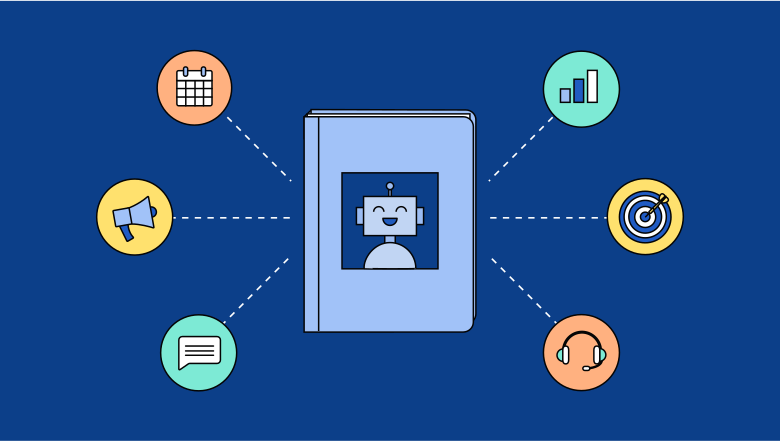



Clapboard at a Glance – A Video-First Creative EcosystemAt its core, Clapboard is a video-first creative platform and creative services marketplace that supports end-to-end production. It is built specifically for advertising, branded content, and film—where stakes are high, teams are complex, and outcomes need to be predictable.Traditional platforms treat creative work as isolated tasks. Clapboard is designed as an ecosystem: a managed marketplace where discovery, collaboration, production workflows, and delivery coexist in one environment. This structure better reflects the reality of modern creative production, where strategy, creative, production, post-production, and performance are tightly interlinked.As an advertising and film production platform, Clapboard supports:Brand campaigns and integrated advertisingBranded content and social videoProduct, launch, and explainer videosFilm, episodic content, and long-form storytellingInstead of forcing marketers or producers to choose between agencies, in-house teams, or scattered freelancers, Clapboard operates as a hybrid ecosystem. It combines a curated talent marketplace, managed creative services, and an AI + automation layer that accelerates workflows while preserving creative judgment.In other words: Clapboard is infrastructure for modern creative production, not just another place to post a brief. The Problem Clapboard Solves in Modern Creative ProductionThe creative industry has evolved faster than its infrastructure. Media channels have multiplied, content volume has exploded, and expectations for speed and personalization keep rising. Yet most systems for hiring creatives, running campaigns, and producing video remain stuck in legacy models.Clapboard exists to address four core creative production challenges that consistently slow down serious marketing and storytelling work.Fragmentation Between Freelancers, Agencies, and Production HousesCreative production today is fragmented acro

The Problem for Marketers & Brand TeamsFinding Reliable Creative Talent Is Slow and UncertainFor marketers and brand teams, the first visible friction is simply trying to hire creative talent that can consistently deliver. The internet is full of portfolios, reels, and profiles. Yet discovering reliable advertising creatives remains slow and uncertain.Discovery itself takes time. Marketers scroll through platforms, ask for referrals, post briefs, and sift through applications. Even with sophisticated search filters, there is no simple way to understand who has the right experience, who works well in teams, or who can operate at the pace and rigor modern campaigns demand.Quality is inconsistent, not because talent is lacking, but because the context around that talent is missing. A beautiful case study says little about how smoothly the project ran, how many revisions it required, or how the creative collaboration actually felt. Past work is not a guaranteed indicator of future delivery, especially when that work was produced under different conditions, with different teammates, or with heavy agency support in the background.Marketers are forced to rely on proxies—visual polish, brand logos on portfolios, testimonials written once in a different context. These signals are weak predictors when you need a specific output, at a specific quality level, with clear constraints on time and budget.The reality is that most marketing leaders don’t just need to hire creative talent. They need access to reliable creative teams that can handle complex scopes and adapt to evolving briefs. Yet the market still presents talent as individuals, leaving brand teams to stitch together their own ad hoc groups with uncertain outcomes.Traditional Agencies Are Expensive, Slow, and OpaqueIn response to this uncertainty, many marketers fall back on traditional agencies. Agencies promise full-service coverage: strategy, creative, production, and account management under one roof. But READ FULL ARTICLE

Video Is No Longer “One Service” — It Is the Spine of Brand CommunicationHistorically, “video” appeared as a single line in a scope of work or rate card: one of many services alongside design, copywriting, or social media management. That framing is now obsolete.Today, a single film can power an entire video content ecosystem:A hero brand film becomes TV, OTT, and digital ads.Those ads are cut down into short-form social content, stories, and reels.Behind-the-scenes footage becomes recruitment films and culture assets.Still frames pulled from footage become campaign photography.Scripts and narratives are re-used across web, CRM, and sales decks.Integrated video campaigns are now the default. Brand teams increasingly build backwards from a core film concept: first define what the main piece of video must achieve, then derive all other forms from that spine.In this model, video influences how the brand is perceived at every touchpoint. The look, sound, and rhythm of the film define what “on-brand” means. Visual identity systems, tone of voice, and even product storytelling often follow decisions first made in video.Thinking of video as a single deliverable hides its true role: it is the structural backbone of brand communication, not just another asset. How Most Marketplaces Get Video WrongVideo Treated as a Line Item, Not a SystemMost freelance and creative marketplaces were not built for video. They were originally optimized for graphic design, static content, or one-to-one gigs. Video was added later as another category in a long list of services.That leads to predictable freelance marketplace limitations when it comes to film and content production:“Video” buried in service menusVideo is often just one checkbox among dozens. There is little recognition that an ad film is fundamentally different from a logo design or blog post in terms of complexity, risk, and orchestration.Same workflow assumed for design, copy, and filmMost platforms apply the same chatREAD FULL ARTICLE

What “Human + Agent Orchestration” Means at ClapboardClapboard is built on a simple but important shift in mental model: stop thinking in terms of “features” and “tools,” and start thinking in terms of teams and pipelines.In this model, AI agents and humans work as one system. Every project is a flow of decisions and tasks. The question at each step is: Who is the right entity to handle this—human or agent—and when?This is what we mean by AI agent orchestration:Tasks are routed to the right actor at the right moment—sometimes a specialized agent, sometimes a producer, sometimes a creative director.Agents handle the structured, repeatable, data-heavy work, such as breakdowns, metadata, estimation, and workflow automation.Humans handle the subjective, contextual, and relational work, such as direction, negotiation, and final calls.Clapboard is the conductor of this system. Rather than being “an AI tool,” it functions as a creative operating system that coordinates human and agent participation end-to-end—from idea and script all the way to production and post.In practice, that means:Every brief, script, or campaign that enters Clapboard is immediately interpreted by agents for structure and intent.Those interpretations inform cost ranges, team shapes, timelines, and risk signals.Humans see the right information at the right time to make better decisions, instead of digging through fragmented files and messages.Workflow automations, powered by platforms like Make.com and n8n, take over the repetitive coordination so producers and creatives can stay focused on the work.Human + agent orchestration at Clapboard is not about cherry-picking tasks to “AI-ify.” It’s about designing the entire creative pipeline so that humans and agents function as a super-team. What AI Agents Handle on ClapboardOn Clapboard, AI agents are not generic chatbots; they are embedded workers with specific responsibilities across the creative lifecycREAD FULL ARTICLE

Why Traditional Freelance Marketplaces Fall Short for Creative ProductionTraditional freelance platforms were built around the gig economy, not around creative production. That distinction matters. Production is not “a series of tasks” — it is a pipeline where every decision upstream affects what’s possible downstream.Most of the common problems with freelance platforms in creative work come from this structural mismatch.Built for transactional gigs, not collaborative projectsGig platforms are optimised for one-to-one engagements: a logo, a banner, an edit, a script. They assume work is atomised and independent. But film and video production is collaborative by default: strategy, creative, pre-production, production, and post are all tightly connected.On generalist marketplaces, you typically have to:Source each role separately (director, editor, animator, colorist, etc.)Manually manage handovers between freelancersResolve conflicts in style, timelines, and expectations yourselfThe result is friction and inconsistency. What looks like a saving on day rates turns into higher project cost in coordination, rework, and lost time.Individual-first, not team-firstThe core unit on most freelance sites is the individual freelancer. That works for isolated tasks; it breaks for productions that require cohesive creative direction, shared context, and aligned standards.Individual-first systems create gig economy limitations for creatives and clients alike:Freelancers are incentivised to optimise for their own scope, not the entire project outcomeClients must “play producer” without internal production expertiseThere is no reliable way to hire intact, proven teams that already collaborate wellCreative production works best when you build creative teams, not disconnected individuals. Team dynamics and shared history matter as much as individual portfolios.Little accountability beyond task completionTypical freelance marketplaces define success as task delivery: the file was uploaREAD FULL ARTICLE


LEAVE A COMMENT
Your email address will not be published.