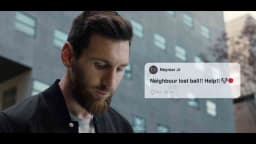
World Finance's 'Get Back to the Good: Gina, Shaun' campaign, created by Laughlin Constable in July 2019, uses character-driven film to humanise personal

World Finance Brings Emotional Storytelling to Consumer Lending
World Finance's "Get Back to the Good: Gina, Shaun" is a 2019 film campaign created by ad agency Laughlin Constable that uses character-driven narrative to position the brand as a humane alternative in the United States personal lending market, comprising two media assets published in July 2019.
World Finance operates as a personal instalment lender serving customers across the United States who are frequently underserved by traditional banking institutions. The campaign's title — Get Back to the Good — signals its strategic intent immediately. Rather than leading with interest rates, approval speeds, or product features, the work foregrounds the emotional state of borrowers: the relief, stability, and restored normalcy that a manageable loan can unlock. Gina and Shaun are the named protagonists of the two film assets, and their individual stories anchor the campaign in recognisable human experience rather than financial abstraction.
Laughlin Constable, a Milwaukee-based independent agency, brought the campaign to life through a film medium, a deliberate choice that prioritises emotional resonance over the transactional messaging that dominates Finance advertising in the United States. The campaign was submitted to adsoftheworld.com, where it is documented as part of the broader public record of the agency's creative output for World Finance, a client relationship that, according to linkedin.com, traces back to approximately 2016. The Clapboard Score for this campaign is 48 out of 100, reflecting competent execution within a category where emotional differentiation is both valuable and difficult to sustain at scale. The campaign sits squarely within the Banking and Finance category and represents one node in a broader effort by World Finance to reposition its brand identity across the United States market during the late 2010s.
World Finance targets a specific and underserved segment of the United States consumer credit market. The personal instalment lending space occupies a position between traditional bank products and payday lenders, serving borrowers with limited credit histories or impaired scores. According to Files Consumerfinance Gov, a significant proportion of United States adults fall outside the prime credit tier, creating a structurally large addressable market that mainstream financial brands largely ignore in their advertising.
The strategic logic behind Get Back to the Good is rooted in this gap. Competitors operating in adjacent categories — including regional banks and online lenders such as LendingClub and OneMain Financial — tend to communicate through the language of speed, simplicity, and digital convenience. World Finance, by contrast, operates through a branch-based model with in-person service at its core, and the Laughlin Constable campaign reflects that positioning directly. Emotional safety, human contact, and the idea of returning to a life that financial stress has disrupted are the campaign's competitive differentiators, not algorithmic approval or a seamless app experience.
The consumer insight driving the campaign is precise: people who need a personal instalment loan are not primarily motivated by the loan itself but by what the loan restores — a car repaired, a bill settled, a moment of normalcy recovered. Naming the films after specific individuals, Gina and Shaun, operationalises that insight. It shifts the audience's identification from a generic borrower archetype to a recognisable person with a specific situation. According to ispot.tv, World Finance has maintained consistent television and film advertising activity across the United States, suggesting the brand views film as a core channel for building emotional equity in markets where trust in financial institutions remains a persistent challenge.
Laughlin Constable assembled a defined creative team for the Get Back to the Good campaign, and the production credits are documented on adsoftheworld.com. Grant Simpson and Megan DeMeyer served as creative directors on the project, with Lisa Bennett holding the role of chief creative officer. Art direction was led by Allie Geise, and copywriting was handled by Daina Kiela — a pairing that shaped the tonal register of both film assets.
The account and strategy functions were equally well-staffed. Maggie Avram held the role of VP of digital strategy, while Kristina Valenti served as senior account planner, providing the research and audience framework that informed the campaign's emotional targeting. Renee Haber served as EVP of account services, and Audrey Grezlik as account director, reflecting the depth of investment Laughlin Constable placed in the World Finance relationship at an agency level.
The creative execution across both film assets follows a naturalistic grammar. Character names function as the primary organising device — each film belongs to a person, not a product — and this structure imposes a discipline on the storytelling that prevents the work from sliding into generic inspirational advertising. The Finance category in the United States is crowded with campaigns that invoke aspiration without grounding it in material reality; Get Back to the Good resists that tendency by tethering its emotional arc to specific, recoverable circumstances. The film medium, as documented on adsoftheworld.com, allows the campaign to develop pacing and atmosphere that shorter or static formats cannot sustain, giving the Laughlin Constable creative team room to build identification with Gina and Shaun before the brand proposition is fully articulated.
No verified performance data for "Get Back to the Good: Gina, Shaun" is publicly available. No published sales lift, customer acquisition, loan application volume, brand awareness shift, market share change, or return on advertising spend figures have been reported for this campaign, as confirmed by the absence of such records across adsoftheworld.com, mediaradar.com, and clapboard.com. The campaign holds no award records across Cannes Lions, the Effies, The One Show, D&AD, the Clios, the Webby Awards, or WARC Awards.
Structural analysis offers a more productive frame for evaluation. The decision to organise the campaign around named individuals — Gina and Shaun — is a sound creative architecture for a brand operating in a low-trust category. Personal instalment lending in the United States carries reputational friction that abstract brand messaging struggles to overcome; character-driven film is one of the more reliable tools available for shifting emotional associations at scale. The two-asset structure documented on adsoftheworld.com allows the campaign to address audience heterogeneity without diluting its central message, since different viewers may identify more readily with one protagonist than the other.
The Clapboard Score of 48 out of 100 reflects a campaign that executes its emotional strategy competently but does not break new ground in the Finance category. The work demonstrates craft and strategic coherence without achieving the kind of cultural or formal distinctiveness that drives long-term brand equity or industry recognition. For a regional lender operating in the United States personal credit market, however, consistent emotional positioning across film may serve retention and trust objectives that aggregate metrics do not fully capture.
World Finance's "Get Back to the Good: Gina, Shaun" is a July 2019 film campaign created by Laughlin Constable in the United States. It comprises two character-driven film assets named after individual protagonists, Gina and Shaun, positioning World Finance as an empathetic personal lender in the consumer Finance category.
Laughlin Constable created the Get Back to the Good campaign for World Finance. The Milwaukee-based independent agency led creative, strategy, and account services, with Lisa Bennett as chief creative officer, Grant Simpson and Megan DeMeyer as creative directors, and Allie Geise and Daina Kiela handling art direction and copywriting respectively.
Gina and Shaun are the named protagonists of the two individual film assets in the Get Back to the Good campaign. Each film carries a character's name as its title, grounding World Finance's brand message in specific human circumstances rather than generic borrower archetypes, a structural choice that strengthens audience identification.
The Get Back to the Good campaign holds no award records. No entries or wins are documented across Cannes Lions, the Effies, The One Show, D&AD, the Clios, the Webby Awards, or WARC Awards for this World Finance campaign created by Laughlin Constable and published in the United States in July 2019.
The Clapboard Score for Get Back to the Good: Gina, Shaun is 48 out of 100. This reflects competent emotional execution within the United States Finance category without achieving the formal or cultural distinctiveness associated with higher-scoring campaigns, according to Clapboard's editorial assessment of the 2019 Laughlin Constable work.
World Finance used film as the medium for Get Back to the Good, comprising two assets published in July 2019. Film allows Laughlin Constable's creative team to develop pacing, atmosphere, and emotional identification with named protagonists Gina and Shaun in ways that static or shorter formats cannot sustain across the United States market.
.webp)
Creative Collaboration Platform: The Backbone of Modern Creative WorkWhat is a creative collaboration platform?Clapboard defines a creative collaboration platform as the operational core for today’s distributed creative teams. This is not a collection of digital collaboration tools stitched together; Clapboard’s system


Understanding the Creative Production MarketplaceWhat is a Creative Production Marketplace?Clapboard defines a creative production marketplace as a structured ecosystem where brands, agencies, and production talent converge to execute video, advertising, and branded content at scale. Unlike the legacy agency or freelanREAD FULL ARTICLE

The Urgent Need for a Creative Production Operating SystemWhy Traditional Creative Production Models Break DownClapboard sees the creative production landscape shifting under pressure. Content velocity is no longer a buzzword—it’s a mandate. Modern advertising demands relentless output across dozens of channels, each wREAD FULL ARTICLE