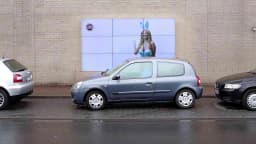
The Volkswagen "Newspaper app" campaign from 2013 leverages an innovative ambient media approach to position the brand as forward-thinking and aligned with modern lifestyle trends in the Indian automotive market. The campaign’s core proposition centers on Volkswagen’s commitment to innovation and smart design, implied through the interactive use of a familiar medium—newspapers—reimagined in a way that reflects the brand’s emphasis on accessibility, technology, and relevance.
Strategically, the campaign taps into the insight that traditional media like newspapers maintain a strong presence in India, even as digital consumption rises. By embedding the Volkswagen Up! within this context, the campaign bridges conventional and contemporary communication channels, appealing to a broad, urban audience that values both heritage and innovation. The choice of ambient media reflects a creative angle focused on surprise, engagement, and real-world interaction, enhancing memorability and brand association.
Targeting primarily young, urban professionals and early adopters interested in compact, efficient vehicles, the campaign subtly underscores Volkswagen’s ability to blend practicality with clever innovation. With limited media assets and modest digital engagement metrics, the campaign’s impact likely hinged on the originality and contextual relevance of its ambient execution rather than conventional mass reach. This approach reflects an understanding of how localized, experiential marketing can create meaningful connections with discerning consumers within the competitive Indian automotive landscape.
FORMAT#1 DEMONSTRATION — Directly shows how a product works and highlights its benefits.
This campaign is titled 'Newspaper app' and is described as an "Innovative media" activation for Volkswagen Up!, executed via the Ambient medium. The context suggests the ad likely revolves around a creative, perhaps interactive, physical demonstration—possibly using printed newspapers to tangibly show a product feature or benefit relating to the Volkswagen Up!, without a story arc, celebrity, or explicit symbolism. No testimonial, user imagery, parody, or comparison is indicated. Given the emphasis on innovative media and the automotive brand’s history of literal, product-centric stunts, the most logical creative device is DEMONSTRATION: clearly, the campaign’s goal is to show how Volkswagen Up! is innovative—most probably by directly demonstrating its unique features or advantages through the ambient medium itself.
ADVERTISING FORMATS EXPLAINED: https://www.clapboard.com/blog/branding-and-advertising/brand-strategy/12-advertising-creative-formats
1. Maruti Suzuki – Market Positioning
Maruti Suzuki dominates the Indian automotive market with a focus on affordability, fuel efficiency, and extensive service networks. Positioned as a reliable and practical choice for Indian families, it offers a wide range of compact and mid-sized vehicles suited for everyday use, emphasizing value for money and accessibility.
2. Hyundai Motor India – Market Positioning
Hyundai positions itself as a contemporary and innovation-driven brand, blending modern design with advanced technology. It appeals to urban consumers seeking style, comfort, and feature-rich vehicles, often emphasizing high quality at competitive prices along with strong after-sales service.
3. Honda Cars India – Market Positioning
Honda leverages its brand reputation for engine reliability, performance, and refined driving experience. It targets mid to premium segments with a focus on sporty aesthetics, fuel efficiency, and technological enhancements, appealing to both young professionals and family-oriented buyers.
4. Toyota Kirloskar Motor – Market Positioning
Toyota is positioned as a brand synonymous with durability, safety, and low maintenance costs. It focuses on building trust through quality and longevity, often targeting customers prioritizing resale value and dependability over aggressive styling or innovation.
5. Ford India – Market Positioning
Ford emphasizes driving performance and safety, promoting vehicles that offer a dynamic driving experience with robust engineering. The brand targets customers looking for a blend of fun, reliability, and modern design, often distinguishing itself through advanced safety features and connected technology.
Q: What is Newspaper app about?
A: Newspaper app is a student campaign created for Volkswagen by the Sir J.J. Institute of Applied Art and launched in India in 2013. Developed by creative Kushal Birari, the campaign uses ambient media to promote the Volkswagen Up! model, targeting urban, tech-savvy consumers. The central idea revolves around merging the traditional familiarity of newspapers with the interactivity of digital technology, positioning Volkswagen as an innovator in the automotive space. The campaign’s single media asset attracted over 15,000 views, highlighting its resonance with audiences interested in creative, real-world brand experiences.
Q: What creative device does Newspaper app use?
A: Newspaper app employs the DEMONSTRATION format, as classified by Clapboard’s 12-format taxonomy. This approach directly shows how a product works and highlights its benefits, with the campaign using an innovative ambient medium to physically demonstrate Volkswagen Up!’s unique features or advantages. Rather than relying on narrative, celebrity endorsement, or symbolism, the campaign’s creative device is a literal, product-centric activation that leverages the tangible qualities of newspapers to make the brand’s innovation accessible and memorable to its audience.
Q: What is the campaign proposition for Newspaper app?
A: The campaign proposition for Newspaper app centers on Volkswagen’s commitment to innovation and smart design, conveyed through the interactive use of a familiar medium—newspapers—reimagined for a modern context. By bridging traditional print with digital interactivity, the campaign appeals to young, urban professionals and early adopters in India who value both heritage and forward-thinking technology. This strategic positioning underscores Volkswagen’s relevance in a competitive automotive market, highlighting the brand’s ability to blend practicality with creative, accessible innovation that resonates with contemporary lifestyles.
Q: How does Newspaper app rank in Clapboard's archive?
A: Newspaper app holds a Clapboard Campaign Score of 63/100. This score reflects the campaign’s creative ambition, execution quality, and cultural relevance as evaluated by Clapboard’s global ad archive.
Q: Who are the competitors in Volkswagen's category?
A: In the Indian automotive market, Volkswagen competes with several key brands: Maruti Suzuki, which leads with a focus on affordability, fuel efficiency, and widespread service; Hyundai Motor India, known for contemporary design and advanced technology appealing to urban consumers; Honda Cars India, which emphasizes engine reliability and a refined driving experience for mid to premium buyers; Toyota Kirloskar Motor, positioned around durability, safety, and low maintenance; and Ford India, which distinguishes itself through driving performance, safety features, and modern design.


 ARCHIVE
.webp)