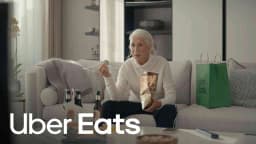
The Uber One campaign positions the brand as a cost-saving membership enhancing the overall value proposition of both Uber and Uber Eats services. By emphasizing savings on delivery and rides, the campaign aims to deepen customer loyalty and encourage increased frequency of use across Uber’s integrated platforms. The promise centers on convenience paired with tangible monetary benefits, framing Uber One as a practical and accessible membership solution for everyday consumers seeking to optimize their spending on food delivery and transportation.
Strategically, the campaign leverages a performance-driven approach within the Food & Drink market, targeting primarily U.S.-based consumers who regularly use delivery services and ride-hailing apps. The creative angle simplifies the value message—“sign up, save, and share”—to encourage swift adoption and organic growth through word-of-mouth. By uniting Uber and Uber Eats under one membership, the campaign capitalizes on cross-platform usage patterns, aiming to increase customer lifetime value through bundled offerings. The use of relatable storytelling in film media and the inclusion of clear calls to action enable efficient audience engagement and conversion. Additionally, the extensive online presence and social media connectivity underscore a strategy designed for digital-first consumers who prioritize both convenience and cost savings in their daily transactions.
FORMAT#6 BENEFIT CAUSES STORY — Builds a story where the product’s benefit is the reason for the action or twist.
This campaign, titled "Break up - Uber One," likely employs a narrative where the benefit of Uber One membership (saving money on Uber and Uber Eats) causes a twist or significant action — implied by the "Break up" title. The campaign's setup and naming suggest that the product benefit (savings) directly triggers a story event, possibly someone ending a previous way of ordering/delivering due to discovering Uber One. There’s no clear evidence of traditional story arc, celebrity use, or direct problem-solution framing, but the focus on a benefit-driven twist aligns this closely with "Benefit Causes Story."
ADVERTISING FORMATS EXPLAINED: https://www.clapboard.com/blog/branding-and-advertising/brand-strategy/12-advertising-creative-formats
1. DoorDash – Market Positioning
DoorDash positions itself as the most reliable and extensive food delivery platform in the U.S., emphasizing fast delivery times, broad restaurant selection, and user-friendly technology. It leverages strategic partnerships and local logistics networks to offer convenience and variety, targeting both urban and suburban customers seeking everyday food delivery solutions.
2. Grubhub – Market Positioning
Grubhub focuses on being a leading online and mobile food ordering platform, highlighting its deep restaurant integrations and loyalty programs. It differentiates by supporting local restaurants and emphasizing easy access to diverse cuisines, catering to customers valuing strong restaurant relationships and seamless ordering experiences.
3. Postmates – Market Positioning
Postmates, owned by Uber, distinguishes itself through delivering not just food but a wide range of convenience items with quick, on-demand service. Its strategic angle is urban and late-night consumers who prioritize fast, flexible delivery options beyond just meals.
4. Instacart – Market Positioning
Instacart specializes in grocery delivery and pickup services but has expanded into prepared meal kits, positioning itself as the comprehensive partner for both groceries and food delivery. It focuses on convenience, time-saving, and trusted partnerships with major grocery chains, catering to customers integrating food and household needs.
5. Caviar – Market Positioning
Caviar targets the premium segment of food delivery, emphasizing high-end, curated restaurant selections and superior service quality. It appeals to customers looking for fine dining experiences at home, differentiating through exclusivity, quality assurance, and elevated culinary options.
Q: What is Uber One about?
A: Uber One is a 2023 campaign created for Uber and Uber Eats, launched in the United States to introduce a new membership program offering savings on both rides and food delivery. Developed within the Food & Drink market, the campaign uses film as its primary medium and features two media assets designed to communicate the simplicity and value of the Uber One membership. The central creative idea revolves around encouraging consumers to sign up, save money on everyday transportation and dining, and share these benefits with others, positioning Uber One as an accessible, cost-saving solution for frequent users of Uber’s integrated platforms.
Q: What creative device does Uber One use?
A: Uber One employs the Benefit Causes Story technique, classified as FORMAT#6 in Clapboard’s 12-format taxonomy. This creative device builds a narrative in which the product’s benefit—specifically, the savings offered by Uber One membership—directly triggers a key action or twist within the story. In this campaign, the benefit of cost savings is positioned as the catalyst for a significant change, implied by the Break up theme, where the discovery of Uber One prompts a shift in consumer behavior. This approach foregrounds the product’s value as the reason for the story’s central event.
Q: What is the campaign proposition for Uber One?
A: The campaign proposition for Uber One centers on positioning the membership as a cost-saving solution that enhances the value of both Uber and Uber Eats services. Targeting U.S. consumers who regularly use delivery and ride-hailing apps, the campaign emphasizes convenience and tangible monetary benefits, aiming to deepen customer loyalty and increase usage frequency across Uber’s ecosystem. The messaging is distilled into a clear call to action—sign up, save, and share—encouraging swift adoption and organic growth through word-of-mouth, while reinforcing Uber One as a practical membership for optimizing everyday spending on food delivery and transportation.
Q: How does Uber One rank in Clapboard's archive?
A: Uber One holds a Clapboard Campaign Score of 59/100 in Clapboard’s global ad archive. This score reflects the campaign’s creative ambition, execution quality, and cultural relevance as evaluated by Clapboard’s curatorial standards.
Q: Who are the competitors in Uber and Uber Eats's category?
A: In the food and delivery services category, Uber and Uber Eats face competition from DoorDash, which is positioned as the most reliable and extensive platform with a focus on fast delivery and broad restaurant selection; Grubhub, which emphasizes deep restaurant integrations and loyalty programs to support local eateries; Postmates, also owned by Uber, which differentiates by delivering a wide range of convenience items with flexible, on-demand service; Instacart, which specializes in grocery delivery and pickup while expanding into meal kits for comprehensive household solutions; and Caviar, which targets the premium segment with curated, high-end restaurant offerings and a focus on superior service quality.


 ARCHIVE
.webp)