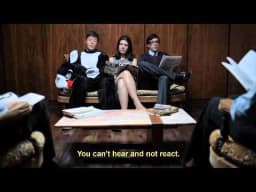
Toronto After Dark Film Festival's 'Kissing, Nachos, Sitting' by Saatchi & Saatchi Canada dramatised three comic phobias to reframe horror-film attendance in

How Toronto After Dark Film Festival Made Phobias the Point of Going to the Movies
Toronto After Dark Film Festival's 'Kissing, Nachos, Sitting' is a three-film Canadian advertising campaign created by Saatchi & Saatchi in October 2014, dramatising comic phobias — philemaphobia, turophobia, and kathisophobia — to reframe a horror-and-genre film festival as the one place where every kind of fear belongs.
The campaign launched in Canada to coincide with the ninth annual Toronto After Dark Film Festival, which ran from October 16 to 24, 2014, at Scotiabank Theatre on 259 Richmond Street West in Toronto. Each of the three short films took an unusual, clinically named fear and played it for darkly comic effect. Philemaphobia — the fear of kissing — anchored the first film. Turophobia, the fear of processed cheese and by extension nachos, drove the second. Kathisophobia, the fear of sitting, completed the trilogy. The unifying creative logic, as documented by Saatchi & Saatchi and recorded in Clapboard's archive, held that everyone fears something, and that Toronto After Dark is precisely the right venue for those fears to be indulged, celebrated, and laughed at.
Saatchi & Saatchi released the official campaign announcement on October 20, 2014, placing the work squarely within the festival's run and maximising relevance to Toronto audiences actively deciding how to spend their leisure time. The campaign was categorised within the recreation and leisure sector and comprised three distinct media assets, each self-contained yet collectively reinforcing the festival's identity as Canada's premier destination for genre cinema. For a niche cultural event competing for attention in the broader Canadian entertainment market, the choice to anchor the campaign in absurdist psychology rather than conventional film promotion represented a deliberate break from the category's defaults.
 ARCHIVE
Saatchi & Saatchi Canada built the campaign's strategic foundation on a single insight: horror and genre film audiences are already self-selecting fear-seekers, so the creative invitation should lean into that psychology rather than explain it away.
The choice to anchor all three executions — kissing, nachos, sitting — in obscure but real clinical phobias transformed mundane cinema anxieties into something absurd enough to earn attention. Rather than advertising the festival's programme directly, as competing cultural events typically do, the campaign reframed Toronto After Dark itself as a sanctuary for the fearful. This positioning distinguished the festival sharply from mainstream multiplex fare and from other Toronto-based film events that compete for leisure spending across Ontario's culturally active urban audience.
The strategic context in Canada in 2014 made the case for precision targeting urgent. According to Statistics Canada, the Canadian motion-picture-theatre and video-exhibition industry generated operating revenue in the range of a substantial market that year, with paid admissions and concession sales collectively representing a significant share of that total. Statistics Canada further reported that cinemas, drive-ins, and film festivals across Canada collectively sold 91.0 million tickets in 2014, while Ontario represented approximately 40.6 percent of national operating revenue, underscoring just how competitive the Toronto leisure market was for any event seeking audience share. Against that backdrop, a campaign that made Toronto After Dark synonymous with gleeful fear — rather than simply another screening schedule — offered genuine differentiation. The festival's niche genre positioning, amplified by Saatchi & Saatchi's phobia conceit, gave Canadian cinephiles a reason to choose After Dark over mainstream programming rather than merely a reminder that the festival existed.
Director Trevor Cornish helmed all three films for the 'Kissing, Nachos, Sitting' campaign, working with production company Sequoia Content to give each short a distinct tonal register that balanced comedy and dread in equal measure.
The creative team at Saatchi & Saatchi Canada was assembled at considerable depth for a campaign of this scale. Executive Creative Director Brian Sheppard oversaw the work, with Group Creative Directors Matt Antonello and Joel Arbez providing the conceptual architecture. Art direction was handled by Rachel Kennedy and Joel Arbez, while copywriting fell to Matt Antonello and Shauna Roe. Agency Producer Michelle Orlando coordinated production alongside Executive Producers Suzanne Allan, Sally Leggett, and Stephanie Pennington, as documented by Saatchi & Saatchi and held in Clapboard's records. Director of Photography Simon Shohet shot the films, lending each execution a visual grammar that could carry both the comedic timing demanded by absurdist phobia scenarios and the atmospheric unease appropriate to a horror-genre festival audience.
Post-production was handled by Relish Editing, with editors Steve Manz, Chris Murphy, and Jackie Roda shaping the pacing of the three films. Colour and post-production finishing was completed by The Vanity, a Toronto-based facility with strong genre-film credentials, whose contribution ensured the work carried a visual quality consistent with the festival's cinematic positioning. Producer Michael Smith rounded out the production roster. The cumulative effect of this team's choices — tight editorial rhythm, considered colour grading, and performance direction calibrated to comic horror — gave the campaign a crafted quality that elevated what could have been a low-budget local promotion into something with genuine creative authority. For a cultural event in Canada with limited media spend, production craft functioned as a force multiplier for the idea itself.
No verified performance data for the 'Kissing, Nachos, Sitting' campaign is publicly available in terms of ticket sales uplift, audience reach figures, or digital engagement metrics attributed directly to the work.
What structural analysis can offer is an assessment of the campaign's effectiveness as a creative system. The three-film format gave the work inherent shareability: each execution was self-contained and built around a named phobia — kissing, nachos, sitting — that invited social conversation independently of any explicit call to action. That architecture is well suited to earned media distribution, particularly for a Toronto-based cultural institution with a loyal but limited genre audience in Canada's competitive leisure market.
The campaign's October 2014 timing, landing mid-festival between the October 16 opening and October 24 close as reported by Saatchi & Saatchi, meant any organic sharing would have driven immediate box-office consideration rather than long-lead brand building. The creative decision to avoid programme-specific content also gave the films a shelf life beyond the 2014 edition, potentially building brand equity for future Toronto After Dark cycles. Clapboard rates the campaign 63 out of 100, recognising a strong and genuinely unusual central idea — the phobia conceit is memorable and strategically coherent — while noting that the absence of documented results and limited verifiable distribution context constrain the overall score. The work represents a credible creative achievement for a niche Canadian leisure brand operating well outside the budgets of its mainstream exhibition competitors.
'Kissing, Nachos, Sitting' is a three-film advertising campaign created by Saatchi & Saatchi Canada for the 2014 Toronto After Dark Film Festival. Each film dramatises an unusual clinical phobia — philemaphobia, turophobia, and kathisophobia — to position the festival as the rightful home for every kind of fear, running in Canada in October 2014.
Saatchi & Saatchi Canada created the campaign. The agency's team included Executive Creative Director Brian Sheppard, Group Creative Directors Matt Antonello and Joel Arbez, and copywriters Matt Antonello and Shauna Roe, as documented by Saatchi & Saatchi and recorded in Clapboard's archive.
The campaign references three phobias: philemaphobia, the fear of kissing; turophobia, the fear of cheese and by extension nachos; and kathisophobia, the fear of sitting. Each phobia anchors one of the three short films produced by Sequoia Content and directed by Trevor Cornish for the 2014 festival.
The ninth annual Toronto After Dark Film Festival ran from October 16 to 24, 2014, at Scotiabank Theatre, 259 Richmond Street West in Toronto, Canada. Saatchi & Saatchi released the official campaign announcement on October 20, 2014, placing it mid-festival to maximise immediate audience consideration.
Clapboard rates 'Kissing, Nachos, Sitting' 63 out of 100. The score reflects a strong and strategically coherent central idea built around unusual phobias, while noting that limited publicly available performance data and constrained verifiable distribution context prevent a higher rating for this Canadian leisure campaign.
Trevor Cornish directed all three films for the campaign, working with production company Sequoia Content. Director of Photography Simon Shohet shot the films, while post-production was handled by Relish Editing and colour finishing by Toronto-based facility The Vanity, as documented by Saatchi & Saatchi and held in Clapboard's records.
.webp)
Creative Collaboration Platform: The Backbone of Modern Creative WorkWhat is a creative collaboration platform?Clapboard defines a creative collaboration platform as the operational core for today’s distributed creative teams. This is not a collection of digital collaboration tools stitched together; Clapboard’s system


Understanding the Creative Production MarketplaceWhat is a Creative Production Marketplace?Clapboard defines a creative production marketplace as a structured ecosystem where brands, agencies, and production talent converge to execute video, advertising, and branded content at scale. Unlike the legacy agency or freelanREAD FULL ARTICLE

The Urgent Need for a Creative Production Operating SystemWhy Traditional Creative Production Models Break DownClapboard sees the creative production landscape shifting under pressure. Content velocity is no longer a buzzword—it’s a mandate. Modern advertising demands relentless output across dozens of channels, each wREAD FULL ARTICLE