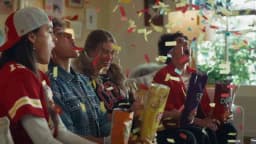
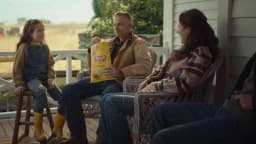
Skittles partnered with Gopuff and Elijah Wood to deliver a live Big Game commercial to one fan's doorstep on February 8, 2026, generating 2.84 billion earned

Skittles Delivers Its Big Game Ad to One Fan's Front Door
Skittles launched a live, in-person Big Game commercial on February 8, 2026, delivering the ad — and a bag of candy — directly to one fan's front door in the United States, in partnership with quick-commerce platform Gopuff and actor Elijah Wood, making it one of the most structurally unconventional Super Bowl commercial concepts in recent memory.
The campaign, titled "Delivering a First," centres on a fictional narrative in which a magical horn summons a mysterious creature — played by Wood — who arrives on demand bearing candy. Rather than confining that premise to a broadcast slot, Skittles activated it as a genuine experiential event. One contest winner, selected via an entry mechanic hosted at DeliverTheRainbow.com, received the live performance at their home on game day. The Skittles Big Game Bundle was simultaneously available for pre-order on Gopuff, anchoring the experiential stunt to a direct-commerce outcome across the United States market.
Gabrielle Wesley, Chief Marketing Officer of Mars Snacking North America, framed the campaign's ambition in a Mars press release: "SKITTLES has always delivered deliciously perplexing experiences to fans, but this year we are bringing the unexpected to fans on game day. Snack selection is nearly as important as the Big Game — so we're excited to give fans a chance to summon SKITTLES, a live commercial, and yes, Elijah Wood too." The campaign was announced on January 13, 2026, according to reporting by Little Black Book, and the creative concept was developed by Team OMC. Skittles earned a Clapboard Score of 71/100 for this work, reflecting strong conceptual originality weighed against the inherently limited reach of a one-household live execution.

Skittles has a documented history of subverting Super Bowl advertising conventions. In 2019, the brand replaced a conventional Super Bowl commercial with a Broadway musical, according to reporting by The Ringer, establishing a creative lineage in which the campaign concept itself becomes the media story. "Delivering a First" extends that lineage into the home-delivery economy, choosing Gopuff as the commerce partner at a moment when quick-commerce platforms are competing aggressively for snack-occasion relevance in the United States against rivals including DoorDash and Instacart.
The strategic rationale is coherent. Super Bowl advertising in the United States commands some of the highest broadcast media costs of any annual event, yet the proliferation of second-screen behaviour, ad-break discussion, and post-game recaps means that earned media and social conversation frequently deliver more measurable awareness than the spot itself. By making the campaign inherently unbroadcastable — a live performance that cannot be paused, skipped, or muted, as Skittles described it — the brand engineered a story that press and social audiences would report and share. Little Black Book covered the campaign on both January 13 and February 9, 2026, emphasising precisely that "unskippable" quality as the editorial hook.
The Gopuff partnership also reflects a deliberate move toward performance-linked brand activity. Rather than treating the Big Game purely as an awareness vehicle, Skittles connected the stunt to a shoppable bundle on Gopuff, giving the campaign a measurable commerce dimension that purely broadcast executions cannot replicate. The global confectionery market is estimated to be growing at a mid-single-digit annual rate, according to Grand View Research and Fortune Business Insights, and within that landscape, snack brands are under increasing pressure to demonstrate that brand investment converts to purchase, not merely recall.
The creative execution of "Delivering a First" rests on a single, high-concept inversion: the ad is the experience, and the experience is the ad. Skittles constructed a fictional world in which Wood plays a creature conjured by a magical horn to deliver candy on demand. That premise is immediately legible as a Skittles conceit — absurdist, tactile, and anchored in the brand's long-running "Taste the Rainbow" platform, which was originally developed by D'Arcy Masius Benton & Bowles in 1994, according to Warc.
Wood's casting serves multiple functions simultaneously. He carries sufficient cultural recognition to generate press interest without overwhelming the Skittles brand identity, and his willingness to perform the role in person — at a stranger's front door, on game day — lends the stunt a quality of genuine commitment that a filmed version could not replicate. Little Black Book's post-event coverage on February 9, 2026, noted Wood's character as "frustrated," suggesting the live performance retained the deadpan comic register that defines the brand's creative voice rather than softening into celebrity endorsement.
The production architecture is deliberately minimal by broadcast standards. There is no elaborate set, no post-production, and no media buy attached to the live event itself. The campaign's one documented media asset is the filmed content used to announce and promote the contest, which seeded the narrative across more than 1,500 media placements, according to reporting sourced from Finance Yahoo and lbbonline.com. Production credits for the filmed elements of the "Delivering a First" campaign are not publicly documented beyond the confirmed involvement of Team OMC as the creative team, as noted in awards database records at oneclub.org.
The campaign produced measurable results across both commerce and earned media dimensions. Skittles recorded a 256% year-over-year sales lift on Gopuff during Super Bowl week, according to data reported by lbbonline.com and finance.yahoo.com. The same sources report that the activation generated Skittles' biggest single sales day in Gopuff's history, a benchmark that gives the stunt direct commercial validation beyond impressionistic brand metrics.
On the earned media side, "Delivering a First" generated 2.84 billion earned impressions across more than 1,500 media placements, according to lbbonline.com. That figure positions the campaign as a substantial awareness vehicle despite — or more precisely because of — its refusal to purchase conventional broadcast inventory. The One Club included the campaign in its 2026 awards database, per oneclub.org, though the specific award category and recognition level have not been independently verified.
Structurally, the results validate the core strategic bet. A campaign built around a single live event, delivered to one household, achieved earned reach that most 30-second Super Bowl spots cannot guarantee through paid placement alone. The commerce integration with Gopuff transforms what could have been a purely PR exercise into a demonstrable sales driver, addressing the recurring criticism that experiential marketing generates attention without measurable purchase intent. For a brand with Skittles' history of Super Bowl subversion, "Delivering a First" represents the most commercially integrated iteration of that creative philosophy to date.
Skittles delivered a live Super Bowl commercial to one fan's front door on February 8, 2026, starring Elijah Wood. The campaign partnered with Gopuff for home candy delivery and ran a consumer contest through DeliverTheRainbow.com, making it one of the most structurally unconventional Big Game advertising activations in recent memory.
Fans entered through DeliverTheRainbow.com, which hosted the contest entry details. Participants were also encouraged to pre-order the Skittles Big Game Bundle on Gopuff. The campaign was announced on January 13, 2026, giving fans several weeks to enter before the February 8 game-day live performance.
Elijah Wood played a candy-delivering creature summoned by a magical horn. His casting brought cultural recognition without overshadowing the Skittles brand, and his willingness to perform live at a fan's doorstep gave the stunt credibility. Little Black Book described his character as maintaining a deadpan, frustrated comic register consistent with Skittles' creative voice.
Skittles recorded a 256% year-over-year sales lift on Gopuff during Super Bowl week, according to lbbonline.com and finance.yahoo.com. The activation also produced Skittles' biggest single sales day in Gopuff history, demonstrating that the experiential stunt translated directly into measurable commerce performance across the United States market.
The campaign generated 2.84 billion earned impressions across more than 1,500 media placements, according to lbbonline.com. That reach was achieved without a conventional paid broadcast slot, validating Skittles' strategy of engineering an inherently newsworthy stunt rather than purchasing traditional Super Bowl commercial airtime.
Skittles has subverted Super Bowl advertising repeatedly. In 2019, the brand replaced its broadcast commercial with a Broadway musical, according to The Ringer. "Delivering a First" extends that creative lineage by making the live experience itself the ad, this time integrating a direct commerce outcome through the Gopuff partnership and the Deliver the Rainbow platform.
.webp)
Creative Collaboration Platform: The Backbone of Modern Creative WorkWhat is a creative collaboration platform?Clapboard defines a creative collaboration platform as the operational core for today’s distributed creative teams. This is not a collection of digital collaboration tools stitched together; Clapboard’s system


Understanding the Creative Production MarketplaceWhat is a Creative Production Marketplace?Clapboard defines a creative production marketplace as a structured ecosystem where brands, agencies, and production talent converge to execute video, advertising, and branded content at scale. Unlike the legacy agency or freelanREAD FULL ARTICLE

The Urgent Need for a Creative Production Operating SystemWhy Traditional Creative Production Models Break DownClapboard sees the creative production landscape shifting under pressure. Content velocity is no longer a buzzword—it’s a mandate. Modern advertising demands relentless output across dozens of channels, each wREAD FULL ARTICLE